
Murata Manufacturing's Environmental Solutions
SDGs×Murata
In order to achieve carbon neutrality by 2050, Murata Manufacturing (hereafter, Murata) has set a target of reducing Scope 3 greenhouse gas (GHG) emissions by 27.5% by 2030 compared to fiscal 2019. Murata handles a monthly logistics volume of 13,000 tons both domestically and internationally, so reducing Scope 3 Category 4 emissions, which are GHG emissions from transportation and distribution of the company's products and raw materials, is a key issue.
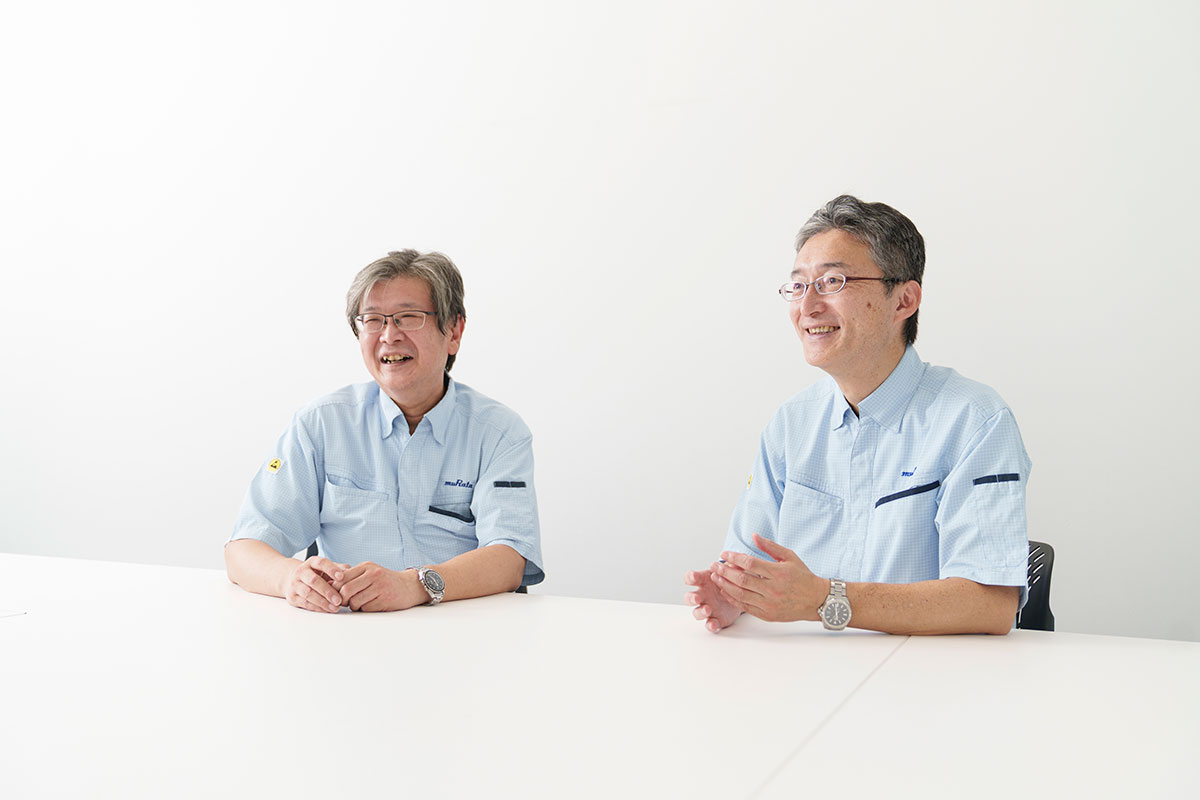
Murata is therefore undertaking a variety of measures to reduce Category 4 emissions, including joint transportation using EV trucks, the first attempt of its kind in the electronic components industry. What challenges does this present, and what measures are being taken? We spoke with five members of the SCM Strategy Department, who are involved in product transportation management, about the innovative aspects of these measures and future prospects.

--There is increasing social awareness around the need to reduce Scope 3 Category 4 emissions. What is Murata's awareness of this issue and what efforts are being taken to address it?
Kokatsu: Scope 3 Category 4 emissions account for about 5% of Murata's overall GHG emissions, which are the total of Scope 1, 2, and 3. While this is not a large percentage in relative terms, we nonetheless consider it an important initiative to reduce Scope 3 emissions, and are promoting reductions in line with our group-wide policy to reduce Scope 3 emissions by 27.5% by 2030.
Logistics, whether actual transportation methods or packaging materials, is closely related to customers and thus surprisingly often catches their attention . We see it as serving a very important role in the sense that it allows stakeholders to directly observe our efforts.
In that context, we are mindful of the balance between the effects of reduction efforts and cost when implementing measures. If something contributes to GHG reductions but results in high costs, then sustainability cannot be ensured. We consider all possible options, including cooperation both within and outside the company, to achieve both environmental impact reductions and economic benefits. We are currently focusing on two main approaches: reduction measures related to logistics, and reduction measures related to packaging and transport materials.
--I hear you are working on modal shifts to optimize transportation methods and reduce GHG emissions.
Fujimura: Modal shifts are one of the initiatives that we are actively pursuing. Murata currently has Logistics Centers in Osaka and Tokyo as its logistics bases, and at the Tokyo Logistics Center we have been progressively switching to environmentally friendly transportation methods since its establishment in 2022.
Furthermore, since truck transport accounts for an overwhelming share of GHG emission sources and amounts in domestic logistics, we began by switching some truck transport to rail transport. This was implemented for transportation between the Tokyo Logistics Center and three group company factories located in Fukui, Nagano, and Miyagi Prefectures. Products are transported from each factory to the Logistics Center using trucks like before, and then rail transport (via JR Freight) is used to return the empty transport containers (buckets) to each factory after products are unloaded. Additionally, the empty buckets fold down to about one-third of their original size for maximum efficiency in JR Freight container loading.
Rather than suddenly changing the transportation method for all products at once, we first focused on returning the empty buckets, which has no impact on product transportation quality. This enabled us to quickly achieve modal shift results.
The buckets are returned in the folded state, which created a new labor burden for reassembly at each factory. However, as each factory is also aware of the importance of reducing CO2 emissions in logistics and Category 4 emissions as part of our environmental initiatives, they understood that this would lead to cost reductions for Murata as a whole. As a result, we achieved cost savings while simultaneously reducing 480 tons of GHG emissions annually.
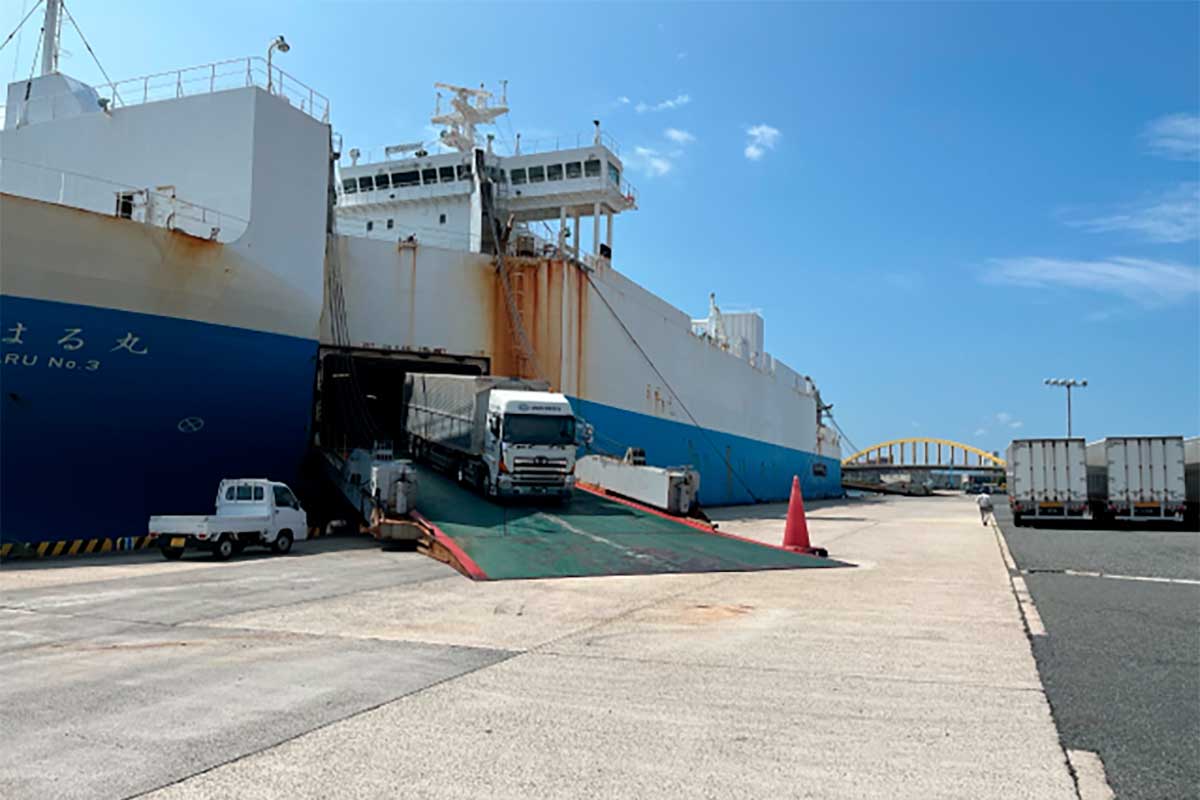
Honda: Following Tokyo's example, the Osaka Logistics Center also considered a modal shift to railways using JR Freight. However, given the freight station location, container restrictions, and the resulting cost increases, it was determined that switching to rail transport would be difficult for the Osaka Logistics Center. Therefore, we investigated a modal shift to ships, which began operation in August 2025.
The method adopted involves driving a trailer together with its cargo bed onto the ship, and then detaching the tractor unit so that only the cargo bed is transported by sea. After leaving the Osaka Logistics Center, the trailer's tractor unit is detached at Sakai Semboku Port, and the cargo bed is transported to Uno Port in Okayama Prefecture. Upon arrival at Uno Port, a tractor unit is attached and the trailer is transported to factories in Shimane and Okayama Prefectures. Using a combination of ships and trailers increases the transport volume per trip, which is expected to reduce GHG emissions by 143 tons annually as well as lower costs.
--Please also tell us about joint transportation using EV trucks.
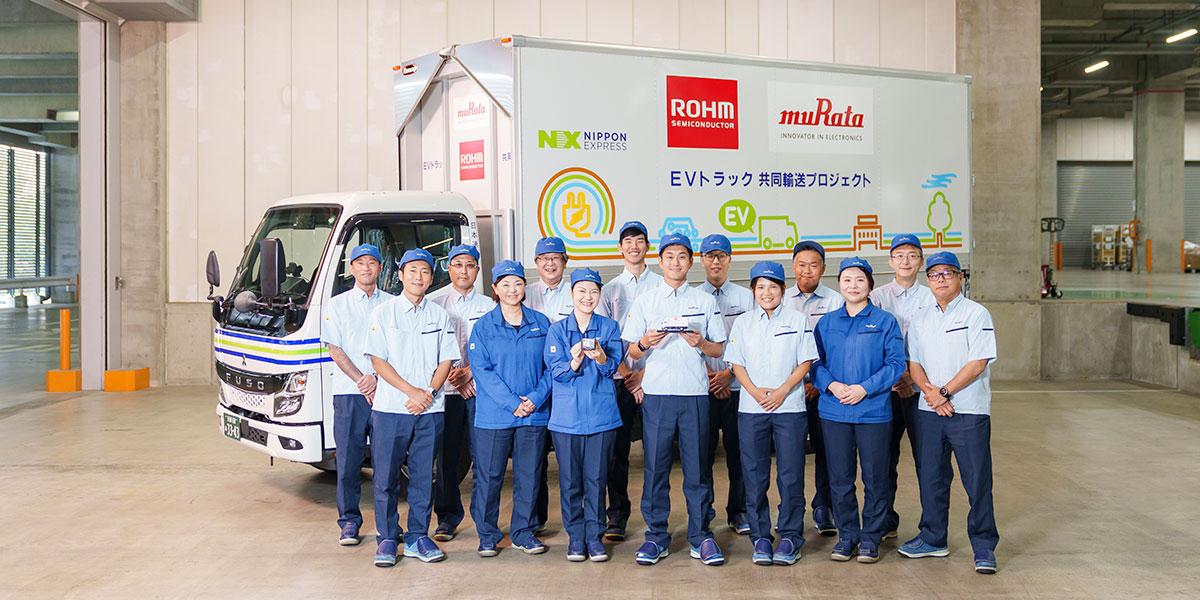
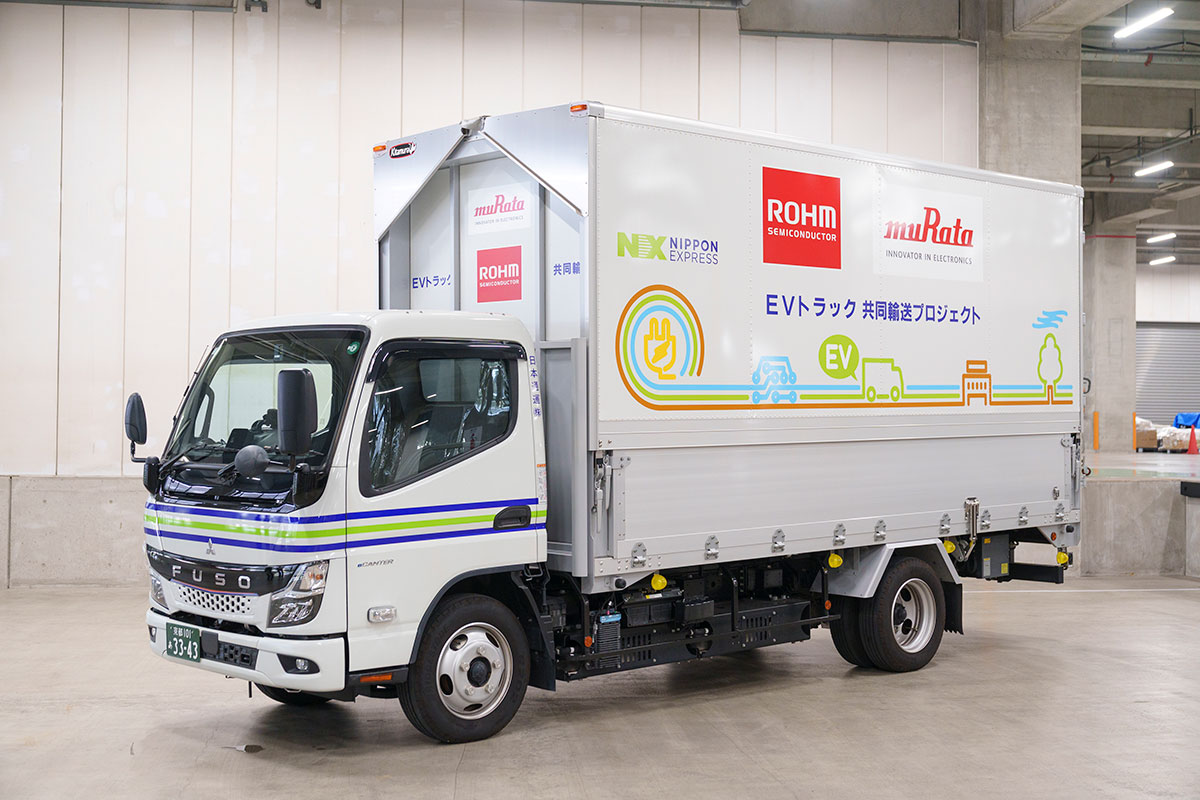
Fujimura: When we first began investigating reducing Category 4 GHG emissions, we consulted with transport companies to explore good options and Nippon Express Co., Ltd. suggested using 2-ton EV trucks. However, these are still new in the market and the higher price per vehicle compared to diesel trucks would greatly increase transportation costs, so we were hesitant to introduce them. Therefore, we considered joint transportation. We approached ROHM Co., Ltd. (hereafter, ROHM), an electronic components manufacturer also headquartered in Kyoto, and they agreed to collaborate, allowing us to turn the idea into reality.
ROHM shares an awareness of environmental issues and initiatives with Murata, such as support for TCFD, membership in RE100, and acquisition of SBT certification. Like Murata, ROHM also handles electronic components, so they insist on maintaining similar levels of transportation quality and safety and use similar transportation routes from Kyoto, which combined with other factors to make them an ideal partner for joint transportation.
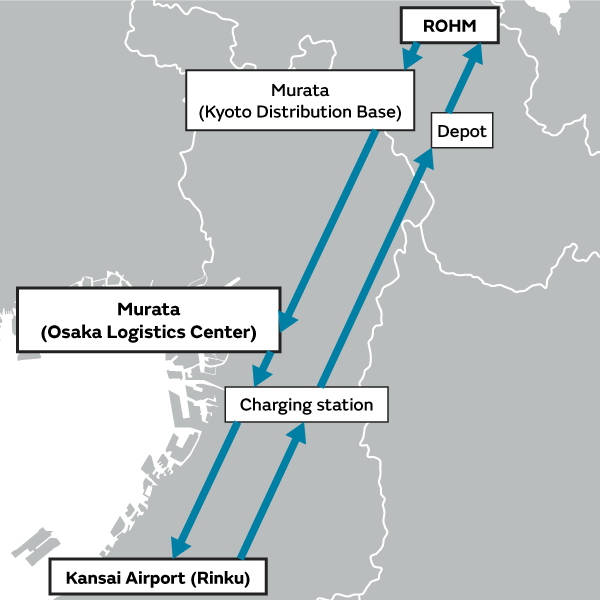
Takahashi: Joint EV truck transportation currently operates one round trip per day. Murata's transport cargo consists of packaging materials and export cargo, and it took about two months to plan the transportation route. First, the EV truck leaves its depot and travels to ROHM's base for cargo handling. It then travels to Murata's Kyoto Distribution Base and Osaka Logistics Center for cargo handling, charges at a charging station, and finally heads to Kansai Airport. On the return trip, the EV truck charges once more before returning to the Kyoto depot. This transportation route covers approximately 210 km, making it one of the longest routes for an EV truck, and operates daily.
This joint transportation is expected to reduce GHG emissions by about 30 tons annually while keeping transportation cost increases in check. Although this is still a small reduction, we believe it has created an important springboard for expanding the initiative going forward.
At the same time, establishing a regular transport schedule has enabled consistent transportation and alleviated the burden on drivers, which helps to address the issue of driver shortages, referred to as the "2024 problem in logistics." Additionally, EV trucks produce less noise and vibration than diesel trucks and also emit no exhaust gas, which we believe improves the working environment for drivers.
Kokatsu: In addition to EVs, we are also interested in FCV (hydrogen) trucks and other new technologies, and hope to see emission reductions through their introduction. Meanwhile, we believe that achieving this joint transportation and improved loading rates can create a potential for reductions even with diesel trucks . One-way usage is also increasing, mainly due to modal shifts, so joint transportation with new partner companies that utilizes return routes is also an option. There are still many possibilities to consider, so we want to actively seek outside collaborators.
--What difficulties or challenges have you encountered in achieving more accurate emissions figures?
Ota: One issue is the method used to calculate GHG emissions. The main method is currently the "ton-kilometer method," which calculates emissions based on the transported weight and the distance. GHG emissions factors are defined for each transportation method, so we obtain weight and distance data from the transport company or contractor, and calculate GHG emissions by multiplying "transported weight × transported distance × transportation method factor."
However, this calculation method will return the same figure when, for example, "transporting 100 kg of freight once to a location 5 km away" and "transporting 50 kg of freight twice to that same location." In reality, GHG emissions should differ for one and two trips, but those figures cannot fully reflect the impact of any initiatives to reduce transportation frequency or increase loading rates, so we feel that the ton-kilometer method has its limitations.
We believe it is desirable to also focus on factors that do not contribute to weight elements, such as adopting the "fuel efficiency method" that takes into account fuel efficiency or the "fuel method" that takes into account fuel consumption. Specifically, if we could utilize our own and other technologies to visualize cargo loading rates that account for volume and cargo content, we would be able to more concretely understand reduction effects. Considering that no such solution exists yet, if Murata could quickly commercialize one, we feel it would help address our own logistics issues while also lead to a solutions business that we could offer to other companies.
--What kind of initiatives are you considering going forward?
Kokatsu: We have four main items in mind. First is continuing to actively promote modal shifts. In addition to rail, ships, and EVs, last year we also conducted a trial of transportation by Shinkansen. This arose from a consultation from the Production Department, which had concerns about transporting components for multilayer ceramic capacitor (MLCC) production equipment by truck, as they are vulnerable to vibration. We have not yet adopted transportation by Shinkansen due to the extremely high cost, but we believe it would be effective for individual domestic deliveries and as part of our business continuity plan (BCP) in the event of disasters or other emergencies.
Second is promoting joint transportation. Here we want to consider a wide range of possibilities for reduction, such as making better use of diesel trucks in addition to EV trucks, and improving loading efficiency. Our work in tackling the challenge of joint transportation using an EV truck together with ROHM showed us that cooperation and collaboration are more important than competition in addressing logistics issues. We want to actively build connections and partnerships with other shippers to achieve collaboration that is mutually beneficial in terms of both social and economic value.
Third is improving loading efficiency. In addition to steadily continuing on-site initiatives, we feel it would be wonderful if we could apply our own technology to visualize loading volumes.
And fourth is to keep up with the latest technological trends and proactively consider all possibilities. For example, we currently use a 2-ton EV truck, but the future will necessitate the introduction of larger trucks and so we intend to actively gather information, including from automakers.
Feedback following our announcement of joint transportation using an EV truck was much greater than we had expected, which made us realize once again the growing social interest in reducing GHG emissions. As I mentioned at the start, in addition to logistics, we are also working on reduction measures related to packaging and transport materials. For example, one initiative we are pursuing is to recycle or otherwise reuse label backing sheets and ink ribbons, which are used in large quantities every day. We are working with suppliers to recycle these items into building materials and solid fuels, which has led to an annual reduction of 1.2 tons of GHG emissions.
Additionally, transport pallets and the transport container buckets mentioned earlier are collected if damaged and recycled horizontally to enable reuse as pallets. The reduction in GHG emissions realized by this resource recycling amounts to 15 tons annually. We have also made transport pallets lower profile and lighter weight, which has enabled us to reduce transport weight and greatly reduce GHG emissions by 707 tons annually.
Going forward, we will continue to promote and spread cutting-edge initiatives in the logistics field, including from a global perspective.