
Data Science × Murata
Take a Behind-the-scenes Look at the In-house Development and Future Outlook for the "Murata Coworker" Generative AI Product With the Product Manager - Annual Conference of the Japanese Society for Artificial Intelligence, 2025
Murata Manufacturing (hereafter, "Murata") internally developed and released the "Murata Coworker" generative AI product, which is currently being used by roughly 27,000 Murata employees in total in their daily work, to successfully generate economic benefits of several billion yen per year. The results of this initiative were reported at the Industrial Session of the Annual Conference of the Japanese Society for Artificial Intelligence, 2025 (JSAI 2025) and generated significant interest (Presentation title: [1G4-IND-2-05] An Introduction to Murata Manufacturing's AI and Data Utilization and Application Initiative).
In this article, Product Manager Koganei of the Data & Analytics Department provides a behind-the-scenes look at the development and operation of Murata Coworker and discusses the future outlook for this product.
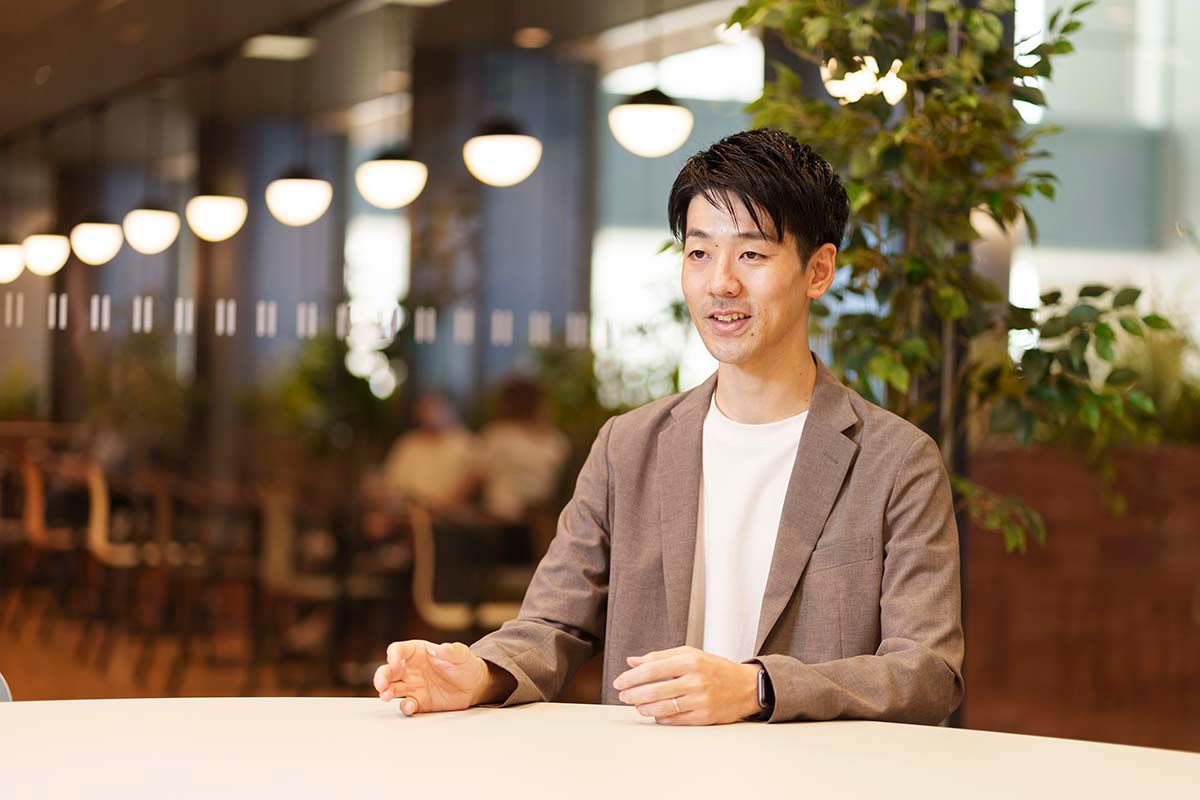
*1 A product manager is the person responsible for providing a product. Their role is to manage the entire product lifecycle as well as maximize customer satisfaction and profits.
1. Murata Coworker Will Transform How All Employees Work
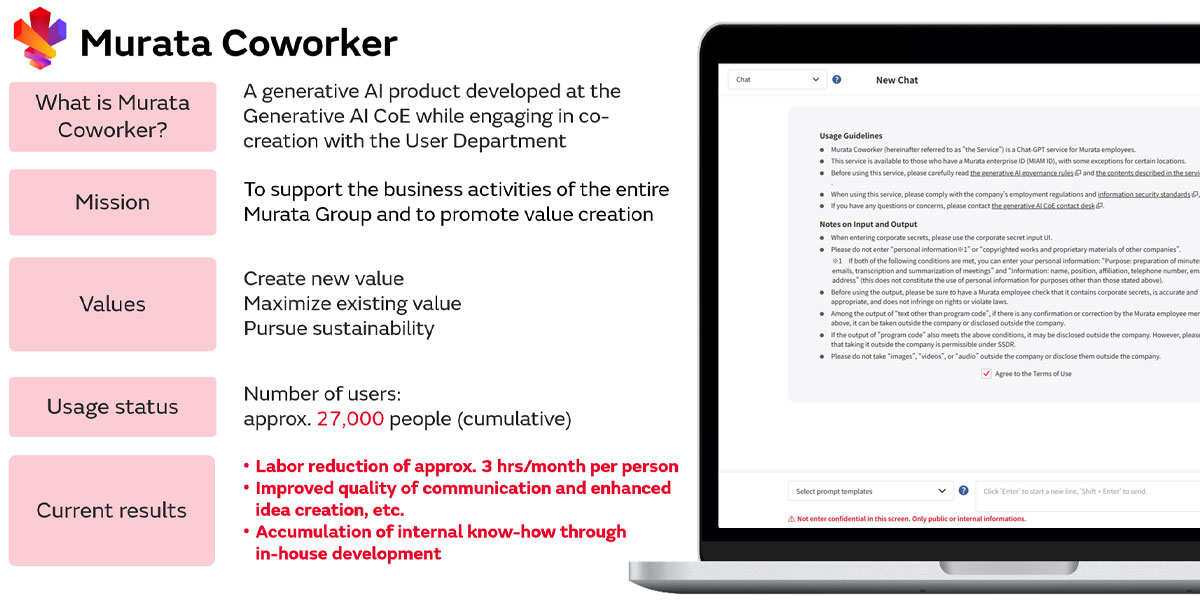
Murata Coworker is a generative AI product that was developed internally and released to all Murata employees in October 2024. The mission of this product is to "support the business activities of the entire Murata Group and promote the creation of new forms of value," while the stated values are to "create new value, maximize existing value, and pursue sustainability," and Murata continues to carry out initiatives that lead to service improvements to achieve these goals.
As a result of such efforts, Murata Coworker currently offers various extended functions such as support for multimodal input and output*2 and RAG*3 as well as a custom UI (User Interface) tailored to each function to improve the UX (User eXperience)*4. Although the development is not yet complete, it has grown into a large-scale product used by roughly 27,000 Murata employees in total in their daily work*5.
*2 Function which enables the input of not only text but also Word, PDF, and other files, images, and audio. For more about the multimodal AI concept, see "Multimodal AI, Which Is Also Related to Generative AI."
*3 RAG stands for Retrieval-Augmented Generation. It is a method which combines search functions with an LLM (large language model) to output text based on search results.
*4 UX refers to the overall experience obtained by a user through the use of a service.
*5 Figures as of July 31, 2025.
While Murata Coworker appears to be steadily growing, the road to get to this point has not been smooth, especially as the product was developed internally. In this article, we take a behind-the-scenes look at the strategies and measures of the Murata Coworker development and introduce the worldview that Murata Coworker aspires to realize.
2. Behind-the-scenes Look at the Murata Coworker Development and the Achieved Results
2.1 Strategic decision to develop a generative AI product in-house
The most important aspect of the Murata Coworker development was none other than the strategic decision to realize this service through internal development after weighing the pros and cons of various possibilities. Behind this decision lay the realization that Murata as a company needed to quickly develop the capability to respond to this trend in anticipation of a future in which the utilization and application of generative AI becomes commonplace. In-house development would lead not only to accumulating know-how through that process, but also have the advantage of strengthening the company's response capabilities during operation, and making it easier to optimize costs. While the heavy workload was a disadvantage during the launch phase, it was thought to be a rational decision that will provide many benefits to Murata in the future.
2.2 Innovations and key points that supported the in-house development
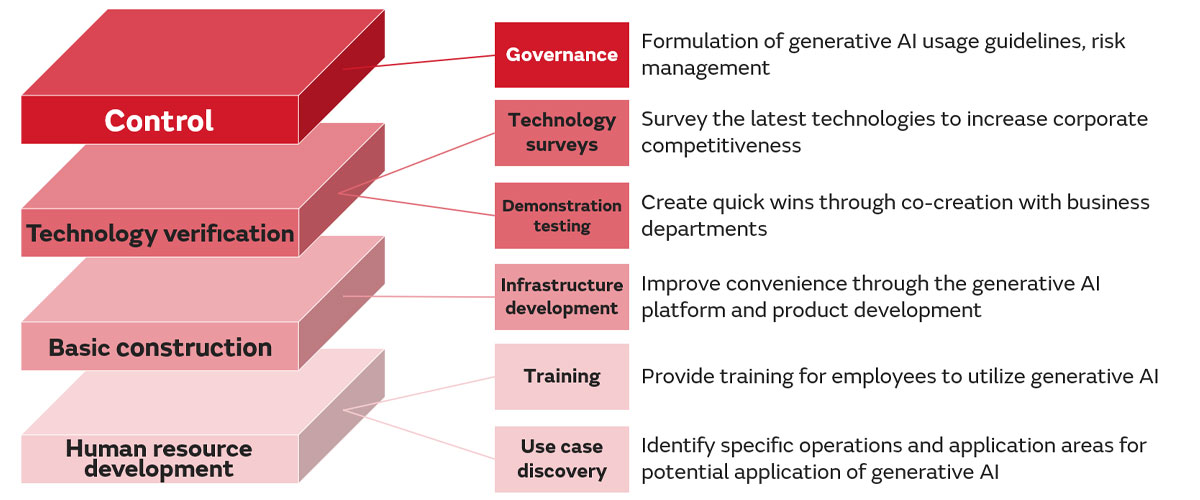
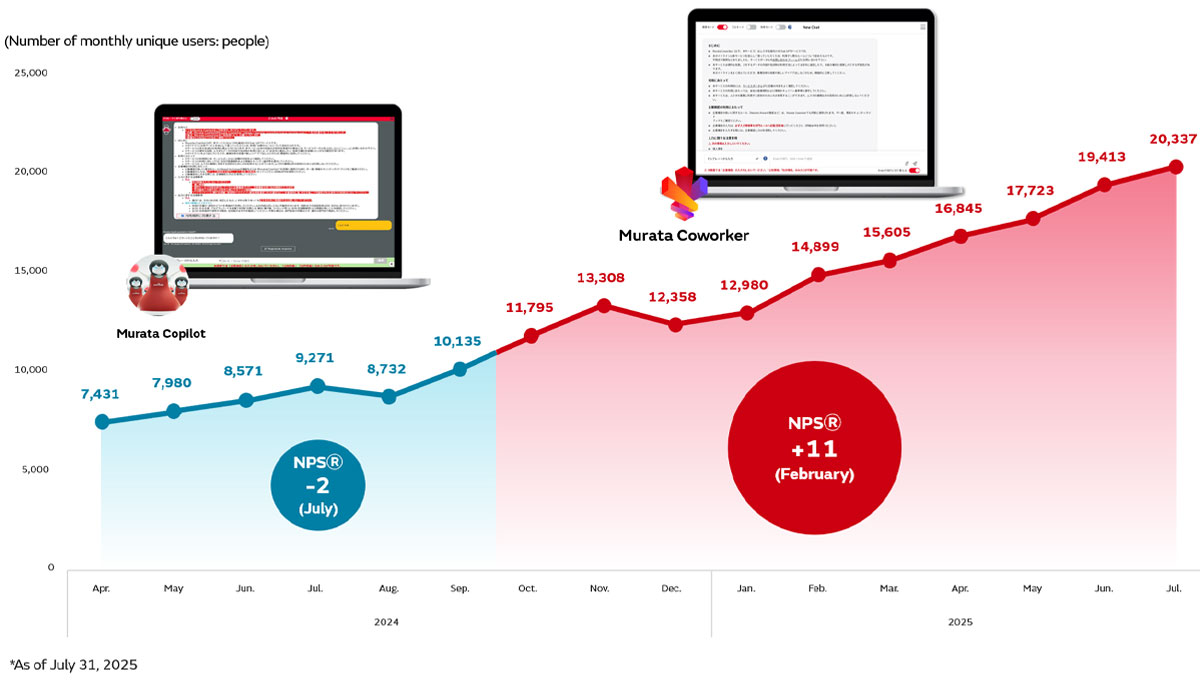
About one year before the release of Murata Coworker, it was released as a beta version called "Murata Copilot." However, with stagnating user growth, the results were disappointing (for details, see Figure 5 under Section 2.3). In response to this situation, various measures and tweaks were implemented, which became major key points of Murata Coworker (Figure 2). Here, we will introduce two key points: the development personnel and system, and the assessment of user needs.
Securing specialized personnel and establishing the development system
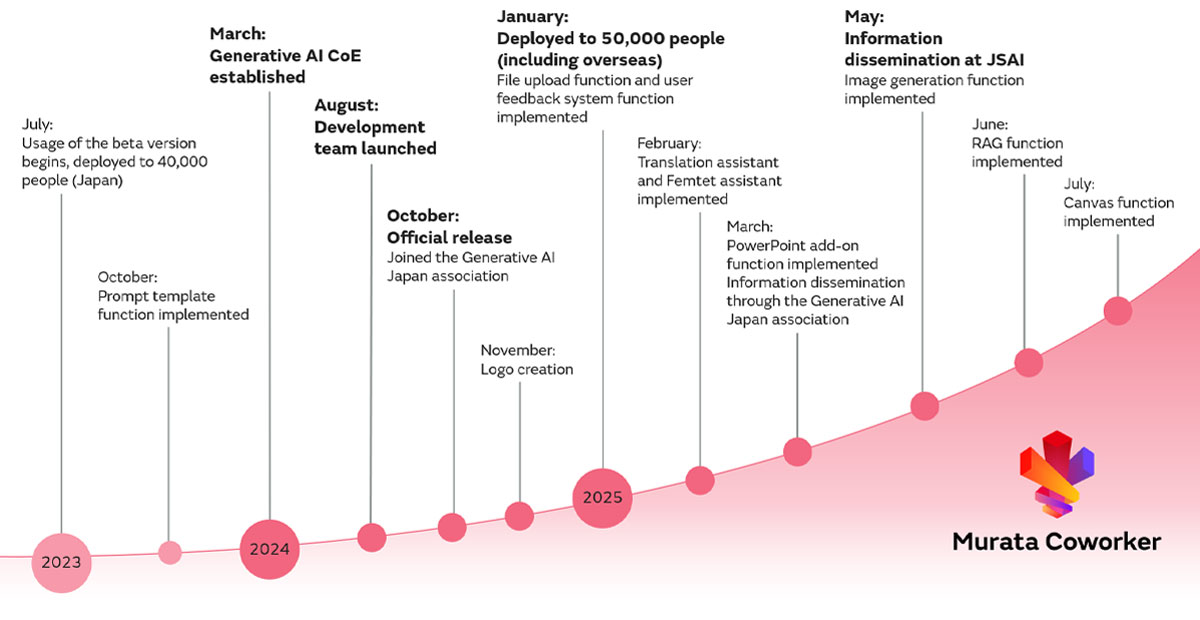
In product development and operation, it is essential to systematically assemble a wide variety of specialized personnel and build a system that enables them to work closely together. To promote the company-wide utilization and application of generative AI at Murata, the Generative AI CoE (Center of Excellence) was established in March 2024 to bring together specialized personnel from different departments (Figure 3). In August of the same year, the Murata Coworker Development Team was established under the Generative AI CoE. The team includes specialized personnel (for example, UI/UX designers and AI engineers) who are essential to the development and operation of Murata Coworker, which made it possible to achieve smooth product development as well as a stable and sustainable operational system.
Continuously assessing user needs
From the perspective of promoting a product, functional extensions and UI design that lead to improved product UX are extremely important beyond the utility and innovation of the functions. Appropriately assessing the user needs and use cases of Murata employees is essential to achieve this goal.
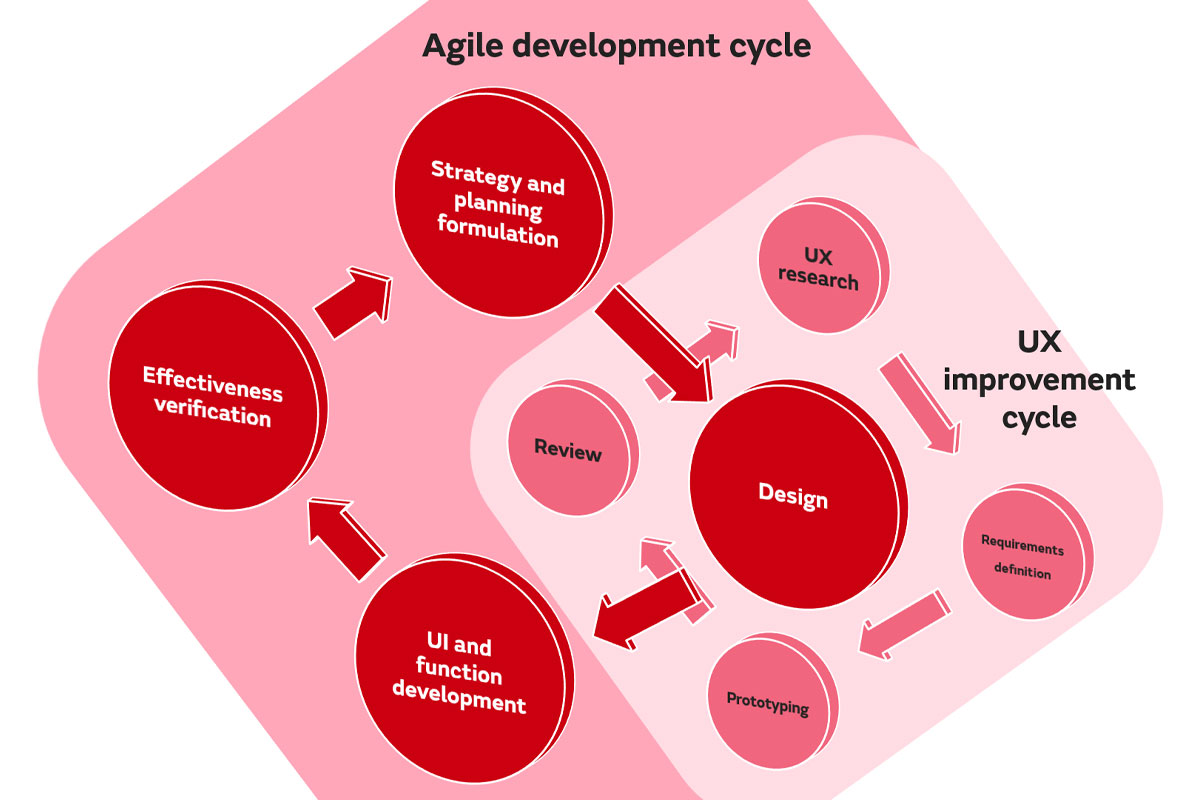
Against this backdrop, information was collected from multiple perspectives (questionnaires, depth interviews, access analysis), and a UX agile development system was built to develop the product and functions utilizing this information during the Murata Coworker development (Figure 4).
2.3 Results achieved by Murata Coworker
After the introduction of Murata Coworker, the number of users of the service visibly increased, and the team successfully improved the user loyalty indicator*6 (Figure 5). This result indicates that Murata Coworker is steadily growing as a product that supports the daily work of Murata employees. The results of the effectiveness measurements show that the quantitative effect of introducing Murata Coworker was improved work efficiency of more than three hours per month per user (corresponding to a company-wide economic effect of approximately several billion yen per year), and the qualitative effects included improved communication quality and enhanced idea generation capabilities.
It is believed that the factors behind the achievement of these results in a comparatively short period of time included the significant impact of the UX agile development discussed in Section 2.2, as well as the implementation of functions that are expected to have a significant impact based on assessed user needs, and activities to promote usage, etc., which led to effective value delivery.
*6 An indicator that quantifies the degree of attachment and trust that users have for a service. In this case, the NPS® (Net Promoter Score®) is used.
NPS® is a registered trademark or service mark of Bain & Company, Fred Reichheld, and NICE Systems, Inc.
Another significant result of the in-house development is that the individual members of the Murata Coworker Development Team were able to improve their skills. Currently, the know-how obtained through Murata Coworker is being applied to the development of other products, which demonstrates that the accumulation of know-how, one of the objectives of the in-house development, is leading to positive results.
3. Future Outlook for Murata Coworker
3.1 Creating new forms of value through the "digital twinning of corporate intelligence"
The spread of Murata Coworker has enabled Murata to take the first step toward accomplishing its mission to "support the business activities of the entire Murata Group and promote the creation of new forms of value." Beyond this first step lies the realization of the vision to create a digital twin of corporate intelligence (Figure 6).
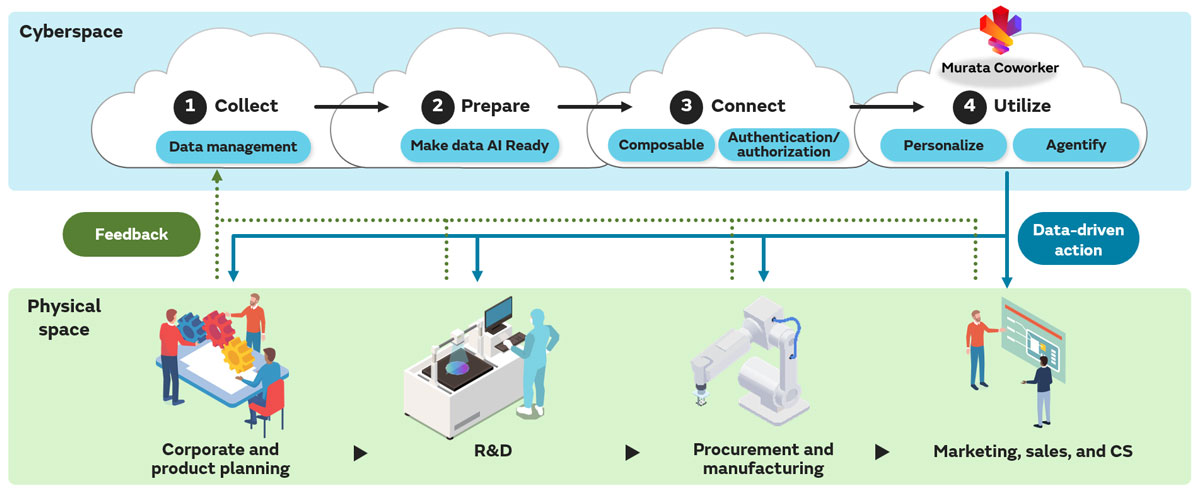
The digital twinning of corporate intelligence is a worldview that uses AI to bridge the corporate activities carried out in cyberspace and physical space to create and provide new forms of value by integrating a company's unique insights and information. In this worldview, Murata Coworker plays the following two roles.
- Learn and grow through information obtained from physical space and actual work to become personalized to each Murata employee.
- Personalized Murata Coworkers mutually link in cyberspace to shape the entire company into a single dynamic knowledge network.
It is believed that the concept shown here is essential to creating "collective strength through CS and ES*7."*8
*7 CS: Customer Satisfaction means continuing to create and provide value that is recognized by the customer. ES: Employee Satisfaction means that every employee achieves satisfaction and continuing growth through the performance of their work duties.
*8 Collective strength through CS and ES means the power created through the six management capitals, composed of organizational, human, manufacturing, and other types of capital, exhibiting their strengths to the greatest extent and interacting with each other at a high level.
3.2 Challenges and Prospects for the Digital Twinning of Corporate Intelligence - From the Perspective of the Product Manager

While the vision for Murata Coworker is clear, it will not be easy to achieve. There are a wide range of challenges, including data integration and formatting to utilize and apply data siloed within each organization, and the appropriate handling of sensitive information contained within the data, etc. Currently, most of the Murata Coworker results are limited to improving work efficiency at the individual level, and it is thought that this is largely due to the various hurdles concerning internal data utilization and application as described above. To resolve these challenges, Murata needs personnel with the specialized knowledge to tackle these technical challenges head on, as well as stronger organizational capabilities. Naturally, this will not be easy, but with the cooperation of various internal and external team members, we hope to make steady progress toward the realization of the "digital twinning of corporate intelligence."
Furthermore, we are planning to implement additional functional enhancement of Murata Coworker itself as a foundation for supporting such challenging initiatives. We hope that future evolution will streamline the work of more employees and accelerate the utilization of company-wide intellectual assets. Please keep an eye out for future developments.
Finally, while we were pleased with the response to "Murata Coworker" at JSAI 2025, we are acutely aware that the recognition of Murata's efforts in the AI space is still quite low. We hope to continue disseminating information so that more people will be aware of Murata's efforts.
*The content of this article is based on information as of the date of publication. The details and names, etc., of organizations and initiatives may be subject to change.
Related articles
- Case Study of Masking Personally Identifiable Information Using Generative AI - Annual Conference of the Japanese Society for Artificial Intelligence 2025
- A Report on Murata Manufacturing's Data Science Case Study Presentations and Corporate Booth - Annual Conference of Japanese Society for Artificial Intelligence, 2024
- Murata Manufacturing Data Scientists Discuss the Power of Practical Application