Integrated Renewable Energy Control Solution efinnos


SDGs×Murata
"There is no doubt that human impacts have warmed the atmosphere, oceans, and land areas."
This statement was made in the Sixth Assessment Report of the Intergovernmental Panel on Climate Change (IPCC), an international organization that conducts scientific assessments of climate change. Now that there is no mistaking the role of human activities in driving global warming, efforts to achieve carbon neutrality present an urgent task. Carbon neutrality is defined as net zero emissions of greenhouse gases (GHGs), which is the total amount of GHG emissions minus the amount absorbed by forests and other carbon sinks.
To achieve carbon neutrality, we cannot rely solely on international agreements; companies must also fulfill their crucial roles in taking steps to reduce GHG emissions. This article explains the basics of Scope 1, 2, and 3 emissions as defined in the GHG Protocol, the uniform standard for calculating and reporting GHG emissions.
Supply chain emissions are the total of all emissions related to an entity's business activities, not just the GHG emissions of the entity itself. This includes GHGs generated throughout all business activities, from raw material procurement to manufacturing, distribution, sales, and disposal. To reduce GHG emissions en route to achieving carbon neutrality, companies must ascertain the emissions of their entire supply chains—not just their own—and take effective measures.
The GHG Protocol is the international standard used to calculate emissions. Under the protocol, companies calculate their own GHG emissions (direct emissions) as well as emissions from their entire supply chains (Scopes 1, 2 and 3 emissions).

Link: Created based on "Guide to Calculating Supply Chain Emissions" (Ministry of the Environment)
GHGs emitted by companies themselves. This includes GHGs generated when the company burns fuel or engages in chemical processing.
GHGs generated from the production of electricity, heat, steam, and other forms of energy supplied by other companies. When companies consume electricity supplied by an electric company that generated it by burning fossil fuels, they are required to record the corresponding GHG emissions as Scope 2 emissions.
GHG emissions with which companies are indirectly involved, and that fall outside Scopes 1 and 2, i.e. GHGs emitted upstream or downstream in companies' supply chains. This includes GHGs generated when transporting raw materials and parts (upstream in the supply chain) and when products sold by the company are processed, used, or disposed of (downstream in the supply chain). Scope 3 is quite broad, and is thus divided into 15 categories. Categories 1 to 8 cover the upstream part of the supply chain, while Categories 9 to 15 cover the downstream part.
| Scope 3 category | Example sources | |
|---|---|---|
| 1 | Purchased goods and services | Procurement of raw materials, outsourced packaging, and consumables |
| 2 | Capital goods | Expansion of production facilities (If constructed/manufactured over multiple years, recorded in the last year in which construction/manufacturing was completed) |
| 3 | Fuel- and energy-related activities (not included in scope 1 or scope 2) | Upstream processes (e.g. mining, refining) of procured fuel Upstream processes (e.g. mining and refining of fuels used to generate electricity) of procured electricity |
| 4 | Upstream transportation and distribution | Distribution for procurement, drayage, and shipping (by the company) |
| 5 | Waste generated in operations | Transport and disposal of waste materials (except valuable materials) by an entity other than the company |
| 6 | Business travel | Business travel by employees |
| 7 | Employee commuting | Commuting by employees |
| 8 | Upstream leased assets | Operation of assets leased to the company |
| 9 | Downstream transportation and distribution | Shipping (downstream transportation and distribution after the company's shipment), storage in warehouses, and sales at retail stores |
| 10 | Processing of sold products | Processing of intermediate products by businesses |
| 11 | Use of sold products | Use of products by users |
| 12 | End-of-life treatment of sold products | Transport and disposal by users at the end of the product's life |
| 13 | Downstream leased assets | Operation of assets owned by the company and leased to others |
| 14 | Franchises | Activities falling under Scopes 1 and 2 conducted by franchisees over which the company presides |
| 15 | Investments | Equity investments, debt investments, project finance, and other investments |
| Other (optional) | Daily life of employees and consumers | |
Link: Categorization of Scope 3 activities, Japanese Ministry of the Environment
Accordingly, GHG emissions by companies—whether direct or indirect—are calculated as Scope 1, 2, or 3 emissions. Classifying and calculating GHG emissions throughout the supply chain into Scope 1, 2, and 3 emissions makes it easier to formulate specific GHG reduction measures and plans.
Every year brings greater demand for disclosure of non-financial information, such as management strategies and sustainability initiatives undertaken by companies. The keys to sustainable corporate management are ascertaining emissions throughout the supply chain and formulating and implementing comprehensive GHG reduction strategies.
When reducing GHG emissions throughout the supply chain, the first step that can be taken is reducing Scope 1 and 2 emissions. Given that these are mainly GHG emissions associated with companies' own fuel and electricity consumption, it is relatively easy to calculate them and implement reduction measures.
Effective ways to reduce Scope 1 and 2 emissions include reducing energy consumption through energy saving and promoting the use of sunlight, wind, and other renewable energy sources.
Japan depends on foreign countries for most of its energy resources. Therefore, increased fossil fuel imports have resulted in a severe trade deficit, comparable in scale to the exports of its main industries. With an energy self-sufficiency rate of only 15.3% in fiscal 2023, Japan needs to make efficient use of its limited energy resources in terms of economic security.
Continuous efforts based on the Plan-Do-Check-Act (PDCA) cycle are critical for effectively promoting energy saving. First, we ascertain and analyze the company's energy usage and facility operating conditions, set energy saving targets, and formulate measures that combine operational improvements, capital investment, and other elements. Then, we steadily take measures while managing progress based on the plan. After implementing the measures, we measure the effectiveness to identify any differences from targets and issues to resolve, which will help us consider measures for improvement and lead to more effective energy saving measures.
Furthermore, energy saving efforts should not be limited to reviewing individual manufacturing processes, but must also involve broader consideration of measures such as reviewing product design. Considering moves such as downsizing products and shifting to recyclable design should lead to more drastic reductions of GHG emissions.
Renewable energy is energy from sources that are always present in nature and can be used sustainably, such as sunlight, wind, water, and geothermal heat. Unlike fossil fuels, which are a finite resource, renewable energy can be used in perpetuity without depleting any resources. It does not emit GHGs, and can contribute to energy security in Japan because it can be produced domestically.
However, the amount of electricity generated from renewable energy sources depends on the natural environment and climate conditions, making it a challenge to convert renewable energy into a stable power source. Therefore, to increase the rate of renewable energy sourcing, we must install more renewable energy generation facilities and develop technologies, as well as developing technology to stabilize power sources to balance supply and demand. As such, what is required is solutions to maximize the use of renewable energy, including developing and introducing control systems that adjust the amount of electricity generated and supplied in response to demand, and storage batteries that store surplus electricity.

For many companies, Scope 3 emissions comprise a large share of their overall supply chain emissions.
While Scope 1 and 2 emissions can be calculated simply by using a company's own gas and electricity consumption as the activity level, Scope 3 emissions cannot be calculated without knowing the energy consumption and GHG emissions of suppliers and other companies. Given the need to collaborate with many stakeholders, it is not easy to calculate actual Scope 3 emissions with a high degree of accuracy, yet that is exactly what is necessary to reduce Scope 3 emissions.
At a basic level, Scope 3 emissions are calculated by multiplying the level of an activity by its emission intensity.
"Activity level" refers to data indicating the scale of a company's activities. Examples include the amount of raw materials purchased and the amount of products transported. "Emission intensity" refers to the amount of GHG emissions per unit of activity. Examples include the amount of GHGs emitted when manufacturing one ton of purchased raw materials or transporting one ton of product over one kilometer.
Thus, the GHG emissions associated with an activity are calculated by multiplying the level of the activity by its emission intensity, and total Scope 3 emissions are determined by adding together the GHG emissions of each activity.
Currently, many companies calculate emission intensity using conventional secondary data such as industry standards provided by governments and industry groups. Unfortunately, this calculation method does not yield accurate results because it does not reflect differences stemming from reduction measures taken by individual suppliers. Consequently, GHG emissions calculated using secondary data-based emission intensities are not the same as actual GHG emissions.
For this reason, more companies are focusing on a calculation method based on primary data—actual values measured by suppliers—and the number of companies taking steps to collect primary data is gradually increasing. This method allows companies to calculate emissions more precisely.
Reducing Scope 3 emissions requires collaborative efforts with suppliers, distributors, consumers, and other stakeholders.
To achieve carbon neutrality, companies are under pressure to reduce Scope 1 and 2 emissions through energy saving and using renewable energy, and also to address Scope 3 emissions, which they cannot do alone. In this context, Murata has set out new targets for fiscal 2050.
Although we were previously working to achieve a 46% reduction in Scope 1 and 2 emissions and a 27.5% reduction in Scope 3 emissions by fiscal 2030, under Medium-term Direction 2027, we have set more ambitious targets to accelerate our reduction efforts and demonstrate our stance on climate change measures and other environmental issues. Specifically, our goals are to achieve carbon neutrality in Scope 1 and 2 emissions by fiscal 2040 and in Scope 3 and the rest of our supply chain by fiscal 2050.
Furthermore, since joining the international initiative RE100 in 2020, we have promoted renewable energy sourcing with the goal of achieving the initiative's targets by fiscal 2050. Additionally, we have issued a declaration to convert 100% of the electricity used in our business activities to renewable energy sourcing by fiscal 2035, 15 years ahead of our original target.
| Scope | Ongoing target | New target |
|---|---|---|
| Scope 1,2 (Domain of emissions due to in-house energy usage such as for product manufacturing at plants and power used at group sites) | FY2030: Reduce by 46% (vs. FY2019) as the SBT 1.5°C target | Carbon neutral in FY2040 |
| Scope 3 (Domain of indirect emissions other than Scope1,2, such as raw material procurement, product transportation, and disposal) | FY2030: Reduce by 27.5% (vs. FY2019) as SBT WB2°C target | Carbon neutral in FY2050 |
To achieve these targets, we are steadily working to reduce GHG emissions through rigorous energy saving and stepping up our expansion of renewable energy sourcing.
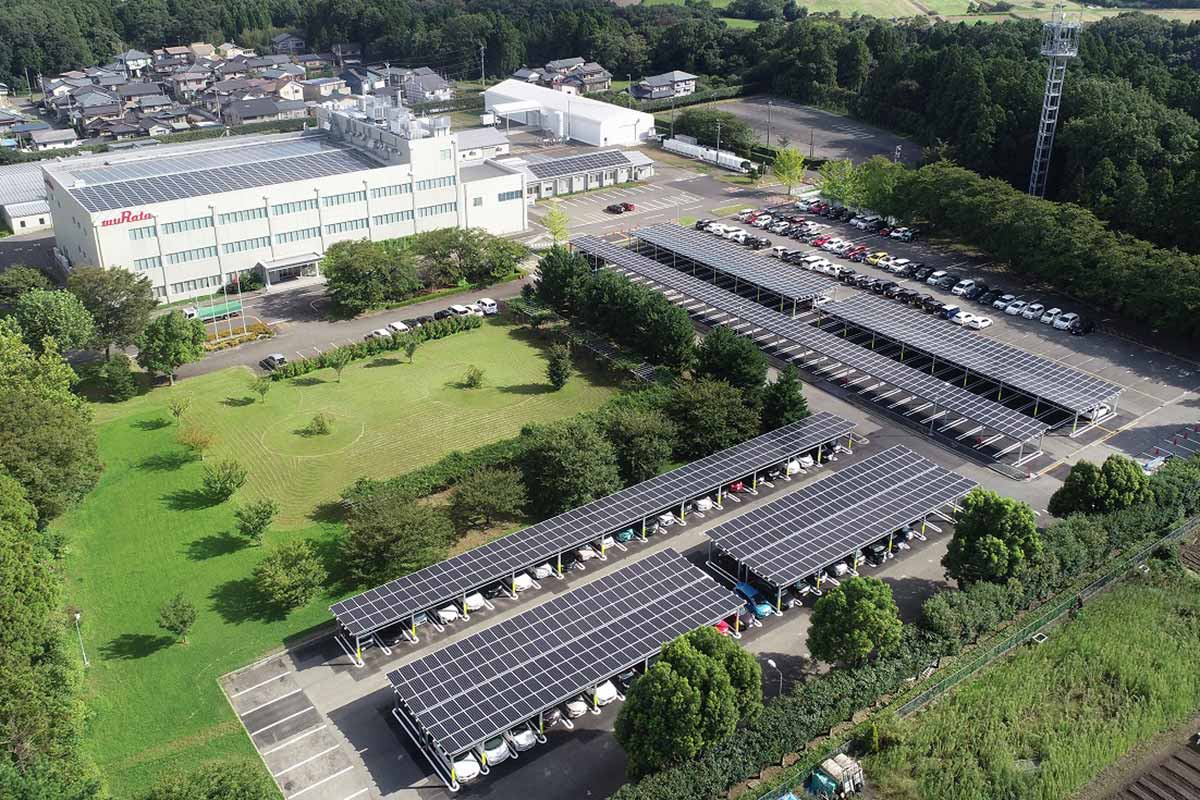
Specifically, each location in the Group sets annual targets, then formulates and implements energy saving measures to meet them. We are also working to minimize energy consumption at plants through measures such as introducing energy management systems that utilize sensors developed in-house. As for renewable energy, we are further accelerating sourcing through a variety of methods. These include sourcing renewable energy through corporate PPAs and grid power agreements, and also maximizing on-site renewable energy sourcing by developing and providing efinnos, our integrated renewable energy control solution powered by advanced optimization technology to control solar power generation equipment and storage batteries.
To reduce Scope 3 emissions, we are taking steps to calculate Scope 3 data more precisely by collaborating with suppliers to collect primary data that accurately reflects their activities. We are also promoting initiatives to achieve carbon neutrality throughout our entire supply chain, including reducing emissions associated with distribution by implementing modal shifts and streamlining loading.
By steadily implementing GHG reduction measures together with internal and external stakeholders, Murata will create a virtuous cycle of social and economic value and contribute to the realization of a sustainable society.