

FR3 Frequency Band Pioneering a New Era of 6G Communications
Several years have passed since the commercialization of 5G mobile communication systems ("5G communications"), and companies and communication-related organizations in countries around the world are accelerating the R&D and standardization of next-generation 6th generation mobile communication systems ("6G communications") with a view toward practical application in the 2030s. In the near future, technologies such as IoT, autonomous driving, smart factories, and smart cities will enter full-scale implementation. However, it is expected that in addition to performance aspects such as communication speed, latency, and the number of simultaneous connections, 5G communications will struggle to support some use cases in terms of advanced integration with AI, sensing functions to understand the environment and situation, and the resilience to maintain communications during disasters, etc. Therefore, 6G is expected to realize a more advanced communications infrastructure than 5G communications.
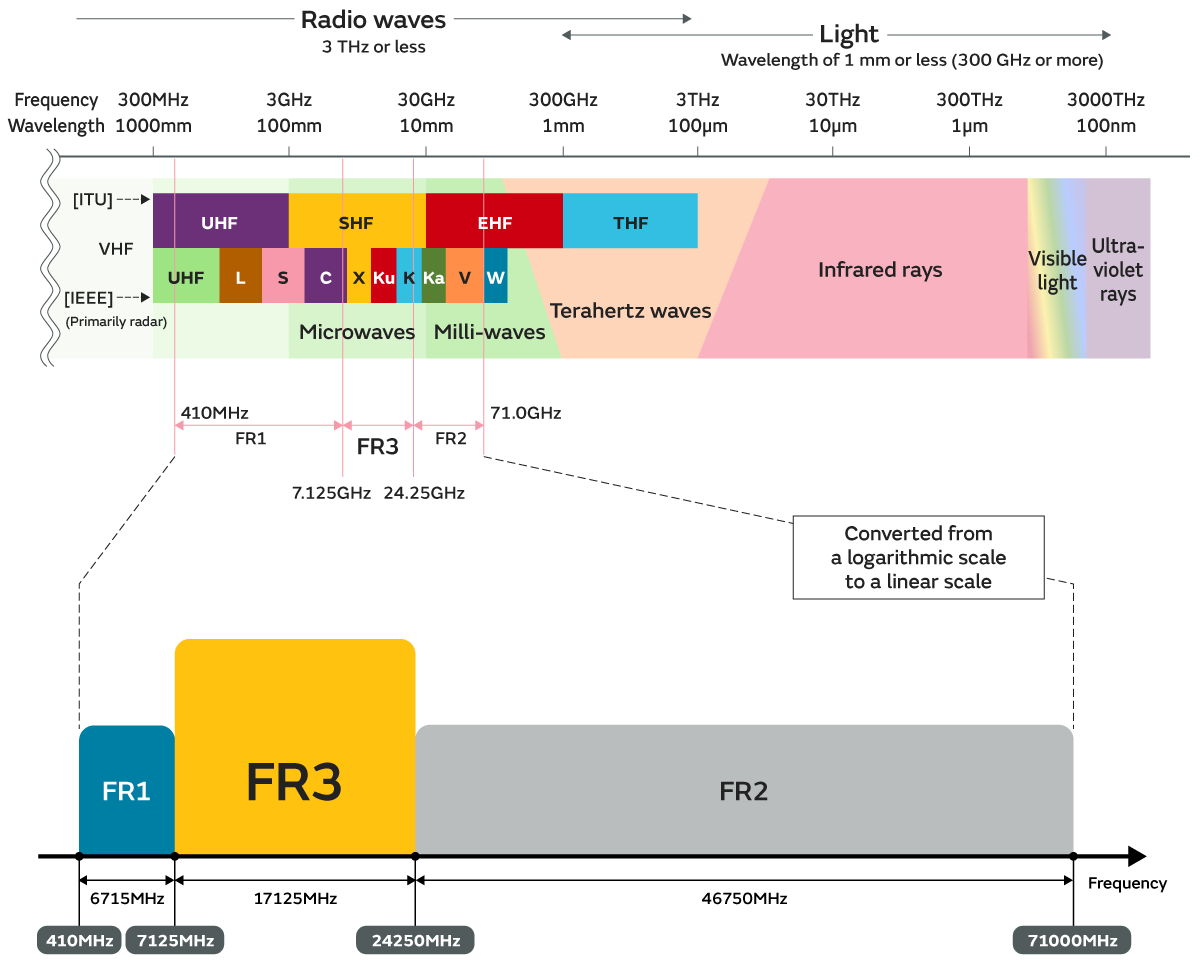
Within the 6G communications standardization efforts, the frequency band from around 7.125 GHz to 24.25 GHz, which is commonly known as "FR3," is attracting attention as a particularly important specification. FR3*1 is positioned between FR1*1 (410 MHz to 7.125 GHz) and FR2*1 (24.25 GHz to 71 GHz), which are already allocated to 4G and 5G communications. Although communications using the FR3 frequency band have an inferior propagation distance compared to FR1, which has frequencies that provide the wide coverage used in mobile communications, FR3 is able to secure a wider bandwidth to enable improvements in communication speed. For this reason, international discussions are currently underway to examine FR3 as a frequency band for 6G communications.
This article discusses international trends regarding FR3 and technologies provided by Murata Manufacturing to support 6G communications.
*1 The "FR" in FR1/FR2/FR3 stands for "Frequency Range," meaning a range of frequencies.
1. Frequency Bands: Important Specifications in 6G Communications
In the 2020s, 5G communications entered practical use as communications infrastructure due to its high speed, large capacity, ultra low latency, and support for a large number of simultaneous connections. However, for next-generation 6G communications, expected to be deployed in the 2030s, performance requirements are anticipated to surpass those of 5G, which offers 10-Gbps-class communication speeds and sub-10-millisecond latency, to deliver 100-Gbps-class high-speed communication and millisecond-level low latency. In addition, the requirements also call for the ability to support simultaneous connections from a vast number of devices, reduced power consumption, broad communication coverage, and more.
In addition to improved communication performance, the requirements for 6G communications are expected to expand the role of communication itself by including advanced AI-integrated control and optimization, integration with sensing that understands the state of the environment and objects, and high reliability (resilience) to maintain communications even during disasters or emergencies.
In particular, securing a wide frequency band to achieve high-speed communications is essential as the foundation for supporting these requirements*2. Radio wave frequencies are allocated to various applications including not only 5G and other forms of mobile communications but also broadcast, satellite, aviation, and maritime, as well as Wi-Fi® and other personal communications. Under such circumstances, there is a global movement underway to secure a common, wide frequency band for 6G communications.
*2 According to the Shannon-Hartley theorem, the frequency band must be widened to increase communication speeds.
2. What are FR1, FR2, and FR3? Frequency Bands for 5G and 6G Communications
2.1 ITU, the international telecommunications organization studying frequency bands for 6G communications
International discussions and consensus-building aimed at securing globally common frequency bands for 6G communications are proceeding within the framework of the International Telecommunication Union (ITU)*3, which is the organization that is internationally responsible for public standardization and regulation in wired and wireless telecommunications.
The ITU is an organization that operates on the basis of its fundamental documents, namely the Constitution of the International Telecommunication Union (ITU CS) and the Convention of the International Telecommunication Union (ITU CV), as well as the operational regulations that supplement them: the Radio Regulations (RR) and the International Telecommunication Regulations (ITR).
The primary sectors of the ITU are shown below. The entity responsible for reviewing frequency bands for 6G communications (IMT-2030, described below) is the Radiocommunication Sector: ITU-R.
- Radiocommunication Sector: ITU-R
- Telecommunication Standardization Sector: ITU-T
- Telecommunication Development Sector: ITU-D
*3 After wireless communication was invented in Italy in the 1890s and used for maritime communication. Subsequently, there was a need for international rules to prevent cross-border interference caused by the spread of radio waves and to ensure fairness in radio wave usage worldwide. This resulted in the establishment of the ITU in 1932 for the purpose of international telecommunication operations, and, in 1947, the ITU became one of the specialized agencies of the United Nations, which currently includes WHO and the IMF.
2.2 FR1 and FR2 as defined by 3GPP and the FR3 band under review by ITU-R
As mentioned above, ITU-R is the entity which is reviewing FR3 as a frequency band for 6G communications.
In 2023, ITU-R approved the IMT-2030*4 recommendation, which is the basic concept for 6G communications, and outlined the performance requirements and evaluation framework required for 6G.
In parallel with these efforts, the World Radiocommunication Conference (WRC) hosted by ITU-R (described below) is also advancing discussions of frequency bands for IMT-2030 (6G). At WRC-23, hosted in Dubai in December 2023, frequency considerations for 6G communications became more concrete with the designation of some bands within the FR3 frequency range for IMT use in particular regions, etc.
Against the backdrop of the discussions of IMT-2030 and WRC within ITU-R, 3GPP*5 is reviewing the frequency classification known as FR3 for 6G communications separately from the FR1/FR2 bands defined for convenience within the technical specifications for 5G communications (see Figure 1).
[Supplemental note]
FR1/FR2/FR3 are not listed in the ITU Radio Regulations (RR) addressed in the next section, and the use of these designations is not legally binding.
*4 IMT-2030 is an abbreviation of International Mobile Telecommunications 2030. IMT (International Mobile Telecommunications) is the general term for the international framework established by the ITU for organizing the performance requirements, evaluation methods, and approaches for frequency usage required for mobile communication systems. Within this structure, IMT-2030 refers to the framework led by ITU-R that outlines the performance requirements and evaluation framework for 6G communications. Based on IMT-2030, 3GPP will formulate specific technical specifications for 6G communications.
*5 3GPP is an abbreviation of 3rd Generation Partnership Project. This is an international standardization project operated with the participation of multiple standardization bodies (for example, ATIS in the US, ETSI in Europe, and ARIB and TTC in Japan) to create the technical specifications for mobile communication systems. The technical specifications are formulated as individual releases with names such as Release 19, Release 20, etc.
3. Review of FR3 for 6G Communications at the ITU-R Hosted WRC
ITU-R divides the world into Region 1, Region 2, and Region 3, and allocates frequencies to each region for the purpose of managing radio wave frequencies (Figure 2).
Specific allocations and changes are discussed and agreed upon at the World Radiocommunication Conference (WRC) with participation from ITU member nations, and the results are reflected in the Radio Regulations (RR). Based on these international RR agreements, the regulatory authorities in each country (for example, FCC in the US, Ofcom in the UK, MIIT in China, and MIC in Japan) determine their own frequency allocations and licensing conditions.
Therefore, the frequency allocations for each region are determined through discussions at the ITU-R hosted WRC, which are reflected in the Radio Regulations. Accordingly, frequencies that are not agreed upon at the WRC cannot in principle be used for international wireless communications.
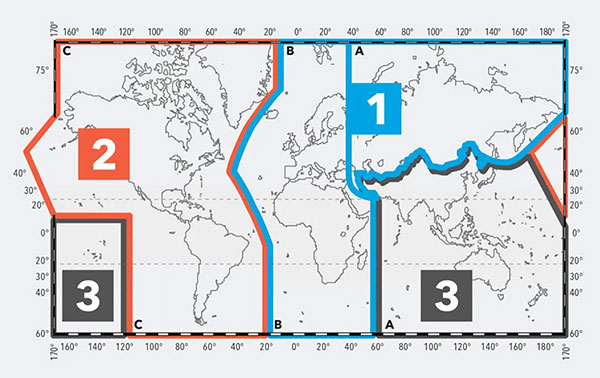
Region 1 (Blue): Europe, Africa, Middle East, etc.
Region 2 (Orange): North and South America, Pacific Islands, etc.
Region 3 (Black): Asia, Oceania, etc.
Source: ITU website
This section discusses the status of discussions at the WRC about FR3, which is expected to become the frequency band for 6G communications.
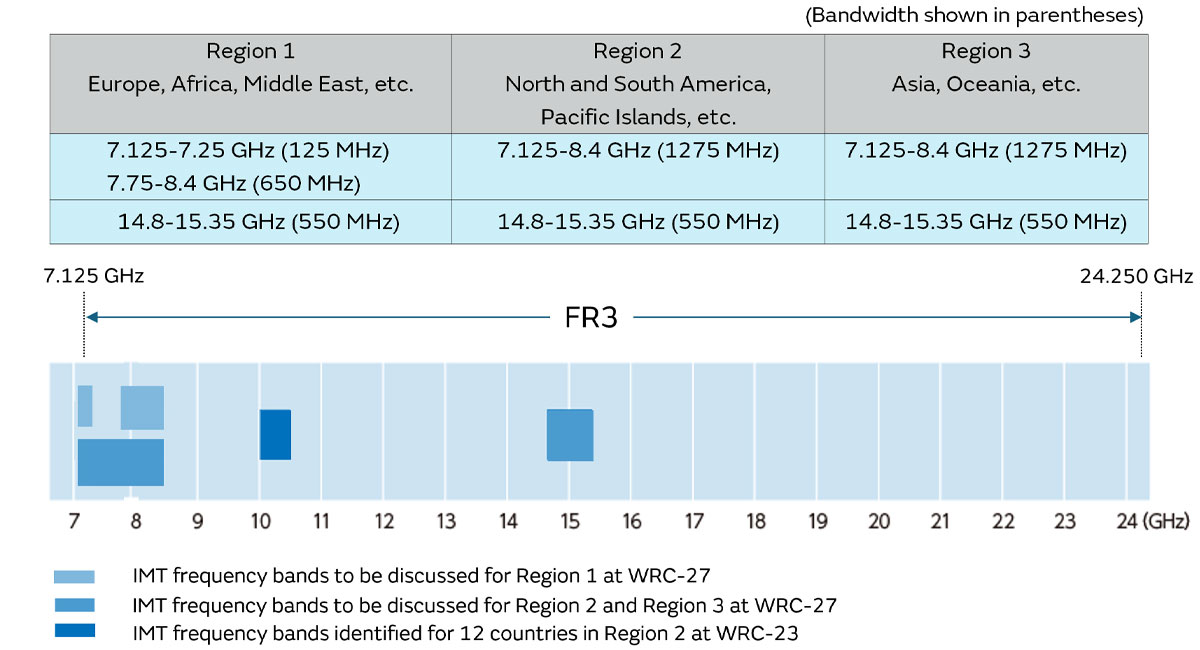
As mentioned in Section 2.2, 12 countries in Region 2, including Brazil, Mexico, and Peru, agreed to designate the 10 to 10.5 GHz band within the FR3 frequency range as IMT frequencies during the IMT discussions (Agenda item 1.2) at WRC-23 held in 2023. However, the US and Canada did not agree to this designation at the time.
At WRC-23, it was confirmed that the identification of IMT frequencies keeping IMT-2030 (6G communications) in mind would continue to be deliberated at the next conference, WRC-27, to be held in 2027 (Agenda item 1.7), and the candidate frequencies are positioned within the FR3 range (Figure 3).
In fact, there are frequencies within the FR3 range that are already being used for satellite communications and other existing systems in some regions. For this reason, ITU-R conducted evaluations concerning the impact of interference on existing systems from 6G radio stations. In the meantime, the question of how to handle the evaluation of interference from existing systems with 6G radio stations remains a subject of continued discussion, and the conclusions to be reached on this matter at WRC-27 are expected to be of significant interest.
Based on the results of such interference evaluations, coexistence conditions and operational rules will be internationally standardized through the WRC.
4. Characteristics of the FR3 Frequency Band - A Comparison with FR1 and FR2
As mentioned above, FR3, which is positioned in between FR1 and FR2, is being considered as a frequency band for 6G communications. In this section, we will consider the advantages of using the FR3 frequency band by comparing it with FR1 and FR2.
The FR1 frequency band is also used in mobile communication systems such as smartphones, etc. Since it is a frequency band that enables radio waves to easily travel long distances, it offers the ability to expand communication coverage. However, the bandwidth that is available to telecommunications carriers as a single frequency band is often limited to between tens of MHz and 100 MHz, which means that high-speed communication above a certain level cannot be expected.
Meanwhile, the FR2 frequency band is also used in mobile communication systems similar to FR1. Since it is able to secure a wide bandwidth, for example, 400 MHz, high-speed communication of tens of Gbps is possible, which is expected to be put to practical use in the future. However, due to the propagation characteristics of radio waves in this frequency band, i.e., high directivity and high propagation loss (short communication distance), a large number of base stations are required for use in high-rise areas or indoors. Therefore, communication devices and services using FR2 frequencies are currently limited in terms of use cases. As outlined above, FR1 can cover a wide area, but is subject to speed restrictions, while FR2 enables ultra-high-speed communication, but has the disadvantage of limited usage environments.
The FR3 frequency band possesses intermediate characteristics that lie between FR1 and FR2. It is able to secure a wider bandwidth than FR1 while demonstrating less radio wave directivity and longer communication distances compared to FR2. Specifically, FR3 has the potential to secure a wide bandwidth similar to FR2. In addition, due to the greater radio wave diffraction, FR3 is expected to provide stable communication even in mixed indoor and outdoor environments.
5. MIMO and Beamforming - Technologies Required to Use FR3
As mentioned in Section 3, because some parts of the FR3 frequency band are being used for satellite communications and other existing systems, coexistence and the impact of interference are important issues in the introduction of 6G communications. To solve these issues, it is expected that technologies developed through practical operation and research using the FR2 frequency band will be applied according to the characteristics of FR3. In particular, spatial multiplexing technology (which enables the simultaneous use of independent spatial channels) combining the antenna technologies of Massive MIMO and beamforming is thought to be one effective countermeasure for these issues (Figure 4).
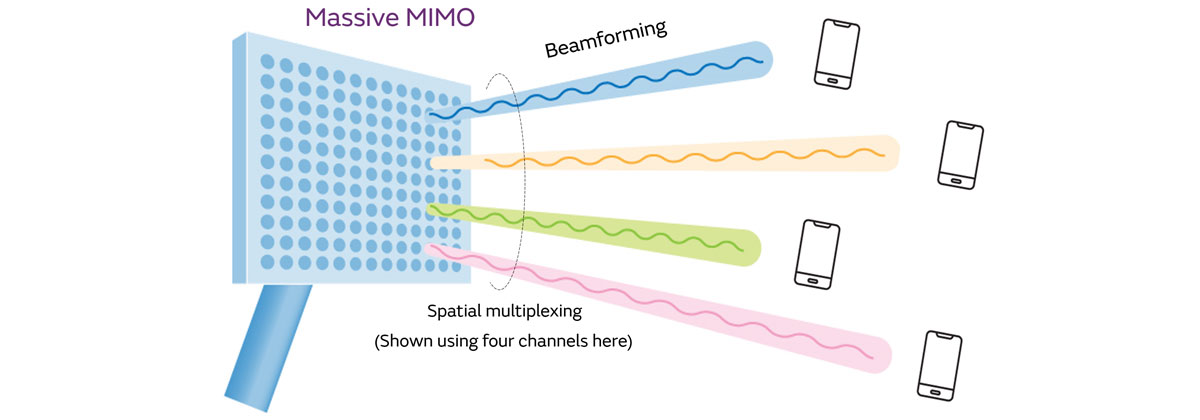
MIMO is an antenna technology that uses multiple antennas to send and receive multiple signals at the same time to improve effective communication speeds and stability through effects such as spatial multiplexing without increasing frequency bandwidth or transmission power. MIMO is represented as 2×2 MIMO and 4×4 MIMO configurations. The 2×2 MIMO configuration consists of two antennas each on the sending and receiving sides while 4×4 MIMO has four antennas on each side. Massive MIMO refers to an antenna configuration that significantly increases the number of antenna elements. The characteristics of Massive MIMO are as follows.
- With Massive MIMO, shorter radio wavelengths enable smaller antenna elements and tighter spacing between elements, which makes it possible to miniaturize antennas and achieve high-density element placement when used in relatively high frequency bands such as FR2 and FR3.
- The use of beamforming technology to intensively transmit radio waves in a specific direction enhances the directivity through high-density placement of antenna elements together with phase and amplitude control to reduce propagation loss and suppress interference.
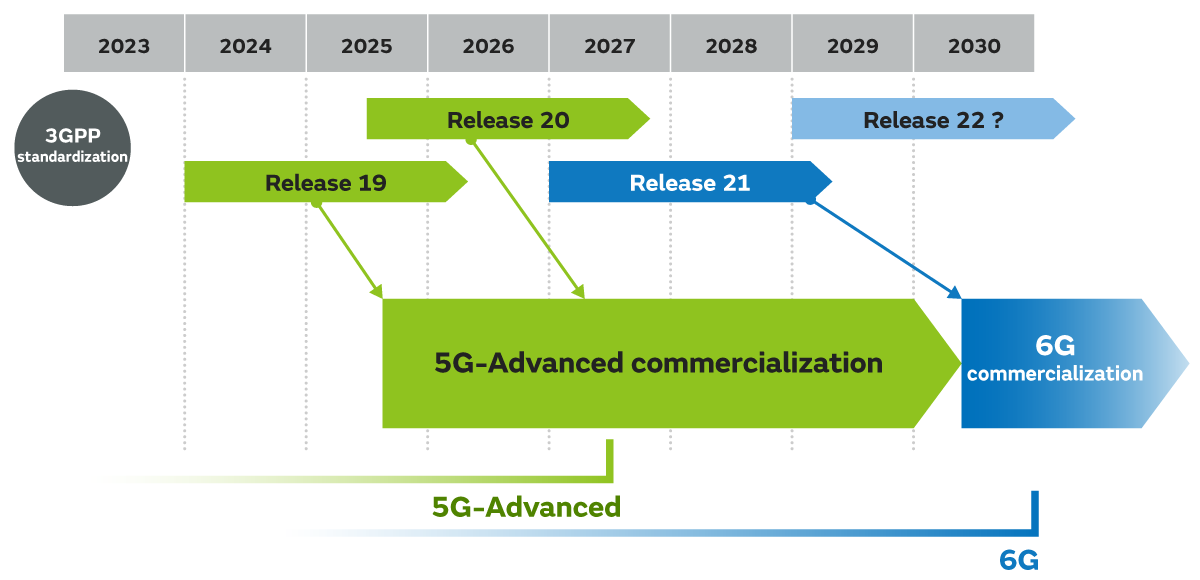
Due to these characteristics of Massive MIMO, antenna technologies combining Massive MIMO with beamforming are being positioned as important technologies for suppressing interference with existing systems, which is an issue when using the FR3 frequency band. Discussions regarding MIMO technology are already underway as part of Release 19 activities within 3GPP (Figure 5).
Furthermore, as shown in Figure 5, Release 20 activities for the technical review of 6G communications started in June 2025, and the initial specifications for 6G communications are scheduled to be created during the Release 21 activities scheduled to start in 2027.
Subsequently, the initial specifications will be submitted as an IMT-2030 proposal by 3GPP to ITU-R in 2029 to mark a major step toward the commercialization of 6G communications.
6. Outlook for FR3 and 6G Communication Technologies - An Introduction to Our Technologies for Addressing Challenges
Amid expectations for the use of the FR3 frequency band in 6G communications, the advancement of various component technologies is essential. To meet these needs, Murata Manufacturing is advancing the technical development and commercialization of power amplifiers, high-frequency filters, modules, low dielectric LTCCs, LCP flexible substrates, and more.
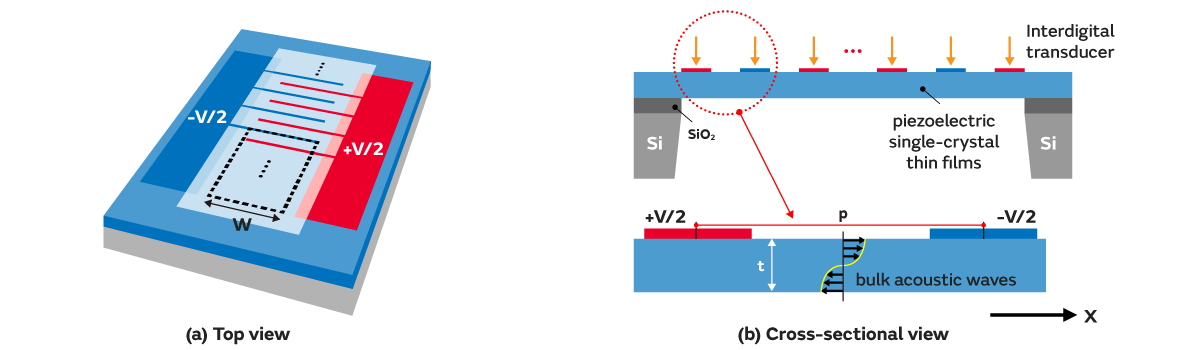
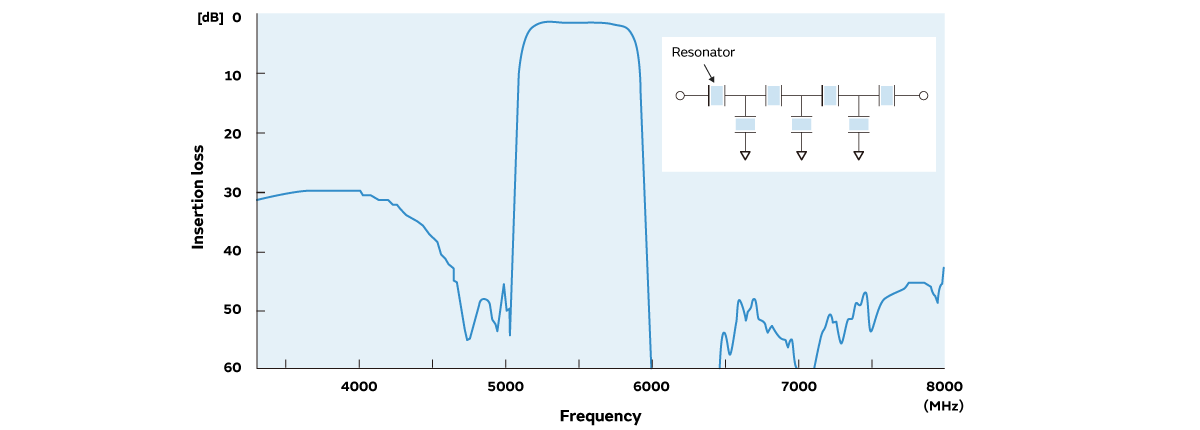
The following is an introduction to the XBAR filter, which supports high-frequency bands of 3 GHz and above and has recently entered the mass production and shipping phase. The XBAR filter is a high-frequency filter achieved by fusing our Surface Acoustic Wave (SAW) filter technology with a technology that excites bulk acoustic waves (BAW) in a piezoelectric single-crystal thin film using interdigital transducers. This technology possesses characteristics which were previously unachievable with SAW filters, such as wide bandwidth, low loss, and high out-of-band attenuation in the 4 to 7 GHz range, and it is capable of realizing these characteristics even at frequencies in the FR3 band that exceed 10 GHz.
XBAR refers to a resonator that uses bulk waves in the lateral direction (X-axis direction), and its structure is shown in Figure 6. When an alternating voltage is applied to the metal interdigital transducers in this structure, a lateral bulk acoustic wave is excited within the piezoelectric single-crystal thin film, which results in electrical resonance. XBAR filters with the desired bandwidths and attenuation characteristics are manufactured by utilizing a configuration which alternately arranges these resonators in series and parallel, and optimizing the number of elements and individual resonance frequencies (Figure 7).
<Column> "Sub-6" Frequency Band for 5G Communications
As mentioned in the main text of this article, multiple frequency classifications are used in the field of mobile communications according to the purpose and context.
- 3GPP classifications: FR1 (0.41–7.125 GHz), FR2 (24.25–71 GHz)
- 3GPP individual classification for 4G communications: e.g. Band 1 (2.1–2.17 GHz)
- 3GPP individual classification for 5G communications: e.g. n40 (2.3–2.4 GHz)
- Common classifications: Low-band (1 GHz and below), Mid-band (1–24 GHz), High-band (24 GHz and above), etc.
- Common classifications: Sub-GHz (1 GHz and below), Sub-6 (6 GHz and below), Sub-THz (approx. 100–300 GHz)
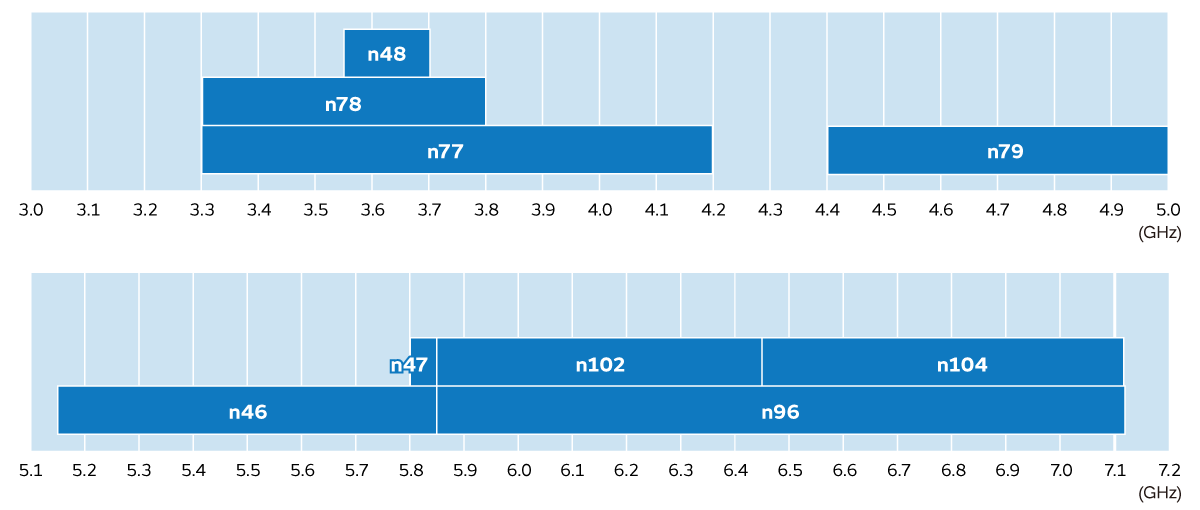
The "Sub-6" range is attracting significant attention here. Sub-6 typically refers to frequency bands below 6 GHz. It has traditionally referred to n77 (3.3–4.2 GHz) and n79 (4.4–5.0 GHz), which are new frequency bands*6 dedicated to 5G communications under 3GPP individual classifications (Figure 8).
However, with 3GPP allocating n104 (6.425–7.125 GHz) for 5G communications, there is a growing trend to include frequencies up to 7.125 GHz, which is the upper frequency of FR1, within the definition of Sub-6. Furthermore, even when 7.125 GHz is included, Sub-6 falls within the Mid-band range, which is another common classification (Figure 9).
*6 Also referred to as 5G NR frequency bands. NR is an abbreviation of New Radio.

Other Links
- Murata Unveils First High-Frequency XBAR Filter for Next-Gen Networks
- Murata Launches World’s First Inner Cavity-Structure Ultra-Low-Loss LCP Flexible Substrate, Achieving Dk below 2.0, Contributing to 6G Realization