
Combining Creativity to Create Technology: What Is Open Innovation?
INDEX
2. Differences between Innovation and Open Innovation
3. Advantages and Disadvantages of Open Innovation
Creating innovation through exchanges and collaborations between different industries, open innovation is an attractive activity for companies. However, it is necessary to correctly understand open innovation to set up a team to realize it, promote the project, and connect it to business success. We provide an explanation in this article on open innovation: from the basic knowledge of open innovation to its advantages and disadvantages. We also provide an explanation on the current state of open innovation, precautions when proceeding with it, and more using the manufacturing industry as an example.
1. What Is Open Innovation?
Open innovation refers an activity where companies create innovation through exchanges and collaborations . In many cases, the parties involved in these exchanges and collaborations are from different industries. These parties also include universities, research institutions, start-ups, and other organizations. Combining hardware and software technologies, knowledge, and experience through exchanges and collaborations with open innovation makes it possible to solve issues and create new value that would be difficult to do with innovation in a single company.

2. Differences between Innovation and Open Innovation
Conventionally, innovation has been carried out within a single company or group. For example, an activity such as creating higher-quality products by improving the accuracy of existing in-house products with in-house technologies and ideas is called "closed innovation." However, as international competition among companies intensifies, it has become increasingly challenging to launch new businesses, enter new markets, or achieve similar successes with closed innovation. Therefore, the concept of open innovation has been gaining traction among many industries.

3. Advantages and Disadvantages of Open Innovation
The advantages of open innovation includes the possibilities to create new value within an organization by exchanging technologies and knowledge with other organizations. However, there can be disadvantages to sharing important information with other companies. With a thorough understanding of these advantages and disadvantages, an organization can maximize the benefits of open innovation.
Advantages of Open Innovation
The following three points display a few of the advantages of open innovation.
- Acquisition of new technologies, knowledge, and more: By implementing the concept of open innovation, an organization can acquire new knowledge and technologies not found in the company. By integrating your company's technologies with knowledge and innovations from different industries, you can effectively address challenges and foster new innovations that would be difficult to achieve independently.
- Rolling out an extensive strategy is easier: Utilizing the technology and knowledge of other companies makes it possible to introduce business strategies beyond the usual scope of the company. This can allow businesses to flexibly respond to the needs of the rapidly changing markets.
- Shortening of the research and development time: It is important to shorten the development time of new products nowadays when the product life cycle is becoming shorter. One can shorten the time needed to research and develop new technologies by supplementing the technologies not found in your company with the technologies of other companies.
In addition to these points, you can expect other advantages such as an improvement in your presence in the market by obtaining capabilities not found in your competitors in the same industry, an acceleration in the speed of business advancement, and also a reduction in research and development costs.
Disadvantages of Open Innovation
The following three points display a few of the disadvantages of open innovation.
- Risk of confidential information, intellectual properties and other assets being leaked: There is a possibility that a company's confidential information may be leaked to other companies. This risk in particular may increase in cases when a company provides their technologies and customer information to other companies.
- To maximize the benefits of open innovation, it is essential to clearly define its purpose. Open innovation should always be pursued with a specific goal in mind. Without a clear purpose, there is a significant risk that the efforts invested in open innovation will be wasted.
- Allocating a limited budget to open innovation can limit the funds available for other research and development activities within your company. This is especially true if the budget is reduced for existing R&D projects, which may lead to decreased employee motivation. Such reductions can result in a loss of talent.
These disadvantages must be resolved through research and consideration in advance. This includes, for instance, clarifying the information that will be disclosed to your business partners, clarifying the business plan, and formulating a balanced investment plan for research and development.
4. Current State of Open Innovation
Expectations and understanding of open innovation are rising at present when we are starting to see the limits to competitiveness through technological innovation with closed innovation in various industries. Nevertheless, as mentioned above, open innovation has both advantages and disadvantages. Accordingly, we describe here the current state of open innovation using the manufacturing industry as an example.
Open Innovation in the Manufacturing Industry
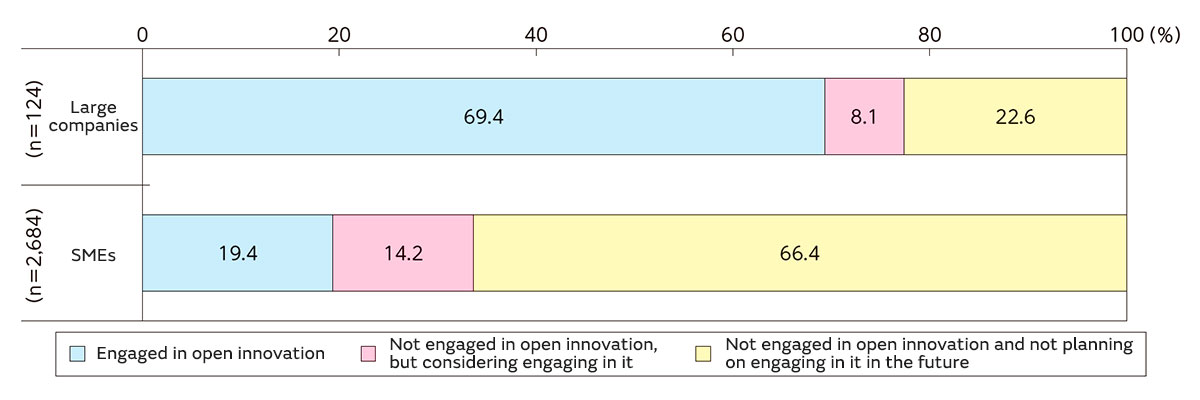
The number of companies engaging in open innovation has also been increasing in the manufacturing industry in recent years. However, the number of companies doing so is still less than in other industries at present. In particular, less than 20% of SMEs are engaged in open innovation (Fig. 2). The majority of the business partners of companies engaged in open innovation are domestic universities and research institutions; few are companies in the same industry, SMEs, venture businesses, overseas institutions, or other organizations (Fig. 3).

Source: Website of the Ministry of Economy, Trade and Industry
*This linked page is in Japanese.
The following are given as the reasons why open innovation is not progressing in the manufacturing industry in this way.
- Attachment to self-sufficiency (closed innovation):
Solving issues with their own efforts is an important mission for engineers involved in manufacturing. They have a resistance to solving issues with external technologies and knowledge. Therefore, even if there is an external organization that can help solve their issues, they do not proactively use the technologies or knowledge of that organization. Self-sufficiency like this interferes with open innovation. - Human resource and skill problems:
It is essential to communicate widely with other companies and research institutions to engage in open innovation. Such communication requires extensive business-related knowledge and communication skills in addition to manufacturing technologies. The shortage of human resources who possess such skills makes open innovation in the manufacturing industry difficult. - Risk of technology leaks:
The biggest concern about open innovation for those in the manufacturing industry whose technological abilities are at the core of their competitiveness is the leak of the knowledge and technologies possessed by their company. This concern can lead to self-sufficiency, and that can result in a reluctance to engage in open innovation.
Open innovation is not progressing in the manufacturing industry for reasons like the above. Furthermore, it is possible to see many cases such as in which it is not possible to connect investment with commercialization and corporate earnings even if companies engage in open innovation.
Necessity and Precautions for Open Innovation in the Manufacturing Industry
Nevertheless, as global competition intensifies and product life cycles become shorter, it is difficult for companies to maintain international competitiveness without introducing open innovation.
Moreover, you may imagine that innovation is something that start-up companies and cutting-edge companies attempt. However, even large companies need to attempt to create new value through open innovation in the manufacturing industry for which market needs are changing rapidly and the shortage of human resources is becoming a serious issue.
Open innovation is a major project with many advantages and disadvantages for companies. For that reason, it is necessary to take great care when selecting business partners. In particular, the degree of disclosure of technical information and quick and accurate responses are essential in addition to the technological capabilities of business partners in commercialization. Moreover, initiatives to provide after-sales support is an important point that affects corporate earnings after commercialization.
5. Summary

Many companies and universities are already collaborating to create new value through open innovation. Under such circumstances, the lagging behind in open innovation in the manufacturing industry is a major issue that will affect the future of monozukuri.
Open innovation aims to create new value by organizations from different fields collaborating and combining their technologies. The many disadvantages and issues facing the manufacturing industry seem to speak to the necessity of collaborating with optimal business partners.
Other Links
Related articles
- Murata Aims for a Society That Utilizes Fatigue/Stress Visualization Through Co-creation with Academia and the Education Sector
- The Vision for Next-Generation Manufacturing of Murata's Distributed Exhaust Circulation One-by-one VOC Removal System - Simultaneously Reducing Environmental Impact and Costs
- Protecting Fetuses with Ultrasound Examinations - Aiming for "Anytime, Anyone, Easily"