

Time and Frequency Domains - The Basics of Digital Communication
In the previous article, "Increasing Communication Speeds - The Basics of Digital Communication," we explained the enhancement of communication speeds by multivalue digital modulation from the perspective of the time axis (time domain). However, the evaluation of electrical communications such as analog and digital communication actually needs to be considered from the frequency domain perspective in addition to the time domain. This article builds on the content of the aforementioned article to delve a bit deeper into the relationship between the frequency domain and communication speed, and why discussion of frequency is important for communication devices such as smartphones. Specifically, we will touch on points such as:
・There is a theoretical upper limit to communication speed.
・Securing a wide frequency bandwidth leads to enhancement of communication speed.
・Utilization of unused frequency ranges is a realistic solution for securing that bandwidth.
1. The Upper Limit of Communication Speed - What is the Shannon Limit?
Fig. 1 shows the configuration of the basic model for communication systems (from Fig. 2 of "Basic Knowledge of Wireless Communication: Wireless Mechanism (1)").
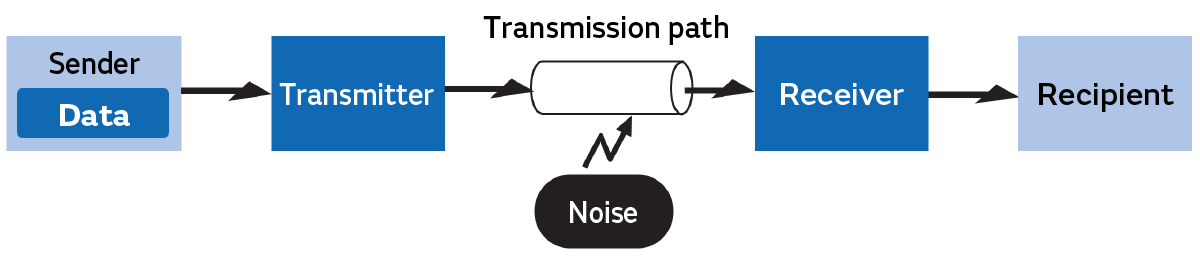
It may seem surprising, but the upper limit of the communication speed in this single-stream model, that is to say the maximum amount of data that can be transmitted over the transmission path, is theoretically determined regardless of the modulation method. This upper limit is called the Shannon limit, and the Shannon limit communication speed is called the communication capacity and is expressed by the following formula*1.
C = B * log₂ (1 + S/N)
C: Communication capacity [bit/s]
B: Frequency bandwidth (Hz)
S: Signal power (Watt)
N: White noise power (Watt)
*1 This is called the Shannon-Hartley theorem. The C which stands for communication capacity is said to derive from the first name of Claude Elwood Shannon, who was one of the people who laid the foundation of modern computer technology.
This formula represents the communication capacity when there is white noise (noise that extends from low frequencies to very high frequencies) with power N on a transmission path that carries a signal with bandwidth B and power S. (An example of calculation is given in "Column: Communication Capacity, Maximum Communication Speed, and Throughput" below.)
From this formula, it is understood that in order to increase the communication capacity, it is necessary to:
- Increase the signal power S or suppress the noise power N, that is to say, increase the S/N ratio, which is the ratio of the two.
- If the S/N ratio is constant, widen the frequency bandwidth B.
Increasing communication capacity can be considered a prerequisite for increasing practical communication speeds. Therefore, to realistically increase communication speeds, since it is technologically difficult to greatly increase the S/N ratio, the basic approach is to secure a wide frequency bandwidth*2. For this reason, efforts are underway to realize high-speed communications (e.g., 6G) by securing wide bandwidths in unused and untapped frequency bands (see "FR3 Frequency Band Pioneering a New Era of 6G Communications").
*2 In wireless communication, standards with higher communication speeds are being developed over time. For example, in Wi-Fi and other standards, devices that use carrier waves with higher frequencies such as 2.4 GHz to 5 GHz, and more recently 6 GHz, have appeared. As a result, there is a tendency to think that use of higher frequencies directly increases communication speeds. In reality, however, these unused high frequency bands are being utilized due to the need to secure a wide bandwidth in order to further enhance communication speeds.
2. Dual Aspects of Communication Speed and Signal - Time and Frequency Domains
2.1 Relationship between Symbol Length and Frequency Bandwidth - Basics
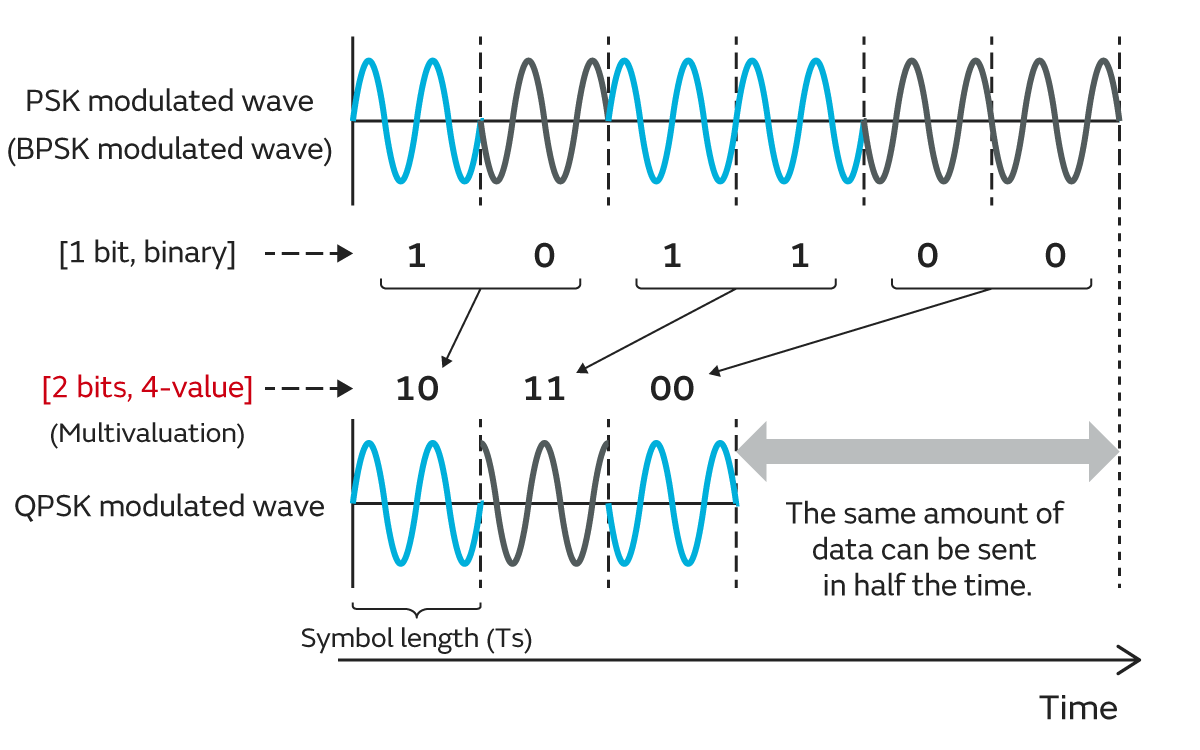
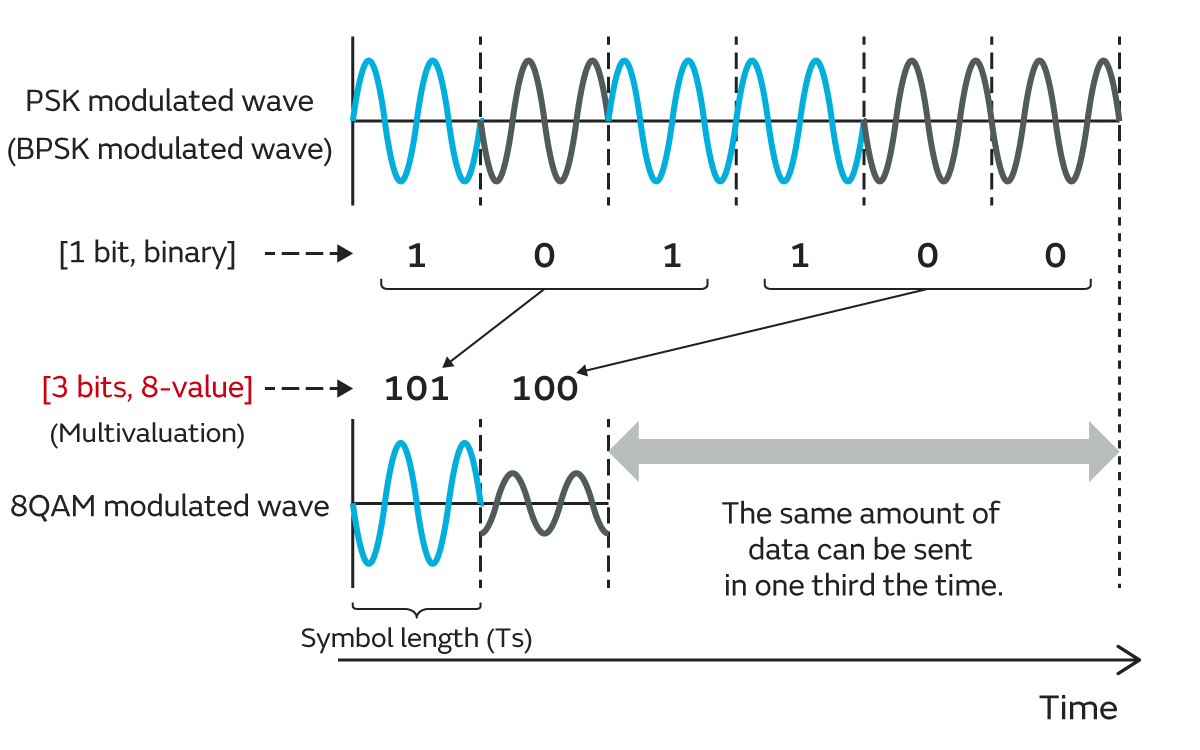
The previous article, "Increasing Communication Speeds - The Basics of Digital Communication," presented Fig. 2 below to explain increasing communication speeds. If we look at this figure a little more carefully, we can see that reducing the symbol length Ts (s) enhances the communication speed. On the other hand, it was mentioned in section 1 above that increasing the frequency bandwidth B (Hz) can also enhance the communication speed. In fact, the symbol length and the frequency bandwidth have an inverse relationship as follows.
(1/Ts) × 2 = B
This means that the signal on the time axis (the moving data) and the bandwidth on the frequency axis (which we will call the spectrum) have a complementary relationship, and that it is necessary to understand the signal and the communication speed, or the speed of the signal, from both the time domain and frequency domain aspects*3.
*3 This is why frequency bandwidth is always discussed, for example, when considering new standards aiming to speed up communications such as mobile communications and Wi-Fi.
2.2 Relationship between Symbol Length and Frequency Bandwidth - Details
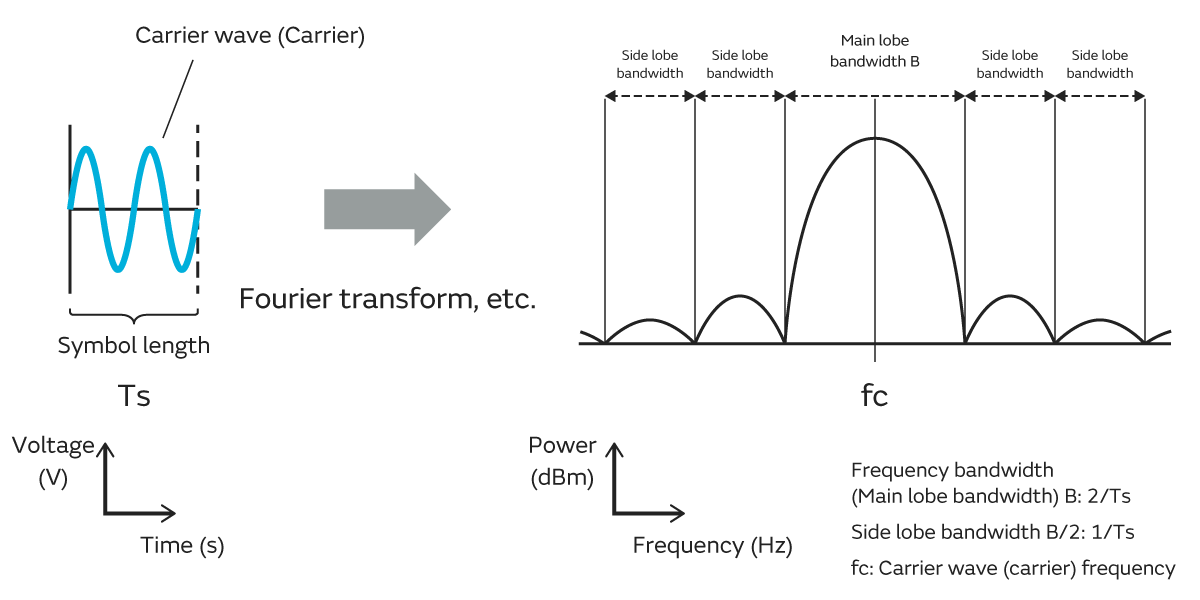
Delving further into the content of section 2.1, in the communications field, including wireless communications, it is assumed that descriptions and evaluations use both the time domain (signal) and the frequency domain (spectrum).
These time and frequency domain characteristics can be mutually transformed by mathematical formulas, where,
- Transforming a signal waveform on the time axis into a spectrum on the frequency axis is called Fourier transform, and
- Transforming a spectrum on the frequency axis into a waveform on the time axis is called inverse Fourier transform.
Fig. 3 below shows a basic example illustrating the relationship between the characteristics in the time domain and those in the frequency domain.
[Advanced supplement]
This article does not provide a detailed explanation of the mathematical operation called the Fourier transform, but the frequency characteristics in Fig. 3 are obtained through the following complex procedures, in part due to conventions in the communications field.
- The unit symbol length is Fourier transformed as an aperiodic function (the shape of the spectrum can be drawn as a continuous line).
- The function obtained by Fourier transform {sin (πfTs) / πfTs} is squared, the common logarithm is taken, and then multiplied by 10 as 10*log {sin (πfTs) / πfTs} ².
Additionally, the center of this shape line is 0, so it is set to fc.
(In the communications field, numerical values are often compared, and these ratios can be in the tens of thousands or even hundreds of millions. Therefore, to make large numerical values smaller and small numerical values larger for easier handling, it has become customary to use common logarithms in the communications field. [dBm] is a unit based on reference power of 1 mW when the measured power is P [W]. For example, 10 W becomes 10*log (10000 [mW] / 1 [mW]) = 40 [dBm].)
From the relationship between the time and frequency domains in Fig. 3, the following important perspectives can be gained with regards to the practical use and design of communication devices.
- Design innovations in the time domain always appear as changes in characteristics in the frequency domain*4.
- It is necessary to comprehensively consider all factors involved in 1 above, such as communication speed, the frequency bandwidth used, and the resistance to noise and interference, and to design while balancing the characteristics in both domains.
*4 For example, reducing the symbol length enhances the communication speed, but correspondingly widens the frequency band.
3. Multivaluation and Frequency Bandwidth
Section 2 explained that multivaluation enhances the communication speed. This section explains the advantages of multivaluation while keeping the communication speed constant, or in other words, the effective use of frequency.
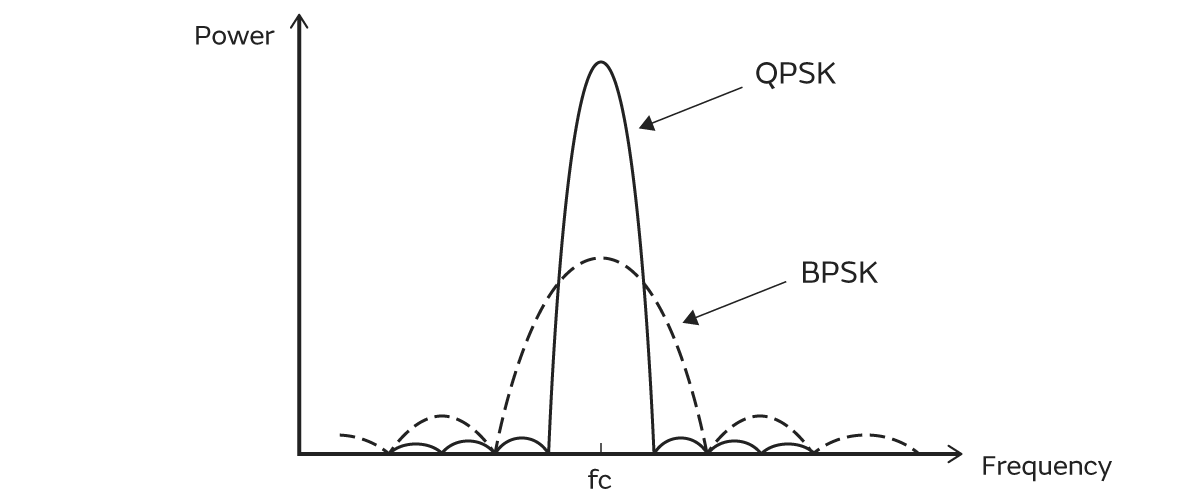
Now, let's consider the frequency bandwidth required to achieve a communication speed of 2 Mbps when transmitting 1 bit per symbol (using BPSK modulation), and the frequency bandwidth required to achieve the same communication speed when transmitting 2 bits per symbol (using QPSK modulation). Table 1 shows the calculation results.
Modulation | Number of bits | Communication speed | Symbol length | Frequency bandwidth |
|---|---|---|---|---|
BPSK | 1 bit | 2 Mbps | 1 µs | 2 MHz |
QPSK | 2 bits | ↑ | 2 µs | 1 MHz |
*5 In addition to baud, sps (symbols per second) is also used as a unit of modulation speed.
From Table 1, assuming the same communication speed, the frequency bandwidth required for QPSK is half that of BPSK (i.e., the modulation rate is halved). Fig. 4 shows an image of the QPSK and BPSK spectra at this time.
As can be seen from this example, greater multivaluation generally tends to result in a narrower bandwidth. This makes it advantageous from the perspective of effective utilization of frequencies, and technologies that make use of this characteristic include frequency-division multiplexing (FDM), multiple access using multiplexing technology (FDMA: frequency-division multiple access), and the OFDM (orthogonal frequency-division multiplexing) modulation method adopted in 4G and 5G communications and Wi-Fi.
Note that, while increasing the valuation per symbol may seem beneficial, it is not that simple in practice. This is due to a limit where, as the number of bits contained in one symbol increases, communication errors also increase, leading to a drop in the S/N ratio and shortening the distance over which wireless communication can be performed without error (see "Column: Communication Capacity, Maximum Communication Speed, and Throughput").
The maximum number of bits per symbol that has been practically applied in wireless communication is 12 bits (4096 values), which has been adopted in Wi-Fi 7 short-range communication*6. For long-range communication, there are hopes that it can be used in 6G communication, but this is still in the research stage.
*6 UWB communication that has been practically applied as short-range communication using pulses (unrelated to multivaluation) rather than symbols ("What Is Ultra-wideband (UWB) Wireless Communication?").
Column: Communication Capacity, Maximum Communication Speed, and Throughput
Let's use an example to calculate the communication capacity C, which is the communication speed limit.
C = B * log₂ (1 + S/N)
C: communication capacity (bit/s), B: frequency bandwidth (Hz), S: average signal power (Watt), N: average noise power (Watt)
Using Wi-Fi specifications as an example, the various values are set as B = 20 MHz, S = -60 dBm (10⁻⁶ mW), and N = -90 dBm (10⁻⁹ mW)*7.
Thus,
C = 20*10⁶*log₂ (1 + (10⁻⁶) / (10⁻⁹)) = 20*10⁶* (log (1001) / log 2) ≒ 20*10⁶*9.97 ≒ 200 Mbps
The maximum communication speed for a single data stream on a Wi-Fi 6 bandwidth of 20 MHz is 96.1 Mbps, which is half the communication capacity, and the throughput that represents the perceived communication speed is said to be 60 to 70 Mbps, which is about one third the communication capacity. To emphasize once again, it is impossible to achieve a communication speed that exceeds the communication capacity with just one stream.
*7 Good communication can be expected given a difference between S and N of 30 dB (a ratio of 1000 times). Note that in this case, it is clear that 1 mW is used as the reference, so it is generally indicated as dB rather than dBm.