
mmWave Radar Sensor Modules
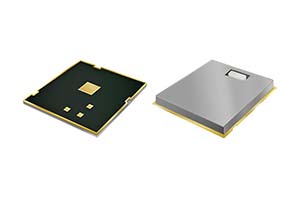

In general, radar (originally an acronym for "radio detection and ranging") is a device that detects the distance to a target and its direction by emitting electromagnetic waves (radio waves) toward the target and then measuring the radio waves that are reflected back. Accordingly, mmWave radar refers to radar that uses milli-waves as its radio waves.
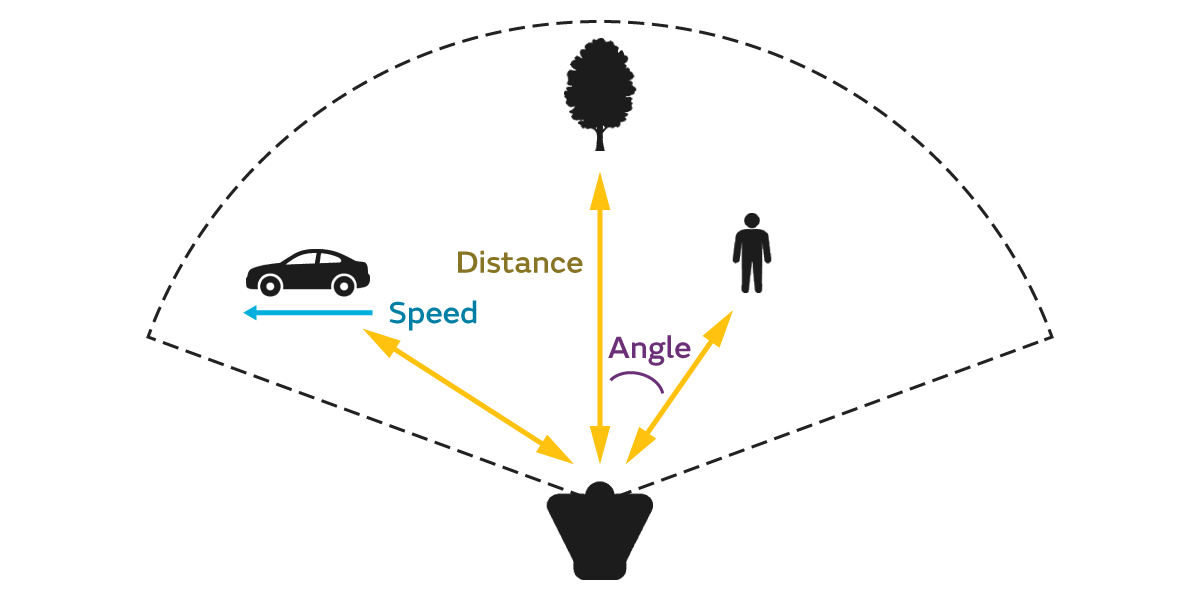
Compared to infrared rays and cameras, mmWave radar's detection capabilities do not decline even in adverse weather conditions such as rain, snow, and fog. Moreover, in addition to the distance to a target and its direction, it can also detect the target's speed of movement. Here, we take a look at the detection principles, usage examples, and future potential of mmWave radar, which possesses these characteristics.
Figure 1 shows the range where milli-waves (also referred to as "mmWaves") fall within the classification of radio waves. In general, milli-waves refer to radio waves with frequencies from 30 GHz to 300 GHz and wavelengths from 1 mm to 10 mm*1. They are called milli-waves because their wavelengths are measured in millimeters (mm).
*1 In fact, there is no strict definition of the frequency range of milli-waves. For example, the 26 GHz and 28 GHz bands, which are now being allocated to 5G communications across the globe, are also treated as milli-waves.
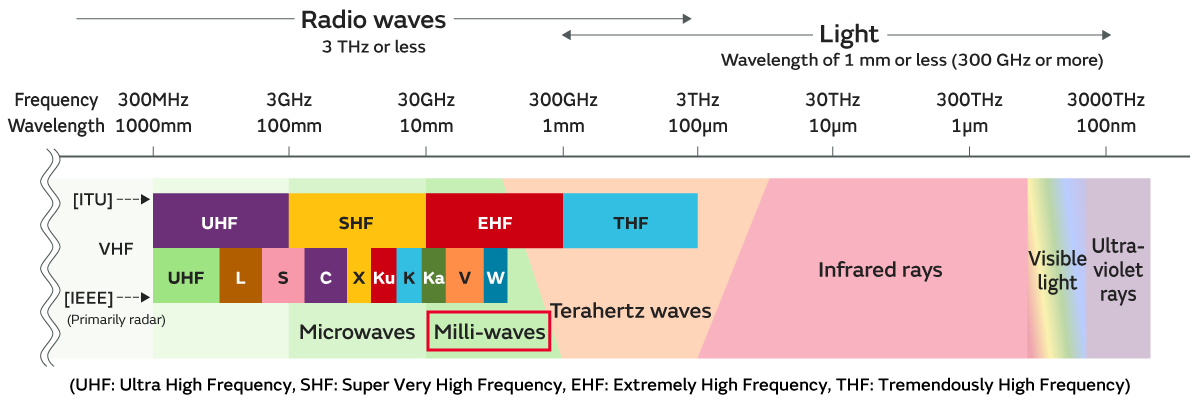
The characteristics of milli-waves include strong directivity and the ability to secure a wide frequency bandwidth. Table 1 summarizes these characteristics.
| Directivity | As shown in Figure 1, the frequency of milli-waves is close to that of light. Therefore, milli-waves exhibit strong directivity similar to light. This means we can say the following about milli-waves. a-1: The signal strength is attenuated by shielding from obstacles such as walls or in the event of extremely adverse weather conditions. a-2: Milli-waves are not suited to long-range communication due to a-1. a-3: Interference with nearby milli-wave systems is less likely to occur in short-range communication. a-4: Milli-waves can penetrate fabrics, resins, and other materials. |
|---|---|
| Frequency bandwidth | The milli-wave bandwidth is an unexplored domain. It is a frequency band for which there is still little demand. This means it is possible to secure a wide frequency bandwidth. (Currently, most frequency domains below a few GHz are already being used. Accordingly, securing bandwidth is subject to the radio laws and business constraints.) |
Wider frequency bandwidth leads to higher accuracy in distance detection in radar (see section 2). Therefore, we can say that frequency bandwidth is an important specification. Furthermore, wider frequency bandwidth leads to faster communication speeds in mobile communications or similar ("Time and Frequency Domains - The Basics of Digital Communication").
As we mentioned at the beginning of this article, mmWave radar is a device that detects the position of a target by emitting milli-waves toward it and then receiving the waves that are reflected back. It can detect objects within a range of up to approximately 300 meters.
Currently, the frequency bandwidths available for low-power radar are the 24 GHz*2, 60 GHz, 76 GHz, and 79 GHz bands. Technical requirements have been specified for each of these. Among them, milli-wave bands (60 GHz, 76 GHz, and 79 GHz bands) have a wide bandwidth. This enables highly accurate detection.
The leading mmWave radar methods are the pulse method and the FMCW method*3. Table 2 describes the characteristics of these methods.
Pulse Method | FMCW Method |
|---|---|
This method involves emitting extremely short pulses of | This method involves emitting a transmitted wave*4 |
*2 24 GHz band: The wavelength of the 24 GHz band is 12.5 mm. This is not included in the 10 mm to 1 mm range defined for milli-waves. Therefore, milli-waves in the 24 GHz band are called "quasi-milli-waves."
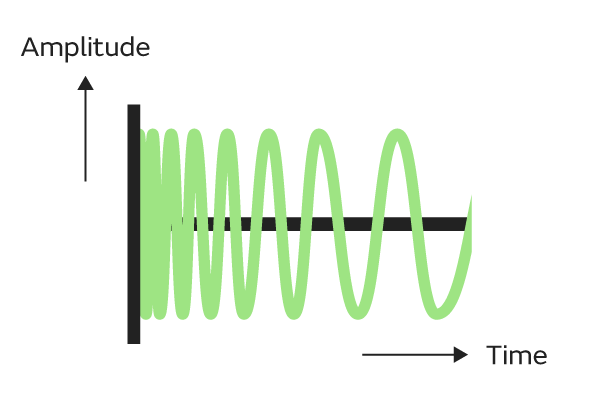
*3 FMCW stands for "frequency modulated continuous wave." It refers to a method that uses a continuous wave whose frequency has been modulated.
*4 Figure 3 shows an image of a transmitted wave in the FMCW method. This wave is sometimes called a chirp waveform.
There are many mmWave radar methods. Nevertheless, most are advanced versions of the FMCW method. Accordingly, we will explain below the configuration of an FMCW mmWave radar and the general principle for detecting targets. Although the configuration is simple, it can acquire complex information such as distance, speed, and angle.
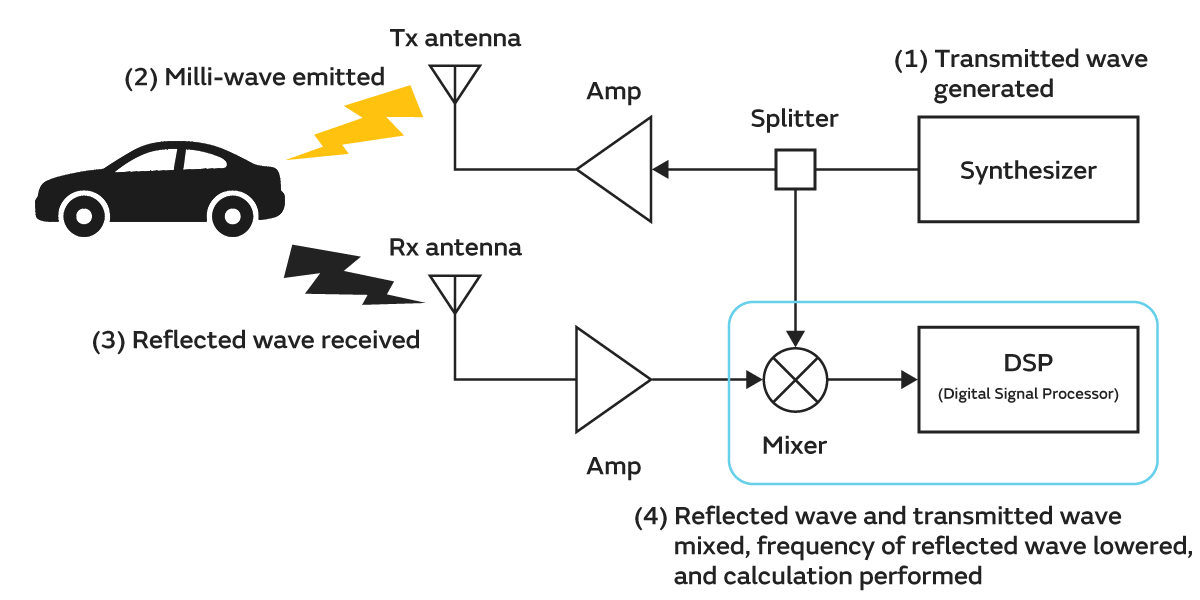
<mmWave radar configuration>
Synthesizer: Generates the radio waves in the milli-wave band to be transmitted (transmitted waves)
Tx antenna: Emits the transmitted waves
Rx antenna: Receives the reflected waves
Mixer: Combines the Tx signal and the Rx signal
Digital signal processer (DSP): Performs the calculation
<Detection principles>
(1) Transmitted wave generation: The synthesizer generates transmitted waves in the milli-wave band.
(2) Milli-wave emission: The transmitted waves are continuously emitted from the Tx antenna toward the target.
(3) Reflected wave reception: The Rx antenna receives the reflected waves returned from the target.
(4) Calculation: The mixer combines the transmitted waves and the reflected waves. An A/D converter converts the combined waves into a digital signal. The DSP then performs the calculation to determine the target's distance, speed, angle, and other parameters.
The FMCW mmWave radar described in section 3 is utilized in many fields. Here, we will explain their usage scenarios and the functions they support by taking automobiles, industrial robots, and drones as examples (Table 3).
| Application | Main usage scenarios | Frequency band used | Detected objects | Functions supported |
|---|---|---|---|---|
| Automobiles | Vehicle surroundings monitoring (front, rear, sides) In-vehicle monitoring | 76 to 81 GHz band (outside the vehicle) 60 GHz band (inside the vehicle) | ・Obstacles, other vehicles ・Condition of driver/passenger(s) ・Detection of passenger(s) left behind | ・Automatic braking ・Lane keeping assist ・Contribution to the realization of Level 2 autonomous driving ・Improved safety |
| Industrial robots | Robot arms Autonomous mobile robots (AMRs) | Mainly 60 GHz band/ 76 to 81 GHz band | ・Distance to people and objects ・Speed, angle ・Surrounding obstacles | ・Avoidance of contact with people ・Arm movement control/stoppage ・Safe autonomous traveling |
| Drones | Flying in populated areas | Mainly 60 GHz band/ 76 to 81 GHz band | ・Distance to the ground ・Pillars, walls ・Power lines, wires, antennas | ・Obstacle detection less likely to be affected by the weather ・Safe flying in populated areas |
mmWave radar detects obstacles and other vehicles around a vehicle. This enables functions such as automatic braking and lane keeping assist. Accordingly, mmWave radar is said to be essential for realizing Level 2 autonomous driving (partially automated driving). Furthermore, monitoring the condition of drivers and passengers and monitoring whether passengers have been left behind are attracting attention as indispensable functions for enhancing safety.
Equipping industrial robot arms with mmWave radars makes it possible to detect the distance between the arm and people or objects, as well as providing speed and angle data. This allows predetermined actions, such as stopping the arm's movement, to be performed. In addition, for example, autonomous mobile robots (AMRs) can travel while avoiding obstacles such as shelves, walls, people, and various industrial equipment.
Drones, especially those flying over populated areas, required a high level of safety. Using mmWave radar to detect the flight path of a drone makes it possible to detect not only the distance from the ground but also pillars and walls, as well as power lines, telephone lines, aerial antenna wires, and other obstacles, regardless of the weather conditions. This enables safe flying in populated areas.
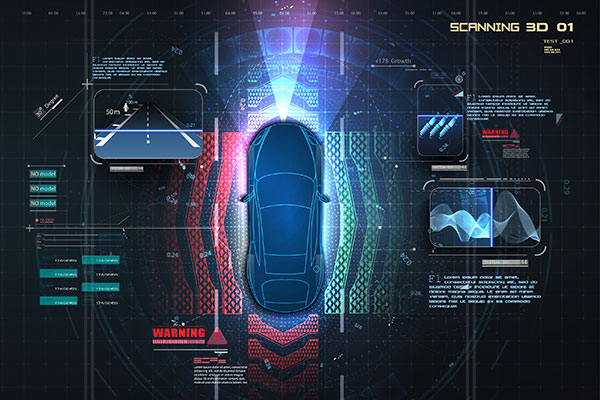

mmWave radar is being utilized in a variety of fields. In recent years, Euro NCAP*5, which is involved in automobile safety performance assessments in Europe, has set out to strengthen collision safety testing. This has led to attention being paid to the utilization of mmWave radar in cabin monitoring systems that enhance in-vehicle safety.
*5 The European New Car Assessment Programme (Euro NCAP) is an independent organization that assesses and publishes information regarding the safety of new cars sold in Europe. The organization conducts tests to rate advanced safety technologies such those involved in collision safety and pedestrian protection. This information serves as a guide for consumers when choosing a car. The NCAP also has a presence in other countries, while the U.S. has the IHS rating and Japan has the JNCAP.
In 2023, Euro NCAP announced new assessment criteria. In addition to technology that deploys airbags according to the passenger's physique and detection of the usage of seatbelts, a function to detect whether children have been left in the vehicle has been added to the assessment criteria. The aim of the latter is to prevent heatstroke accidents, which have been increasing in number in recent years and are caused by children being left inside vehicles. To meet these requirements, a cabin monitoring system that assesses the conditions inside the vehicle is considered essential.
A cabin monitoring system is a mechanism that uses sensors inside a vehicle to monitor the condition of the driver and other occupants. It then activates the brakes and/or an alarm if necessary. The mechanism consists of a Driver Monitoring System (DMS) that checks the driver's physical condition and level of attention and an Occupant Monitoring System (OMS) that assesses the position and movement of the occupants. Cameras have been widely used as sensors. However, there are many situations that are difficult to detect with cameras alone. They include cases in which a baby is in a rear-facing child seat or an occupant is wrapped in a blanket, and whether a seatbelt is being used.
In this context, mmWave radar is considered a promising device (sensor) to complement or replace cameras. mmWave radar can penetrate fabric and the backs of seats. Therefore, it is capable of detecting objects that cannot be seen by cameras. Moreover, it can capture even minute movements. This also allows it to detect subtle biological changes such as heartbeats and respiration. These characteristics mean that mmWave radar is expected to significantly contribute to improving DMS and OMS functions in cabin monitoring systems and to boost compliance with the new safety criteria required by Euro NCAP.
mmWave radar is a device - a sensor - with outstanding detection capabilities. However, to meet the diverse detection needs of the future, sensor fusion will be crucial. This sensor fusion combines multiple sensors such as ultrasonic sensors, infrared sensors, and cameras, as well as mmWave radar.
Sensor fusion is a technology that integrates data from multiple sensors to acquire information that cannot be obtained with a single sensor. For instance, combining a mmWave radar with an image sensor makes it possible to acquire information about the driver's fatigue and attention levels not only from their bodily movements but also their eye movements and facial expressions. It is then possible to issue alerts as necessary.
In the future, sensor fusion centered on mmWave radar is expected to be a technology that greatly improves surrounding environment recognition, safety, and reliability, not only in automobiles but also industrial robots, drones, and various forms of mobility.