
Technologies and Ideas for Realizing a More Comfortable Society Through Wireless Power Supply (Wireless Power Transfer)
INDEX
1. Current Situation, Challenges, and the Outlook for Wireless Power Supply
1.1 Current Situation of Wireless Power Supply - Why This Technological Development Is Needed
1.2 The Future of Wireless Power Supply - Application to All Fields
1.3 Challenges in the Development of Wireless Power Supply - Ensuring Safety and Establishing Laws
2. Applications for Wireless Power Supply in the Mobile Field
2.1 Preventing Over-discharge in Products Equipped with Lithium-ion Batteries (LiB) After Shipping
2.2 Wireless Power Supply to Wearable Devices for Business Use
2.4 Wireless Power Supply to IoT Devices in Manufacturing and Logistics
3. Murata Manufacturing is Researching and Developing Wireless Power Supply Technologies
1. Current Situation, Challenges, and the Outlook for Wireless Power Supply
Wireless power supply, also known as wireless power transfer (WPT), refers to a system that literally supplies power to electronic devices and electrically-powered devices, etc., without connecting any cables.
We will start by explaining the current situation, the challenges in technological development, and the future prospects of this technology.
1.1 Current Situation of Wireless Power Supply - Why This Technological Development Is Needed
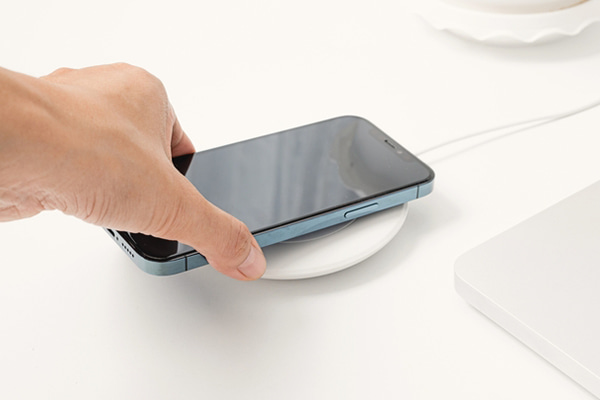
Currently, the most common wireless power supply systems in use charge smartphones and other devices by placing them on top of a charger. While this eliminates the need to plug in and unplug cables, such systems can only supply power over an extremely short distance, and the device must largely remain in contact with the charger. In addition, if the device is not aligned with the coil when it is placed on the charger, it might not charge. For this reason, power supply systems that fix the smartphone in place with magnets are often used, but it is said that the effort required is not so different from plugging in and unplugging a cable.
Meanwhile, research and development is underway for future wireless power supply systems that can be used in an efficient and stress-free manner in various fields and applications.
This development is motivated by the fact that, while many devices for industrial and consumer use are capable of wireless data communication, they require cable-based power supplies and wiring to charge their built-in lithium-ion batteries.
For example, in industrial applications, many wireless devices may require a power supply and charging at the same time. In such scenarios, wireless power supply systems can dramatically improve the efficiency of power supply and charging tasks by reducing the workload, costs, and problems involved in connecting and checking the power supply cables.
1.2 The Future of Wireless Power Supply - Application to All Fields
The future vision for wireless power supply is expected to initially be a system that supplies power to and charges IoT devices just by casually placing them in a certain location, while further development anticipates the emergence and adoption of wireless power supply for electric vehicles (EVs) and other systems. One of the goals for this technology as it advances is to enable users to live and work without having to think about supplying power to devices.
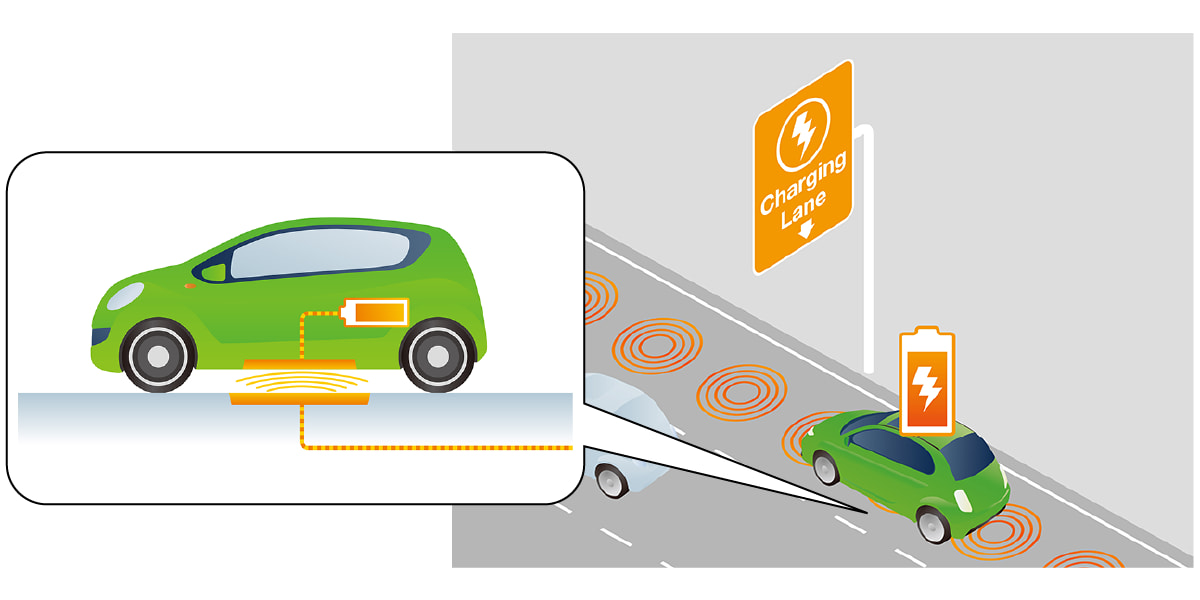
Technological advances in wireless power supply will benefit a wide range of fields. In addition to gadgets and electric vehicles (EVs) for individual users, the evolution of wireless power supply will likely bring significant benefits to manufacturing and logistics, medicine, entertainment and amusement facilities, sporting events and concerts, and various other fields as devices shift to IoT.
1.3 Challenges in the Development of Wireless Power Supply - Ensuring Safety and Establishing Laws
In the future, it is hoped that innovations in wireless power supply will eliminate concerns about remaining battery life and charging, as well as improve convenience and contribute to future lifestyles and social activities through devices that do not contain a main battery due to the availability of wireless power supplies.
Factors that are required for such innovation in wireless power supply include research into wireless power supply technologies and techniques, investigation into the safety aspects, such as avoiding adverse effects on the human body, and the establishment of essential laws in each country to regulate the available frequencies and output, etc., when handling electromagnetic waves.
1.4 Future Prospects for the Technological Development of Wireless Power Supply - From Mobile to Mobility
Due to the aforementioned challenges, the development of wireless power supply is starting with innovation in the mobile field, where the low power consumption of devices such as smartphones, wearable devices, various IoT devices, and small drones for photography, etc., can be met with relatively small amounts of power.
From the perspective of technological development and the establishment of laws and other factors, it is believed that this will subsequently expand into high-power mobility fields such as transport drones and electric assist bicycles, electric motorcycles, and electric vehicles (EVs), which require more power and are powerful enough to transport people and cargo.
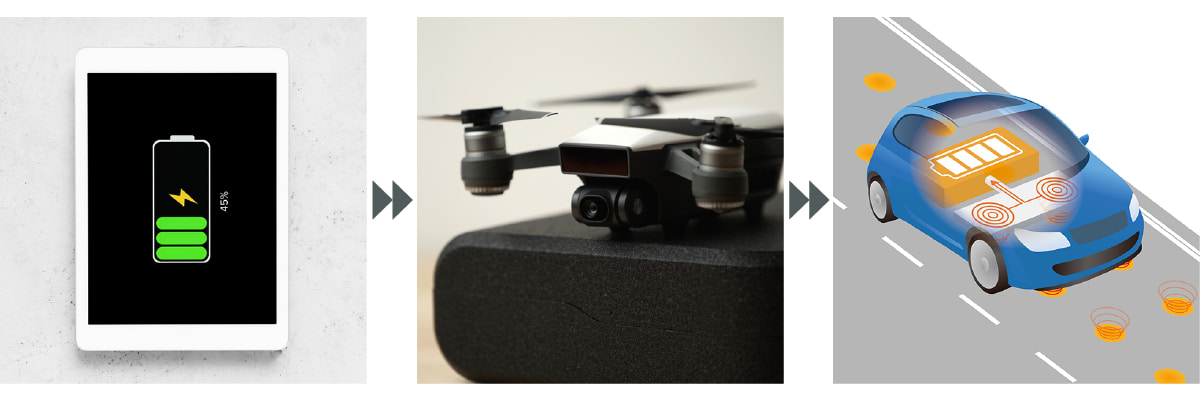
Moreover, wireless power supply technologies that ensure a high level of safety regardless of the magnitude of power to be transmitted are also being planned to supply power to electric vehicles (EVs) with human passengers and implanted devices in the medical instrument field, etc.
In the next section, we will introduce potential applications for wireless power supply in the mobile field, where research and development and demonstrations, etc., are already underway and the technology is likely to be adopted first.
2. Applications for Wireless Power Supply in the Mobile Field
Research and development as well as demonstrations of wireless power supply are currently underway in the mobile field with the aim of making it more prevalent. While there are various methods for implementing wireless power supply, here we will mainly focus on several ideas for using wireless power supply systems (cavity resonance-enabled WPT) that can supply power to an object just by placing it in a space that shields it from electromagnetic waves (inside of a container, locker, or cargo bay, etc.) as a way to safely put wireless power supply into practice.
2.1 Preventing Over-discharge in Products Equipped with Lithium-ion Batteries (LiB) After Shipping
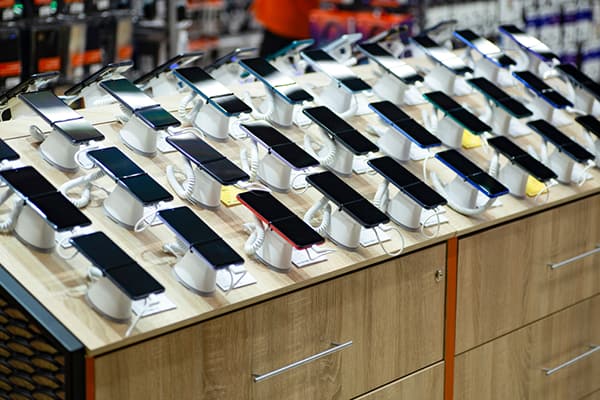
These days, many products, such as laptops, tablets, smartphones, wearable devices, and completely wireless earphones (TWS), etc., contain lithium-ion batteries.
However, the lithium-ion batteries can discharge while the products are packaged and shipped, displayed in stores, or warehoused, which can lead to the over-discharge of some products if left for a long time.
Therefore, if wireless power is supplied to all of the packaged products at one time, they can be charged in cargo bays, on the store display shelves, in store storage rooms, and while being stored in warehouses to prevent the over-discharge of lithium-ion batteries.
2.2 Wireless Power Supply to Wearable Devices for Business Use

Wearable devices are becoming more prevalent as one type of IoT device at manufacturing and construction sites. For example, they are being used to monitor the health of workers to prevent accidents, and to perform checks with AR glasses during equipment inspections. In addition to IoT devices, power also needs to be supplied to clothing equipped with fans and heaters to reduce the physical burden of working in harsh climates.
If these devices could be charged during work breaks or after work simply by casually placing them inside of a wireless power supply box without any particular alignment, it would reliably charge the batteries of devices involved in the safety of workers and equipment and enable them to be used without stress or worry.
2.3 Wireless Power Supply to Equipment for Entertainment and Amusement Facilities and Music, Sporting, and Other Events
Wearable Devices, etc., at Facilities and Event Venues

For example, many staff members at theme and amusement parks, as well as large concerts and sporting events, use wireless communication devices such as microphone headsets and transceivers. By placing such devices into a box and supplying power to them wirelessly, multiple devices can be charged at the same time, eliminating the need to connect power cables to each one at busy sites.
Using VR Headsets at Amusement Facility Attractions

As entertainment has become more high-tech in recent years, amusement facilities are increasing the number of attractions that feature VR headsets and other devices worn by visitors. Wirelessly supplying power to multiple devices at the same time in a fast and reliable manner while customers are entering and leaving makes it possible to provide such forms of entertainment without the risk of running out of power.
IoT-enabled Equipment and Supplies in the Field of Sports

IoT is also making strides in the field of sports, with sensors being installed in balls and other equipment to provide faster and more accurate judging.
Many ball games use a large number of balls interchangeably, so if wireless power could be supplied to multiple balls with built-in sensors at the same time by simply placing them in a storage area, it would eliminate the need to worry about problems caused by flat batteries. Wireless power supply enables the smooth and reliable preparation of important equipment for judging sports competitions, and improves operational efficiency.
2.4 Wireless Power Supply to IoT Devices in Manufacturing and Logistics
Wireless Power Supply to IIoT Devices in Smart Factories

Wireless power supply is highly compatible with manufacturing sites where many IIoT (Industrial Internet of Things) devices have been implemented in the shift to smart factories.
With sensors now being used for a myriad of tasks, such as determining whether parts and products are in stock, judging whether they are acceptable or defective, positioning, taking dimensional measurements after machining, and performing preventive maintenance by acquiring data about equipment and machinery, the number of sensors that transmit data wirelessly or are battery-powered is increasing.
In many cases, automatic machining processes for small parts or products are often covered with a clear case, and clean rooms are frequently used in the manufacturing process of electronic components. Providing wireless power to IoT devices in restricted spaces such as these makes it possible to supply power without wiring.
Supplying Wireless Power to Wireless Code Readers Used in Warehouses

At manufacturing sites and logistics warehouses, barcode and 2D code readers are widely used for inventory control, warehouse management, and implementing traceability. Even if inline automatic scanning is introduced, human intervention is inevitable when dealing with sudden changes and scanning errors, etc. As manual code readers that are battery-powered and can send and receive data wirelessly become more common, simply placing them in a shelf-like box to wirelessly supply power to multiple devices at the same time enables efficient and reliable operation.
In addition, installing a wireless power supply system in a truck bed or cargo container, etc., enables multiple products equipped with lithium-ion batteries to be charged simultaneously by simply storing them in their packaged state during shipping.
3. Murata Manufacturing is Researching and Developing Wireless Power Supply Technologies
One of the wireless power supply technologies that Murata Manufacturing is researching and developing is a method called "cavity resonance-enabled WPT (wireless power transfer)."
Possible application scenarios for cavity resonance-enabled WPT include wireless power supply for the mobile field, as mentioned in "2. Applications for Wireless Power Supply in the Mobile Field."
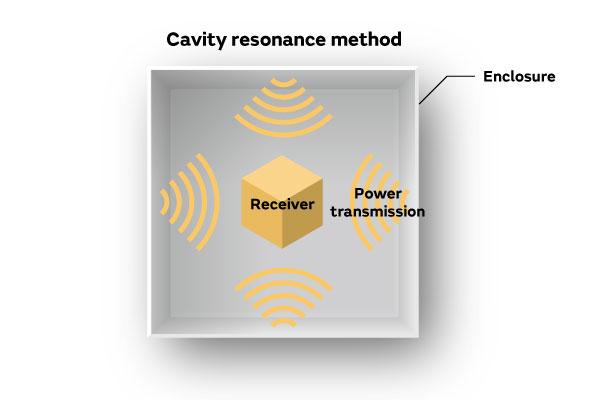
In a wireless power supply system using the cavity resonance method, power can be supplied by simply placing an object with a small, connected power receiver inside an enclosure that can shield it from electromagnetic waves (the size, shape, and material of the enclosure, as well as the form of the power receiving device, are developed according to the object being powered).
This eliminates the problem of power not being supplied due to improper alignment, which occurs with conventional wireless chargers, and enables multiple devices to be powered and charged at the same time as long as they are placed inside the box. In addition, this approach has the added benefit of preventing the leakage of electromagnetic waves.
Murata Manufacturing is looking for collaboration partners who can work with us to come up with potential applications for the cavity resonance method. For more details, please see the related link.
Related articles
- The Need for Reuse, Repurposing, and Recycling of Lithium-ion Batteries (LiB) and for Battery Characterization and Degradation Diagnosis
- Providing Components and Solutions for the Automobile Society of the Future: Murata Manufacturing at the Automotive Engineering Exposition 2025
- Part 5: How do lithium-ion batteries contribute to the realization of a sustainable society? A look at the benefits of replacing lead-acid batteries, recycling methods, and the possibilities for the future