
LF Antennas (Antenna Coils)

In recent years, transportation robots are increasingly being introduced in logistics warehouses and manufacturing sites. There is therefore a growing need for automation in which the robot itself determines the optimal path and then transports its cargo. Autonomous mobile robots (AMRs) have become increasingly widespread in response to such demand. In this article, we summarize the differences between conventional transportation robots and AMRs. We also explain the effectiveness of sensing using LF communication to address issues facing AMRs, such as sensor malfunctions and missed detections caused by blind spots.
AMRs are highly autonomous automatic transportation robots. They are garnering particular attention at logistics warehouses and factories where there is a need to eliminate labor shortages and improve work efficiency. The main features of AMRs are as follows.
Transportation robots have conventionally been called automatic transportation robots, unmanned transportation vehicles, or automatic guided vehicles (AGVs). The traveling route, speed, and stopping positions of AGVs were guided by guidance media (magnetic tape, optical reflective tape, electromagnetic inductance cables, etc.). On the other hand, as mentioned above, AMRs autonomously plan and modify their paths, and move and stop accordingly. We have classified the traveling methods of transportation robots into three types: path guide (AGVs), self-navigation (AMRs), and target guided (example: following a person or cart)*1. We have summarized the differences between these methods in Table 1. AMRs do not require guidance media. This is therefore expected to reduce the operational burden related to the paths they take.
*1 There is a view which considers AGVs that are capable of self-navigating to be AMRs. However, we distinguish here between AGVs and AMRs based on the contrast between the path guide and self-navigation methods.


Comparison | Path Guide | Self-navigation | Target Guided |
|---|---|---|---|
Traveling | Travels according to | Self-navigates while determining | Detects the target it will |
Onboard | Requires guidance media. | Does not require guidance media. | Guidance media is not required. |
Onboard | Guidance media detection | LiDAR sensors, cameras, | Cameras, proximity sensors, |
Operation | Dependent on guidance | It is possible to flexibly modify | Dependent on the targets to |
Applications | Routine transportation, | Flexible transportation in | Picking*2 support, convoy |
*2 Picking: This refers to the task to retrieve and collect products from shelves based on shipping instructions in logistics warehouses and elsewhere
Self-navigating AMRs that safely travel by determining their own traveling routes and avoiding obstacles while detecting people have many advantages. However, interference with traveling still occurs even if using LiDAR sensors, cameras, other optical sensors, and SLAM. Furthermore, there have been many cases in which these problems materialize only after AMRs are introduced. Below, we discuss the main issues facing AMRs.
The LiDAR sensors and cameras installed on AMRs are capable of highly accurate sensing. However, they sometimes malfunction.
LiDAR can be subject to false reflections from highly reflective glass and shiny metal. It also has difficulty detecting objects with low reflectance. Moreover, smoke, water vapor, and similar can cause false detections. When multiple LiDAR sensors are present in the same space, mutual interference between laser signals can also lead to oversights and false detections.
On the other hand, although cameras are capable of recognition based on image information, they are extremely dependent on the lighting environment. If the light receiving unit becomes saturated (overexposed) due to strong direct light or light sources such as welding, image information may be lost and this may temporarily make detection impossible. Conversely, in dark places, insufficient light reception increases noise, which lowers the recognition accuracy. In addition, reflections from glass and metal surfaces, as well as things like smoke and water vapor, can cause misrecognition.
LiDAR sensors, which use lasers, and cameras can only detect objects within a clear line of sight. Therefore, they may not be able to detect objects and people hidden from view. Accordingly, these sensors alone cannot detect all obstacles in areas with many blind spots such as those with sharp corners and narrow aisles. That means the robots may collide with cargo and equipment. Furthermore, it might not be possible to detect people in blind spots in areas where people frequently come and go, which could lead to collisions.
Ensuring accuracy and reliability is an issue in AMR stop positioning and boundary management. Measurement errors from LiDAR sensors, cameras, and various other sensors, as well as estimation errors in SLAM and calibration discrepancies between sensors may lead to deviations in the stopping position. Sloping and uneven floors also reduce detection accuracy. As a result, AMRs face issues performing operations that require accuracy at the level of a few centimeters, such as WPT,*3 and in determining the boundaries of restricted zones.
*3 WPT: This is the abbreviation for wireless power transfer. WPT is also known as wireless power supply, and wireless power transmission. It is a system that supplies power to electronic devices without connecting cables.
AMRs use SLAM, which allows them to simultaneously estimate their own position and generate maps of their environment, in order to grasp their surroundings and then autonomously determine their traveling route. They receive transportation instructions from a management system while traveling and then move. Therefore, wireless communication with the management system plays an important role.
However, various equipment in manufacturing and other processes can generate electromagnetic noise and wireless signals. Such interference and communication errors can cause unstable communication between the AMR and the management system. This can result in the occurrence of problems such as operational shutdowns and loss of control of the main body.
LF is the abbreviation for low frequency. It refers to the frequency band between 30 kHz and 300 kHz. LF communication is a wireless technology that uses this frequency band (LF band). Specifically, LF communication uses frequencies below 135 kHz in the LF band. Sensing is then achieved by communicating with a magnetic field between the transmitting LF antenna and the receiving LF antenna or a radio frequency identification (RFID) tag.
Sensing using this LF communication (hereinafter referred to as "LF sensing") has the following features.
LF communication may be a promising option to solve the issues faced by AMRs that we outlined in section 2: sensor malfunctions, collisions with obstacles and people, and stop positioning and boundary management. Below, we describe how LF communication helps to solve each of these issues.
We have shown that the LiDAR sensors and cameras of AMRs sometimes malfunction due to environmental factors (reflections from glass and metal, smoke and water vapor, strong light or dark places, etc.) (refer to section 2). Nevertheless, as we explained in section 3, LF sensing uses magnetic fields. Therefore, it is not affected by strong light or dark places. It can also detect objects with low reflectance. Even in settings where LiDAR sensors and cameras struggle, including environments with smoke and water vapor, LF sensing has the potential to effectively complement the unhindered travel of AMRs.
We have shown that AMRs face a risk of collision (refer to section 2). However, LF sensing uses magnetic fields, which can easily reach even behind obstacles. This means that even obstacles and people in blind spots created by equipment, walls, and other objects can be detected by LF sensing despite being difficult to detect with LiDAR sensors and cameras.
Position deviations caused by LiDAR sensor and camera measurement errors, SLAM estimation errors, sensor calibration offset, floor inclines, and other issues make it difficult to ensure accuracy at the level of a few centimeters for stopping positions and to determine restricted zone boundaries (refer to section 2).
Plugging in and unplugging cables for charging is not required with WPT. However, it is still necessary to guide AMRs to locations where they can be supplied power. The position and distance measurement accuracy of LF sensing is high at just a few centimeters. It is therefore expected to enable highly precise guidance to AMR power supply locations and accurate determination of restricted zone boundaries.
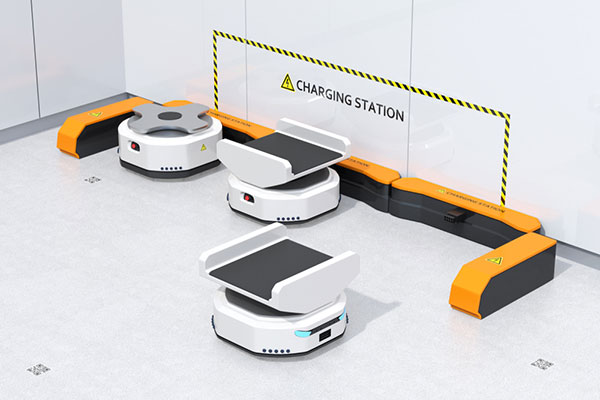

AMRs are transportation robots equipped with advanced sensor technologies. Safe traveling and operation are important points when considering the usefulness of AMRs in the field. Moreover, it is essential to consider user perspectives, such as operability, safety, and maintainability. Accordingly, it is important to incorporate the opinions of those in the field and to confirm them through trials and other methods when introducing AMRs into the field. Given this background, it is expected that LF sensing will contribute to solving the issues directly facing AMRs in the field.