Capacitor

Radar ghost noise problem occurs when switching noise of a PMIC is superimposed on IF signal. Therefore, PMIC output lines need filters to remove switching noise.
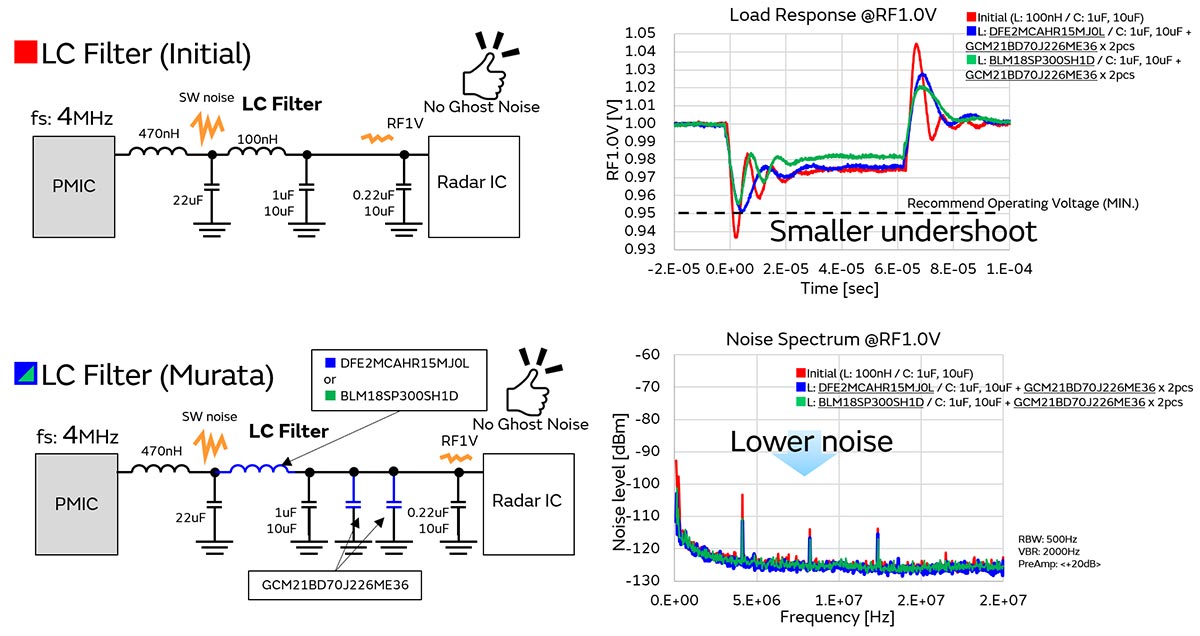
LC filters provide high noise rejection, but due to Rdc of a inductor and LC resonance, load response voltage may become large. And that could exceed an operating voltage limit of a radar IC.
Therefore, Murata proposes the following two filters with less load voltage variation.
Switching noise of a PMIC is superimposed on IF signal, causing the object to be misdetected in positions where it should not exist.
This means ghost noise. A filter is required on the PMIC output line to eliminate switching noise.
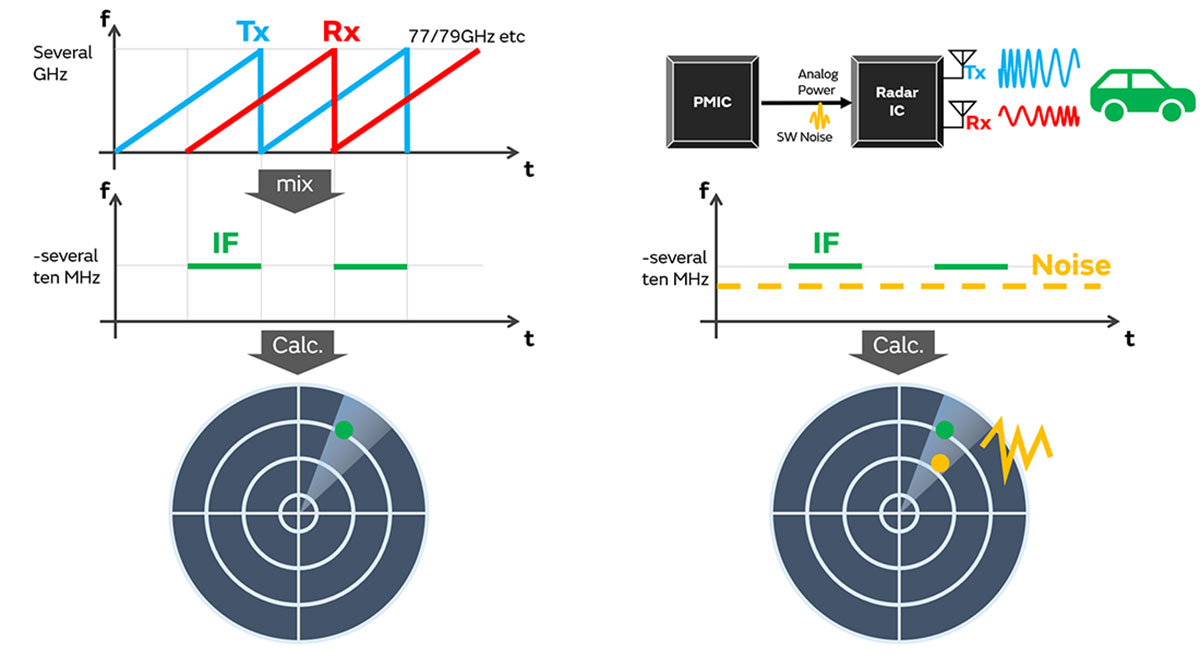
We performed ghost noise generation experiments using a 79GHz radar substrate. Without a filter on a PMIC output line, switching frequency (fs) and positions calculated from its harmonic frequency will produce ghost noise.
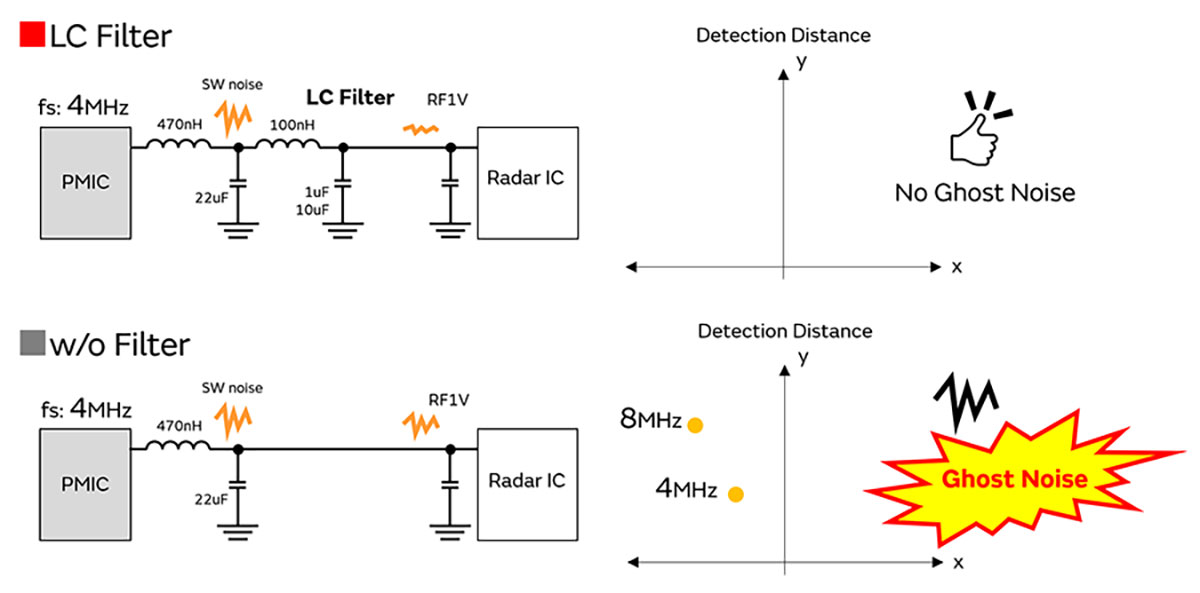
LC filters are effective in suppressing ghost noise, but on the other hand, they have the disadvantage of increasing voltage load fluctuation of radar ICs. If you choose an inductor with large inductance to improve the filter characteristics, the voltage fluctuation may become even larger and the undershoot may exceed the lower limit of the recommended operating voltage of the IC.

By taking advantage of low ESL characteristic of 3-terminal capacitors, it is expected to reduce switching noise by more than 10dB. And because Rdc is small and LC resonance does not occur, there is almost no voltage drop.
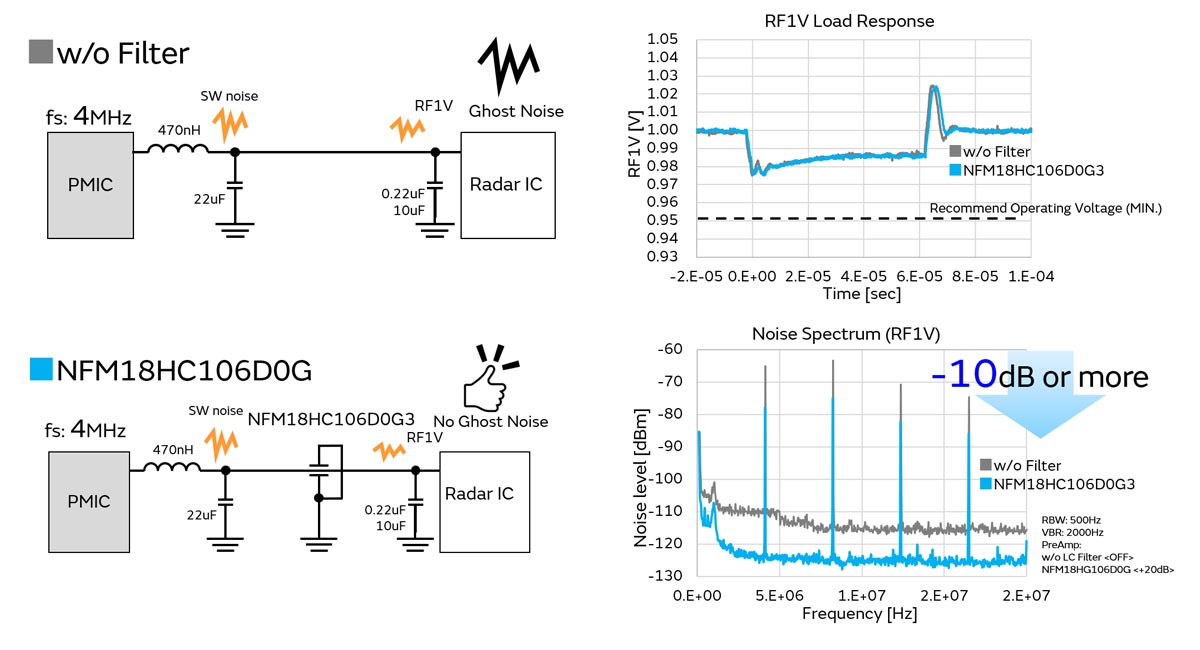
By devising a combination of inductors and capacitors, voltage fluctuations can be reduced even with an LC filter.