
Digital Twin Utilization Scenarios That Will Change the Way Industries Work
The digital twin technique of producing new value by linking a real space (physical space) and a digital space (cyberspace) is attracting attention. This is a technology to capture data from a real space and then reproduce it in high precision in a digital space. It makes it possible to predict and simulate what will occur in the real space. We explain here how digital twins are being applied and what kind of effects they produce.
Digital Twins: Expected to Be Utilized in Various Fields
A well-known example of the introduction of a digital twin is the adoption of this technology in the factory of a Japanese air conditioner manufacturer. This company introduced a production management system equipped with a digital twin function into its factory to realize a non-stop factory on the manufacturing line. The system captures information with sensors and cameras from the manufacturing equipment and then reproduces the manufacturing process in a digital virtual space. This reduces process stagnation and other waste. The result is cost effectiveness.
The application of digital twins is not limited to the manufacturing industry; progress is also being made on the digital twinning of cities and buildings. It will become possible to automate deliveries, navigate with augmented reality (AR), and perform other actions by constructing digital twins from data on buildings and other structures and data on people recognized from images, robots, and other objects. It is also believed that digital twins will be applied to people flow analysis, disaster response, and other applications. There are hopes the technology will be expanded to cover entire cities.
Efforts are underway to digitally twin marine ecosystems, for example, in even larger fields. The idea is to digitize the underwater conditions with cameras and sensors to lead to the promotion of carbon absorption by underwater algae and other organisms and the conservation of biodiversity.
In this way, digital twins have a wide range of applications. It is expected that digital twins will provide new value from homes to business sites, cities, and natural environments.

Visualizing the Real World in the Cyberworld for Analysis and Prediction
Let's review digital twins here. Digital twins are a technology that reproduce the conditions of real spaces at high precision in digital spaces. This enables real spaces to be expressed in digital spaces based on data captured from various sensors, cameras, and other devices. The term of "twin" in digital twin refers to the twinning of a real space and a digital space.
If data is captured appropriately, the twin in the digital space should behave in the same way as the twin it is paired to in the real space. Accordingly, the idea is to use the twin in the digital space to perform various analyses, predictions, and other operations. This enables analysis and predictions about the real space. Through this, it becomes possible to respond to troubles difficult to verify in real spaces, to predict the future beyond time, to experience the real space from a remote location, and to perform other operations by utilizing the digital space.
Collecting information in real time from real spaces, digital twins can comprehensively grasp the conditions of real spaces in real time in digital spaces. It is also possible to grasp the real-time conditions from equipment sensors and other devices. However, that only tells you the status of a single piece of equipment. The construction of a digital twin is helpful to accurately grasp the conditions across entire systems, plants, and other facilities in real time to be able to respond and otherwise deal with troubles even more appropriately.
Furthermore, it is possible to use advanced analytical functions utilizing artificial intelligence (AI) and other technologies in the digital space. Analyzing events occurring in a real space and then predicting what kind of situations will arise in the future means it is possible to make appropriate repair plans in advance. In this way, it becomes possible to respond beyond time.
Digital twins reproduce real spaces in digital spaces. Therefore, it is also possible to eliminate location constraints that are unavoidable in real spaces. Take cases in which tasks, education and training, and other processes require the know-how of experienced engineers. It is possible in those cases for experienced engineers located away from the site to utilize digital twins to provide remote guidance. It is possible to reproduce on-site conditions in a digital space by using augmented reality (AR) and other user interfaces. It is then possible to provide appropriate guidance to on-site employees and others from a remote location.
Digital Twins Are Being Introduced into the Manufacturing Industry
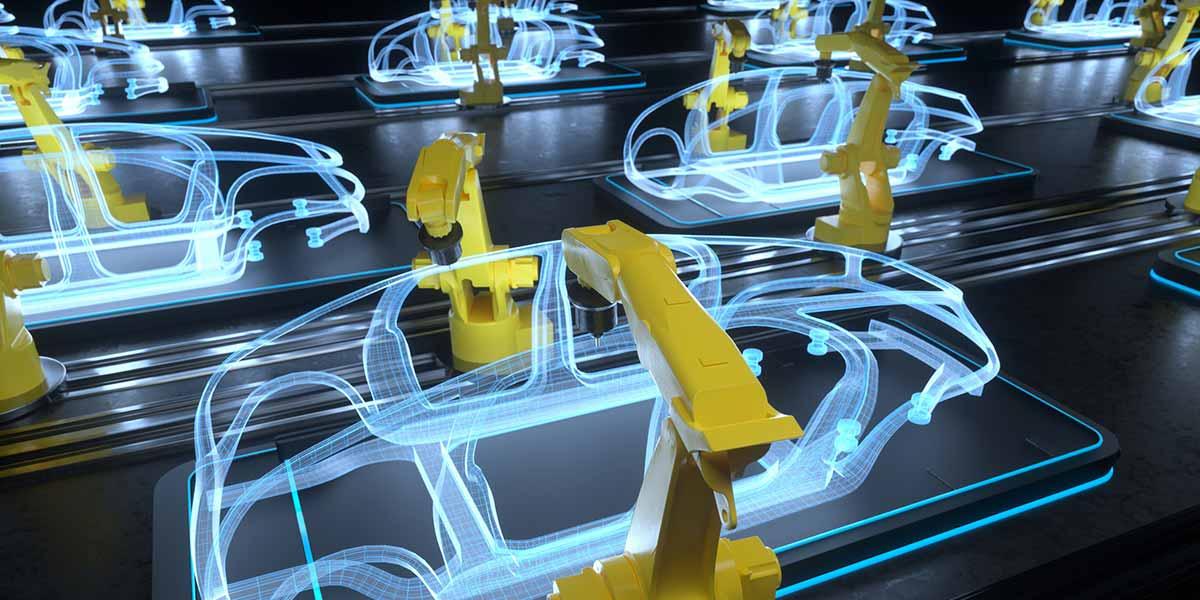
Digital twins are expected to be widely utilized. The utilization of digital twins is already particularly advanced in the industrial field. Various types of detailed data are required to digitally twin vast real spaces like cities or the natural environment in high precision. On the other hand, when the purpose of the digital twin is specified to a factory or other closed space, it is easier to construct it than a city or natural environment. Capturing data in real time with various sensors from factory manufacturing equipment and analyzing video information from cameras and then visualizing manufacturing site conditions, the movement of robots and other situations allows effects directly linked to business to be obtained. Losses from line stoppages are significant for the manufacturing industry. Accordingly reducing downtime can be expected to have direct cost-effectiveness.
Going one step further than grasping the current situation, digital twinning can also lead to the optimization and increase in efficiency of manufacturing processes. It is not easy to modify an actual manufacturing line and to then demonstrate process optimization. However, freely simulating line changes and more can be done with a digitally twinned manufacturing line. It is possible to simulate many manufacturing processes and to construct optimized processes without touching the manufacturing line in the real space. This makes it easier to take measures that lead to improved production efficiency and cost reductions.

Repeated Testing and Development in Digital Spaces to Transform Sites
The advantage of digital twinning is that it allows you to test in a digital space what you cannot realize in a real space. For example, to verify safety when automobiles crash, a method is adopted in which actual vehicles are crashed. However, if a high-precision digital twin of the vehicle is built, it becomes possible to verify its safety with a simulation in a digital space without actually crashing it. Tests that lead to damaged equipment, verification of interference between humans and equipment, and other tests difficult to conduct in real spaces can be performed repeatedly in a digital space to derive appropriate answers.
Digital twins are also effective in design and development sites. For instance, when developing a product in the past, a mockup and prototype would be made and then their performance would be checked while feeding back the results into the design. If we become able to do these things on a digital twin, it will become possible to make multiple prototypes in a digital space. Their performance can then be compared with only the highest-performing ones being turned into actual prototypes. At the same time, if a manufacturing line for a new product can be optimized in a digital space, it will produce efficient processes from design and development to manufacturing.
Thus, digital twins have many possibilities. On the other hand, we must carefully examine how we obtain data, how we set the data types and accuracy, and how we perform analysis in digital spaces. Simply digitizing existing data may not always produce a digital twin that meets the required performance. We must also pay attention to factors such as the cost of implementation and security to ensure the safe use of data as well. It is believed that overcoming these hurdles will lead to the impetus to bring new value to the industrial world. Accordingly, steady progress is being made on the practical application of digital twins.
Related articles
- Digital Twins: Creating Virtual Replicas of Real Spaces to Drive Innovation
- Communications network management applying AI (Artificial Intelligence)/ML (Machine Learning): Technological Trends Leading to Beyond 5G/6G
- Contributing to the Realization of Society 5.0 with “Proximity and Force Sensor” and “Invisible ID Tags”