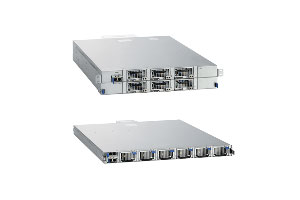
Centralized Power system (OCP Compliant)
In today's digital society, the various devices and systems used by individuals, companies, governments, etc. are connected to the cloud to enable the sharing and effective utilization of data across society as a whole. Behind the scenes of our prosperous and sustainable lifestyles and businesses, data centers exist as a form of large-scale, high-performance information processing infrastructure that is not visible in our daily lives. Data centers have now become an important form of social infrastructure for supporting society on a par with electricity and communications. In addition, they are also the most prominently advancing type of social infrastructure, and it has become impossible to discuss the development of AI and DX (digital transformation), for which demand is growing, without mentioning data centers. This article explains the role of data centers as well as the servers and other equipment and component technologies that they use.
We utilize video streaming services, cloud storage, and a wide range of other services provided over the Internet on a daily basis. These services have become so pervasive that it is difficult to imagine our daily lives without them. Furthermore, the use of cloud services has become essential in business and social activities as well. Cloud computing has taken hold in our work in a wide range of applications including the ERP (Enterprise Resource Planning) and CRM (Customer Relationship Management) systems used in daily core operations, big data analysis in decision-making and development, and in recent years, IoT (Internet of Things) systems for managing factories and plants.
The cloud accumulates vast amounts of data on a global scale and provides the various services that we use by running a wide variety of information processing, such as advanced AI processing, at high speed. It is data centers that are responsible for sharing and processing such data.

Historically speaking, data centers were born, as their name would indicate, as places for storing and sharing data used across departments within companies. With the growth of the Internet, data centers are now evolving into a form of infrastructure for supporting a digital society to effectively and efficiently realize the accumulation and advanced processing of data shared across society.
This article explains the significance of data centers, which have become an essential form of social infrastructure in today's increasingly digital society. Furthermore, it also addresses the issues that must be solved for the further evolution of data centers.
It may seem as if the convenient apps and services that we use on smartphones, PCs, and other information devices are enabled by the functions and performance of the devices themselves. Of course, there are also devices that can be used on their own. However, connecting to a data center and linking individual information devices makes it possible to use higher-value services that cannot be achieved with standalone devices.
For example, it can be said that conversing in real time with overseas business partners through automatic AI translation, selecting and listening to popular music from a massive list of songs according to one's mood, and using generative AI to automatically generate a desired illustration is only made possible by sharing the massive data storage capacity and information-sharing capabilities of data centers across society.

The reason such high value-added services can be provided is that the massive data storage and information processing capabilities of data centers are available to use regardless of the device functionality and performance if the communication environment in place. Furthermore, other benefits of using data centers include the ability to use the latest functions without buying a new device, flexibly extend functions and performance as needed, and easily apply advanced security measures, etc. that require specialized IT expertise.
In addition, it is not possible to talk about DX (digital transformation), which is one trend in contemporary society, without data centers. DX is an initiative to improve the state of society using digital technologies. There are a diverse range of people with different backgrounds around the world. Until now, there were disparities in available information and the social services that one could enjoy depending on the region in which they lived. Moreover, there may be those who can only afford inexpensive devices or who are not very skilled at handling machinery.
With DX, it is important to be able to provide convenience to such diverse groups of people without leaving anyone behind. Providing services that use data centers has the effect of correcting such disparities by sharing information and processing functions across society. Data centers have produced many results such as providing online administrative services that can be used by busy people in their spare time and cloud-based educational services that open up future paths for young people in developing countries.
In particular, the demand for data centers is dramatically increasing against a backdrop of expanding AI application and the rapid advancement of the technologies being used.
Generative AI, large language models (LLM), and other technologies are becoming more sophisticated, and demand is also increasing for servers equipped with high-performance GPUs (Graphics Processing Units) suited to AI-related processing.
In addition, trends aimed at effectively updating functions and performing maintenance by modeling the functions of automobiles and many other devices, plant equipment, social infrastructure, etc. and managing them with digital twins placed in data centers are also accelerating. To address such needs, there is a growing movement to build out larger-scale data centers in great numbers.
At the same time, new issues are also emerging as data centers become more sophisticated, larger in scale, and plentiful.
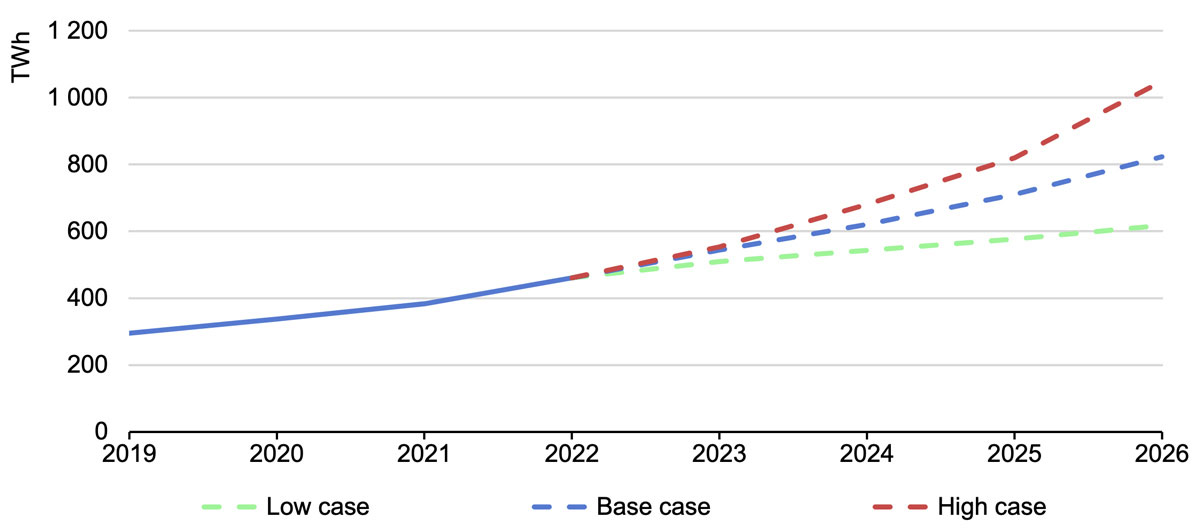
First, the amount of power consumed by data centers is steadily increasing. According to the International Energy Agency (IEA), the total energy consumption by worldwide data centers was about 460 terawatt-hours (TWh) as of 2022. In the most extreme case, it may more than double, reaching 1,000 TWh in 2026 (Figure 1). Constructing enough power plants to meet this sudden increase in power consumption is challenging. Therefore, the power efficiency of servers and air-conditioning equipment in data centers must be improved.
In addition, due to the enormous amount of power consumed by servers, cables, etc. and released as heat in data centers, new heat dissipation technologies must be introduced. Generally speaking, the semiconductor chips that act as the "brains" when executing arithmetic processing inside the server, etc. cannot operate properly unless the operating environment is maintained within a certain temperature range. In some cases, they may fail due to the heat that they generate. For this reason, various heat dissipation measures, such as liquid cooling systems, have been developed and introduced to replace conventional air cooling systems.
Data centers are likely to play an even greater role in society going forward. Active technology development is underway in both hardware and software to achieve more advanced and high-performance data storage and information processing capabilities as well as solve newly emerging issues.
Perhaps it can be said that the realization of a prosperous and sustainable society depends on the further development of such technologies for data centers.