

Equipment maintenance DX by sensor data × data analysis
Part 1: Overview and Key Points of Predictive Maintenance by Sensor Data × Data Analysis
In order to improve profitability in general factories in the manufacturing industry, equipment maintenance that prevents breakdowns and troubles and supports rapid recovery is becoming extremely important. Urgent themes in equipment maintenance initiatives include sophistication of equipment maintenance due to the increasing sophistication and scale of factory equipment, and labor-saving in conjunction with the decrease in the working-age population.
Predictive Maintenance (PdM) based on the premise of utilizing IoT/sensing technology and sensor data is attracting a great deal of attention as a means of addressing these themes. Due in part to the recent boom in DX promotion by the public and private sectors, DX of equipment maintenance continues to advance, and PdM, which is at the center of this, is attracting more attention day by day.
Therefore, we have decided to provide a series of articles titled "Equipment Maintenance DX by Sensor Data × Data Analysis" for people who want to know and understand the basics of PdM mainly from the perspective of sensor analysis. We hope that this series will be useful to such people.
In this first article of the series, we will provide an overview of PdM based on data analysis of sensor data, and explain the key points to be aware of before implementing PdM.
INDEX
1. Definition and Position of PdM
2. Sensor and Data Analysis Technologies Used in PdM
3. What Should Be Done Before Implementing PdM - Key Points of PdM
1. Definition and Position of PdM
Various maintenance methods have been proposed according to the practice criteria, and are generally classified as shown in Fig. 1. Of the maintenance methods classified as instrumentation and equipment maintenance, PdM is one that constitutes preventative maintenance, and is sometimes referred to as Condition-Based Maintenance (CBM). Please see the following article for an overview of each maintenance format and its advantages and disadvantages.
Related articles: Ideal State of Equipment Maintenance: Technology That Realizes Predictive Maintenance

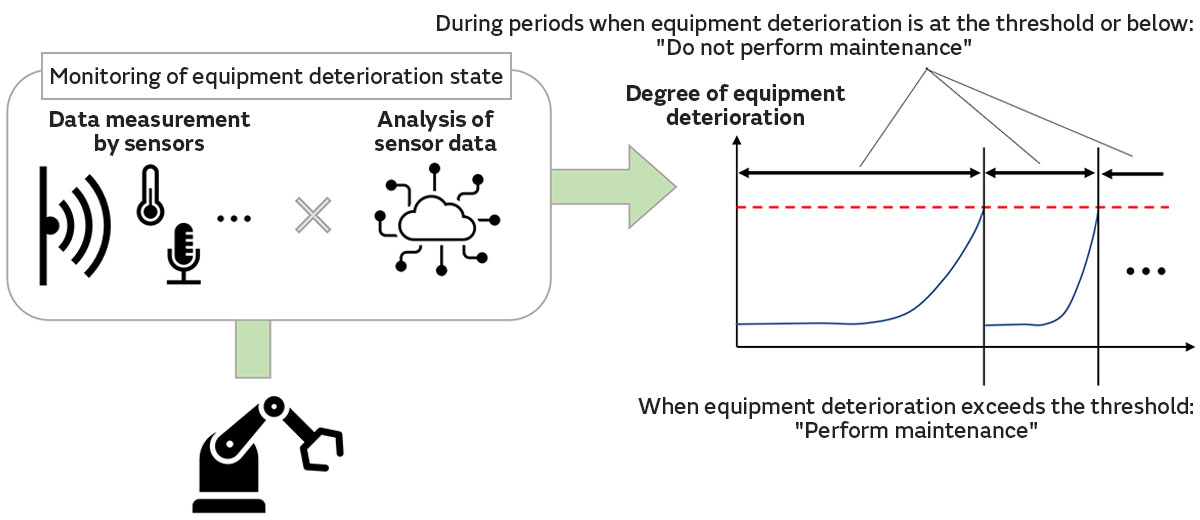
PdM is defined as "a form of maintenance that is carried out in response to the deterioration state detected by changes in parameters obtained from sensors, etc." (UK Standard) PdM decides whether to perform maintenance based on evidence, so it can be considered a maintenance method based on rational criteria as compared to other maintenance methods (Fig. 2). For this reason, the cornerstones of PdM are various sensors that can grasp the status of equipment, and diagnostic technology (data analysis) that enables deciding whether to perform maintenance based on that data.
2. Sensor and Data Analysis Technologies Used in PdM
PdM makes use of a wide range of sensors, but sensors specialized in detection of characteristic phenomena that occur in equipment operation are generally used. Typical examples are thermal and vibration sensors that detect heat and vibration generated in operation. As mentioned in Chapter 3 below, in addition to the selection and installation positions of sensors according to the maintenance target, the sensor price itself is also a key point.
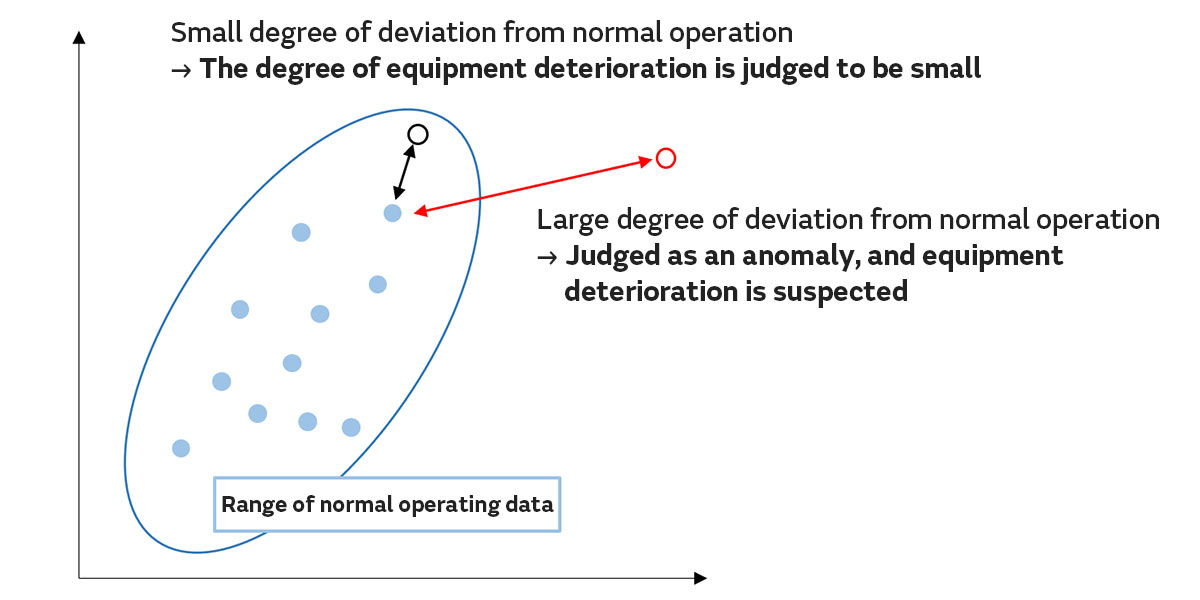
Like with sensors, PdM also makes use of many data analysis technologies. A typical example is anomaly detection technology. Anomaly detection enables determination of whether a particular data is anomalous or not by quantifying how far it deviates from normal data, that is, the degree of that deviation. On the other hand, in the case of equipment deterioration, the degree of deviation from the normal operating condition can be used as one criterion. Thus, there can be said to be a strong relationship between equipment deterioration and the objective of PdM (Fig. 3).
Note that the degree of deviation may be calculated using raw sensor data, pre-processed data such as noise removal, or features obtained by extracting distinctive characteristics (e.g., periodicity) found in the data as separate data.
Classifications, characteristics, specific methods, and other details of data analysis technologies such as anomaly detection used in PdM will be explained in turn in the second and subsequent articles of this series.
3. What Should Be Done Before Implementing PdM - Key Points of PdM
Sensor and data analysis technologies that support PdM are evolving on a daily basis, and diverse solution services are being proposed by various companies. However, PdM of equipment cannot be realized simply by introducing these services as is. Table 1 below summarizes typical key points to keep in mind when implementing PdM. Please refer to this when considering implementation of PdM.
Key points to keep in mind | Details |
|---|---|
Selection of the optimal maintenance method | ・PdM may not be optimal for all maintenance targets. |
Selection of the optimal sensors | ・It is necessary to select and install the optimal sensors for the |
Implementation and operational costs | ・One disadvantage of PdM is a high initial implementation cost. |
Establishment of PdM personnel | ・Compared to conventional maintenance methods, it is even more |
Selection of appropriate data analysis methods | ・The appropriate technologies and methods depend on the |
The optimal PdM will vary on a case-by-case basis depending on the nature of the equipment to be maintained as well as budget and resource circumstances. Therefore, rather than implementing PdM and related services in a top-down manner, it is considered necessary to thoroughly discuss the feasibility with concerned parties beforehand, and to find PdM that will be a good fit for your company.
4. Conclusion
PdM is an equipment maintenance method that is attracting attention amidst social demand for greater sophistication and labor-saving in the maintenance of production equipment in factories. PdM is a rational maintenance method that clarifies equipment deterioration states from sensors and measured data, and decides whether to perform maintenance based on those results and evidence.
The two core technologies of PdM are IoT/sensing technology and data analysis technology. These are developing on a daily basis, and can be said to hold the potential to achieve further sophistication and labor-saving in equipment maintenance.
On the other hand, there are many key points to consider before implementing PdM. If these key points are ignored and PdM is implemented in a top-down manner, there is a risk that it may lower the cost performance of maintenance.
The situation surrounding equipment maintenance varies from company to company, including factory equipment, production systems, supply chains, budget, and personnel. It may be important to reconsider what kind of maintenance is optimal for your company, such as which maintenance method is suitable for each equipment, and what kinds of systems are needed to realize more sophisticated and labor-saving maintenance through PdM.