
Digital Twins: Creating Virtual Replicas of Real Spaces to Drive Innovation
A "digital twin" refers to a technique to reproduce a virtual reality in a digital space (cyberspace) using information from a real space (physical space). Creating twins of real spaces in digital spaces is expected to produce value. We explain the basic concept of digital twins, their components, and examples of their application.
Digital Twins Are Also Being Built by the National and Prefectural Governments
It has become more common to see the term "digital twin" in IT-related news and elsewhere. The Digital Agency is working with the Ministry of Economy, Trade and Industry, the Ministry of Land, Infrastructure, Transport and Tourism, and other organizations to realize the construction of digital twins. The agency is aiming to construct a digital twin using 3D geospatial information, weather conditions, traffic conditions and other data to reproduce a virtual city in a digital space. The purpose of this digital twin is for the operation of autonomous mobility vehicles including self-driving cars in the future. As one such attempt, Shizuoka Prefecture is working to construct VIRTUAL SHIZUOKA. VIRTUAL SHIZUOKA will reproduce Shizuoka Prefecture at a scale of 1:1 in a virtual space as a collection of dots. The Tokyo Metropolitan Government is also engaged in the Tokyo Digital Twin Project. The government hopes through this project to utilize digital twins in disaster prevention, urban development, mobility, the environment, tourism, and other industries.
Digital twins are also being introduced in the private sector by companies pioneering the utilization of digital technology. These digital twins are being used to realize non-stop factories, to provide remote support to engineers, and to develop technologies in new fields, among other applications.
Constructing a digital twin involves creating a twin of the real world in the digital world. The state of objects in the real world is captured as data using sensors, cameras, and other devices. It is then reproduced in the digital world. If we can reproduce real-world objects at high precision in the digital world, we can confirm that their behavior is the same in the digital world as it is in the real world. For example, let's consider the creation of a digital twin of a factory. If we operate this factory in a digital space continuously for a long period of time, we can identify future troubles and the timing of repairs. We can verify the future situation without causing the equipment in the real world to fail.
Digital Twins and Cyber-Physical Systems
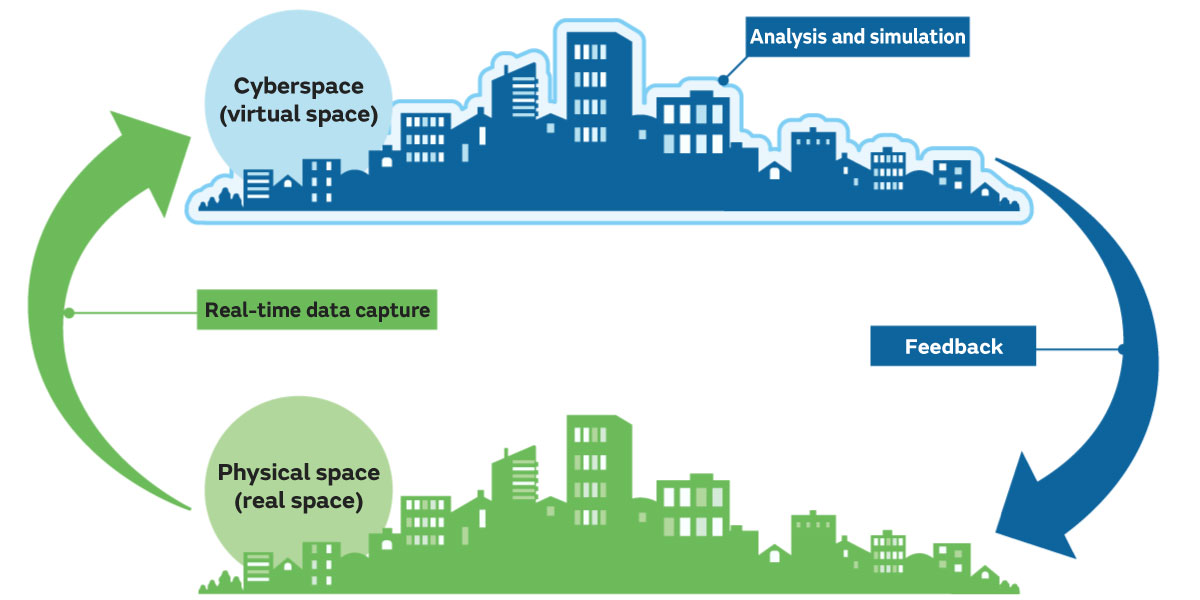
"Cyber-physical system" (CPS) is a term similar to digital twin. Cyber-physical systems also capture real-world data and then analyze it in cyberspace; that is, a digital space. Moreover, cyber-physical systems feed back analysis results to improve conditions in the real world.
We can see that digital twins and cyber-physical systems are similar concepts in the sense that they attempt to produce new value by synchronizing conditions in the real world and a digital space. If we look closely at these concepts, we find that the main purpose of digital twins is to simply utilize the results of reproducing and analyzing the real world in a digital space. The difference with cyber-physical systems is that their purpose is to create a cycle of improvement through feedback to the real world. In other words, it would be best to think of digital twins as one element of cyber-physical systems.
Components of Digital Twins
What kind of system components are needed to realize a digital twin? The following are the four main components.
- Data capture
- Data collection
- Analysis and parsing
- Feedback
It is necessary to capture data in real time to identify the current conditions of the real world in a digital space. Data captured by sensors and other devices must be collected in the digital space for analysis and parsing. On top of that, there is a need for a platform to analyze and parse the collected data at an advanced level. It is necessary to have the latest technology to be able to feed back and utilize those results in the real world.
One thing we would like to consider here is the quality of the data we capture. No matter how great the data collection mechanism and analysis platform we have, if the quality of the data itself is low, it will be difficult to produce value. It is important to understand that it is not enough to simply capture data; the frequency of data capture, the types of data required, the precision when digitizing the data, and other elements are fundamental considerations for producing value with digital twins.
Technologies to Cultivate Digital Twins
Next, let's take a look at the specific technologies necessary to realize digital twins. Digital twins are realized by combining many technologies.
Various sensor technologies are used to capture data. In the case of a digital twin of a factory, log data generated by existing production equipment is important. If reproducing aircraft, automobiles, or similar with a digital twin, engine, motor, and a variety of control data are required. Digital twins of cities and social infrastructure also require temperature, humidity, 3D data of buildings and roads, and real-time pedestrian and automobile location information, among other data. Data such as images and videos from cameras and sounds from microphones as well are used to construct digital twins. They are considered sensors in a broad sense.
Simply capturing this data will not lead to the benefits of digital twins. Wireless communication is useful in many cases to collect information in real time from sensors, measuring instruments and other devices. High-capacity communication is sometimes essential to handle high-definition images. There is also a need for low latency and high reliability. There is high demand as well for low-cost devices that can be operated with batteries for a long time. To satisfy those conditions, there is a need to effectively utilize wireless communication methods that can achieve high performance. Examples of these methods include the latest 5G network and the 6G network that is now starting to become the standard. If it is within a limited area such as a factory, Wi-Fi, local 5G, and other methods should also be considered as options. We can see that the process from capturing to collecting data in digital twins overlaps greatly with the infrastructure to realize the Internet of Things (IoT).
Next, advanced computing power is required to analyze the collected data. Accordingly, high-performance computer-equipped data centers and cloud services are used. The utilization of artificial intelligence (AI) is also an important element when making inferences from unknown data relationships. The extent to which digital twins can reproduce real-world situations in a digital space depends on the power of those analyses and parsing.
Furthermore, a mechanism is needed to feed back knowledge gained in the digital space to the real world. In addition to mechanically feeding back digital twin analysis results to the control of equipment and other devices, augmented reality (AR), virtual reality (VR), and other digital space visualization techniques are used to provide feedback to the real world via humans.
What Can Digital Twins Do?
We can obtain various effects that would not be possible in the real world alone by constructing a digital twin. If we construct a digital twin to monitor factory equipment, we can detect signs of failure by observing the conditions in the digital space. If we then carry out inspections and maintenance in advance, it can lead to preventing troubles and downtime from failures. That produces positive value for businesses.
Similarly, digital twins can be used to simulate real-world systems. Utilizing digital twins to perform simulations for factories and farms allows several patterns of efficient operation to be considered. We can then apply those results to actual operations. Feeding back simulation results using AR or VR also makes it possible to provide virtual education and for experienced workers to remotely give instructions to younger workers on-site.

One more way that digital twins would be useful is their application to development and future prediction. For instance, it is not realistic to verify collision avoidance using actual automobiles and pedestrians when developing self-driving cars. Destructive tests and similar to investigate the durability of production equipment leads to the line stopping if using the actual equipment until it breaks. Conditions that cannot be put into practice in the real world are possible in the digital space of a digital twin. It is possible to use digital twins to improve the software of self-driving cars by repeatedly avoiding collisions and to verify how production equipment will behave in the event of an unimaginable tsunami or earthquake. Constructing digital twins of geographic information may also lead to disaster prediction, the early understanding of damage, the prevention of secondary disasters, and more.
Beyond that, as we looked at in relation to cyber-physical systems, feedback to the real world will likely be involved. There are currently expectations that digital twins will be utilized in real-time decision-making, system control, and other applications.
Related articles
- Digital Twin Utilization Scenarios That Will Change the Way Industries Work
- Communications network management applying AI (Artificial Intelligence)/ML (Machine Learning): Technological Trends Leading to Beyond 5G/6G
- Contributing to the Realization of Society 5.0 with “Proximity and Force Sensor” and “Invisible ID Tags”