

Combining Both Energy Saving and Comfort in Air-Conditioning Equipment: Automatic Control of Air-Conditioning by AI
In recent years, global warming and other environmental challenges have been recognized as pressing global issues. As a result, there is growing interest in energy-saving technologies for high-energy-consuming equipment, such as air conditioning systems in multi-floor buildings and large facilities. Consequently, energy-saving innovations are increasingly being integrated into air conditioning equipment*1. Murata Manufacturing is actively developing various energy-saving solutions, with initiatives for air-conditioning systems serving as a prime example.
The place where energy-saving technologies should be applied to air-conditioning equipment is the air-conditioning control that brings out the performance of the equipment. Air-conditioning control is also responsible for creating a comfortable space. However, it is not easy to combine both energy saving and comfort. This is because it is necessary to automatically optimize the operating status of air-conditioning equipment while taking into account various related elements which are constantly changing to achieve that combination.
We provide an explanation in this article of the key points that should be kept in mind to combine both energy saving and comfort with a particular focus on automatic control by AI, which is attracting a great deal of attention as air-conditioning control technology, for air-conditioning control in large facilities.
*1: It is said that approximately 40% to 50% of the energy consumed in large facilities comes from air-conditioning.
1. Air-Conditioning Equipment: Central Air-Conditioning and Individual Air-Conditioning
The air-conditioning equipment used in multi-floor buildings, shopping malls, and other large facilities can broadly be divided into two types: individual air-conditioning and central air-conditioning. We give the features of each air-conditioning method in Table 1. Comfort in facilities is produced by utilizing and apportioning these air-conditioning method features.
| Air-Conditioning Method | Features |
|---|---|
| Central air-conditioning | Centrally controls air-conditioning over an entire building Sends the heat for cooling and heating generated by the heat source units to the air |
| Individual air-conditioning | Controls the air-conditioning independently for each room like with regular air conditioners |
Central air-conditioning that can efficiently and centrally control the temperature over an entire building (Fig. 1) is considered to be the key to realizing energy saving and comfort in large facilities where the space is particularly large. However, central air-conditioning involves central control. This means it has a low level of flexibility. It is not good at keeping up with the optimal conditions for energy saving and comfort, which change dynamically according to the weather and movement by people*2. Accordingly, central air-conditioning in large facilities is fixed under conditions where the set temperature is constant in most cases.
*2: In some cases, it may be possible to combine both energy saving and comfort by using both the individual and central air-conditioning methods.

Central air-conditioning has such issues, but there is the following measure to compensate for them.
- Quantify and evaluate the energy saving and comfort over the entire facility
- Use the quantified data to control the air-conditioning by feeding back the optimal operating conditions to the heat source units so as to combine both energy saving and comfort
We will now from here unfold this measure and explain how to quantify and evaluate energy saving and comfort, and how to find the optimal operating conditions.
2. Energy Saving and Comfort in Air-Conditioning
Quantification of Energy Saving in Air-Conditioning: COP
The coefficient of performance (COP) is one of the numerical indexes used to evaluate energy saving in air-conditioning regardless of the air-conditioning method. The COP is defined as in Formula 1.
![Formula 1: COP = Cooling and heating capacity [kW] / Power consumption for cooling and heating [kW]](/sites/default/files/static/en-global/images/article/automatic-control-of-air-conditioning-by-ai/for-airconditioning-001-en.jpg)
Cooling and heating capacity: This refers to the quantity of heat removed from the outside (in the case of cooling) or the quantity of heat supplied to the inside (in the case of heating) when performing cooling and heating
Power consumption for cooling and heating: This refers to the electric power necessary to perform the cooling and heating
Accordingly, the higher the COP, the better the energy-saving performance of the air-conditioning. The COP can, so to speak, be thought of as the air-conditioning version of the index for automobile fuel efficiency.
However, it is important to note that the COP may deviate from the true energy saving performance under actual usage conditions when the outdoor temperature fluctuates. That is because it is an index which assumes there will be certain outdoor temperature conditions.
Quantification of Comfort in Air-Conditioning: PMV and DI
The factors that affect comfort in a building include the temperature, humidity, CO2 concentration, illuminance, and air pressure. Devices that quantify and capture these factors are generally called environmental sensors.
The data obtained from environmental sensors is the quantification of environmental data. It can be used to calculate various comfort evaluation indexes. Thermal indexes are often used to evaluate comfort. Examples of these indexes include the Predicted Mean Vote (PMV) and the Discomfort Index (DI). We give the definitions and usage methods of these indexes in Table 2.
Thermal | Definition | How to Interpret | Applicable | |
|---|---|---|---|---|
Predicted | PMV = M : Metabolic rate [W/m²] | +3 | Hot | Thermal sensation |
Discomfort | DI = Td : Dry bulb temperature [°C] | ~50 | Unbearably cold | Only during cooling |
*3: The thermal load [QL] is calculated from numerical values related to temperature, humidity, airflow, radiation, metabolism, and clothing.
3. Automatic Control of Air-Conditioning by Utilizing AI and Environmental Sensors
Control to keep the COP at a high level is necessary to save energy in central air-conditioning (hereinafter referred to as "air-conditioning"). We can see that achieving this requires control to reduce the power consumption for cooling and heating from Formula 1 in the previous section. It is known that this power consumption for cooling and heating varies greatly depending on:
- the energy required for cooling and heating over the entire building (thermal load quantity)
- the temperature of the thermal medium immediately after it is released from the heat source unit (supplied water temperature).
For example, in the summer, the higher the outdoor temperature, the greater the cooling capacity required to keep the inside of the building at a constant temperature. Therefore, the thermal load quantity increases accordingly; that is, the power consumption for cooling increases.
On the other hand, the closer the supplied water temperature of the thermal medium (cold water in this example) is to room temperature, the lower the power consumption for cooling in the heat source units can be. Accordingly, control to keep the COP at a high level for energy saving means controlling the supplied water temperature.
The set temperature is generally kept constant, that is, the supplied water temperature is kept constant, in air-conditioning with centralized control (see 1 above). Nevertheless, air-conditioning control technology that enables automatic control of the supplied water temperature by utilizing AI has been proposed in part because of the rapid progress in AI technology recently. We are attempting control based on the following concept (Fig. 2).
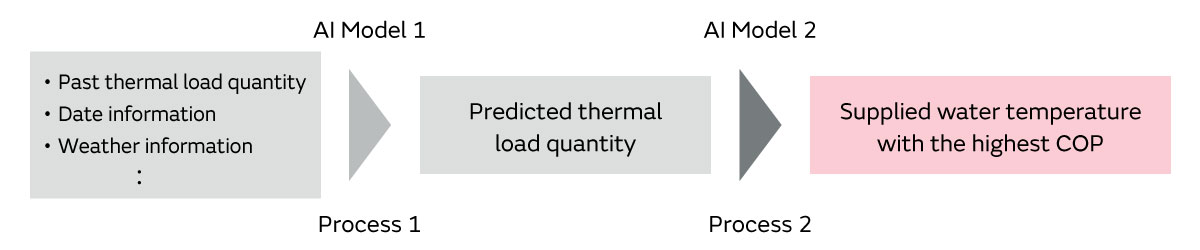
- There is a time lag in reflecting the supplied water temperature in the air-conditioning temperature due to the impact of the thermal load quantity. Therefore, predicted information on the thermal load quantity is necessary when attempting to calculate the supplied water temperature suitable for improving and maintaining the COP level.
- This predicted information on the thermal load quantity (hereinafter referred to as the "predicted thermal load quantity") is calculated by training AI on past thermal load quantity data, and also date information, weather-related information, and other environmental data to generate an AI model of the predicted thermal load quantity (generation of AI Model 1 in Process 1).
- A high-level COP can be obtained by training the AI on data that indicates the relationship between this predicted thermal load quantity, the past COP, and the supplied water temperature to generate an AI model that predicts the supplied water temperature (generation of AI Model 2 in Process 2).
As mentioned in 2 above, environmental data is necessary to calculate the predicted thermal load quantity. This data also includes measurement data from environmental sensors such as outdoor temperature data and humidity data. This shows that data from environmental sensors makes an important contribution to the generation of AI Model 1 in Process 1 and is thereby an essential data acquisition method for the automatic control of air-conditioning.
Moreover, as shown in Table 2 in 2 above, this environmental data is also used to visualize changes in comfort in the building. In particular, we use DI to visualize such changes.
4. Method of Verifying the Effect from the AI Control of Air-Conditioning Equipment
As we explained in 3 above, AI is utilized to control the supplied water temperature to keep the COP at a high level and to contribute to energy saving (hereinafter referred to as "AI control"). We introduce here a method for verifying how effective implementing AI control is in reducing the power consumption and CO2 emissions in heat source units.
Normally, it would be appropriate to verify the effectiveness of AI control by confirming its effect through a comparison of the power consumption and CO2 emissions when using and when not using it under the same conditions. However, in reality, the time and date, weather, number of people in the room, and other conditions do not match in the two cases. Moreover, it is also difficult to directly measure the power consumption and CO2 emissions in the heat source units. This means it is not possible to apply this verification method here (Fig. 3).
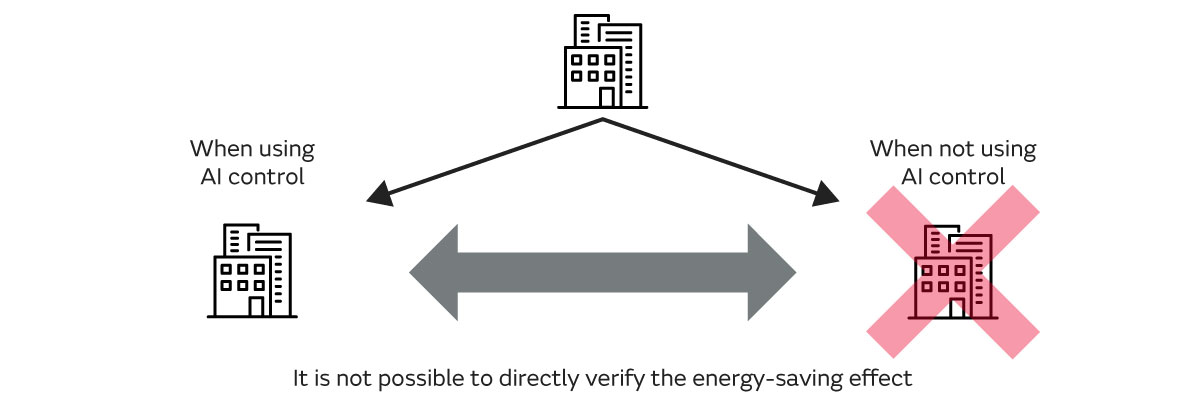
Accordingly, a verification method to confirm the energy-saving effect is presented here as an alternative to that with the ratio of the following COPs:
(a) COP when using AI control
(b) COP when not using AI control (supplied water temperature kept constant).
We find the COP in (a) with Process 2 in Fig. 2 and also calculate the COP in (b) using the AI model in Process 2 in the same way with the supplied water temperature kept at a constant.
The specific verification method is as follows.
First, we take the COP ratio to equal [(a) COP when using AI control / (b) COP when not using AI control]. We can confirm the energy saving and CO2 emissions reduction effects with Formula 2 and Formula 3 below using this ratio.


*4: CO2 emission coefficient of the heat source unit (unit: kg-CO2/kWh)
We learn from the above two formulas that the higher the COP ratio is above 1, the greater the power reduction effect, that is, the energy-saving effect, and the greater the CO2 emissions reduction effect.
5. Summary
In this article, we introduced the concept of providing energy and comfort saving air conditioning equipment in large facilities through AI-driven control.
Operating air-conditioning that combines both energy saving and comfort is not an easy task in large facilities with a high volume of moving people. The solution to this is air conditioning control technology using AI and environmental sensors, as described in part 3. Even as this control technology is still developing, it is becoming possible to automatically maintain the optimal air- conditioning operations.
We will continue to promote energy-saving initiatives using AI and sensors to realize an environmentally and people-friendly world in the future. We hope that our efforts will contribute to creating a better environment.
Related articles
- New Timing Device (Crystal Unit) Technology Unlocking the Data Center Market - Exploring the Evolution of the "Heart" Supporting the Foundation of the AI Society
- Case Study of Masking Personally Identifiable Information Using Generative AI - Annual Conference of the Japanese Society for Artificial Intelligence 2025
- Take a Behind-the-scenes Look at the In-house Development and Future Outlook for the "Murata Coworker" Generative AI Product With the Product Manager - Annual Conference of the Japanese Society for Artificial Intelligence, 2025