
Stretchable Printed Circuit

INDEX
1. What Are Stretchable Printed Circuits?
2. What Is Printed Electronics?
3. Examples of Solving Issues with Stretchable Printed Circuits in the Medical Field
Wearable devices, typified by smartwatches and head-mounted displays, have been realized using flexible boards that can be bent. However, next-generation wearable devices require stretchability and conformability so that they can flexibly follow body movements and collect the various data emitted by the body. That is why stretchable printed circuits were developed.
It is essential for stretchable printed circuits to have the mechanical property of being able to stretch and for them to be able to maintain their electrical properties even when stretched. We will explain here how it is possible for these opposing properties to coexist. We will also look at the kinds of situations in which stretchable printed circuits are expected to be utilized.
This article introduces medical applications as an example of how our stretchable printed circuits can be used. The stretchable printed circuit itself is not designed, manufactured, or marketed as a medical device as defined by applicable laws and regulations.
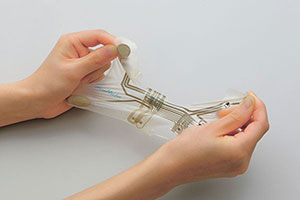
Stretchable printed circuits are electronic circuit boards for which circuit patterns have been formed using stretchable boards and conductive materials. These circuits utilize the technology of printed electronics in which conductive materials are coated to boards using printing technology. These boards are made using stretchable urethane-, silicone- or similar material-based elastomers. In addition, silver is mainly used for their conductive materials. The high stretchability and conformability enable electronic circuits to be mounted on free-form surfaces such as the knee, elbow, and other joints, neck, and chest (Fig. 1).

Previous stretchable printed circuits suffered from various issues. Those issues included significant changes in electrical properties such as the resistance value due to stretching, the occurrence of migration*1 caused by voltage application in high-humidity environments, and reduced long-term reliability due to those issues, as well as the need to take measures to deal with heat when soldering electronic components.
However, there have been improvements in electrical properties and measures to counter migration thanks to better board and conductive materials, ingenuity in wiring design, the development of soldering materials that enable welding at low temperatures, and other advances in recent years. This has made the practical use of stretchable printed circuits possible. Another feature of stretchable printed circuits is that they are environmentally friendly, as the circuit patterns are printed directly on the boards.
*1 Migration:
This is also called the migration phenomenon. It is a phenomenon in which wiring and electrodes move on insulators and at interfaces due to the effect of electrolysis. When migration occurs, the insulation resistance value deteriorates. This causes a short circuit to occur between the electrodes and for the electronic devices to then fail.
Printed electronics is a technology that uses printing technology to print conductive materials on boards to form electronic components and circuit patterns. This makes it possible to realize extremely thin coating and high-definition wiring.
The conventional technique in the process of board manufacturing is called "photolithography." This technique involves coating conductive material to the whole surface of the boards and then dissolving the unnecessary parts with a chemical solution to form circuit patterns. In contrast to this technique, printed electronics involves directly printing circuit patterns on the boards. Therefore, there is no process to dissolve the unnecessary parts with a chemical solution. That means it has advantages including saving resources, saving energy, and enabling the use of diverse board materials.
Printed electronics have been utilized as a means to realize the laminated structure of multilayer ceramic capacitors (MLCCs) and laminated reactors up to now. For example, multilayer ceramic capacitors have a structure in which thin dielectric ceramic sheets and metal electrodes have been alternately laminated (Fig. 2). Sheets are made by coating a slurry of ceramic dielectrics and binders on carrier films and then drying them. These are called "green sheets." After repeatedly printing electrodes on these sheets, they are then baked to harden them. The number of layers here can reach several hundred.

It is also possible to form circuit patterns on thin film by using flexible conductive materials in addition to rigid boards made with glass, resin, and other materials in printed electronics. Furthermore, circuit patterns can also be formed on stretchable materials by using stretchable conductive materials.
This has realized flexible boards that can be bent (Fig. 3) and stretchable printed circuits that can be freely stretched (Fig. 1).

Stretchable printed circuits can follow free-form surfaces such as the knee, elbow, and other joints, neck, and chest. Moreover, mounting various electronic components on stretchable printed circuits enables the development of equipment worn on the body to obtain brain wave, heartbeat, and other vital data*2 and to monitor joints after surgery.
*2 Vital data:
This refers to the basic data needed to provide appropriate treatment and nursing care such as the heart rate, respiratory rate, pulse rate, body temperature, blood pressure, and oxygen saturation.
It is expected that stretchable printed circuits will be utilized in various fields. We introduce examples in the medical field here. Medical devices up to now faced the following problems.
We introduce below some stretchable printed circuit utilization examples to solve these issues.
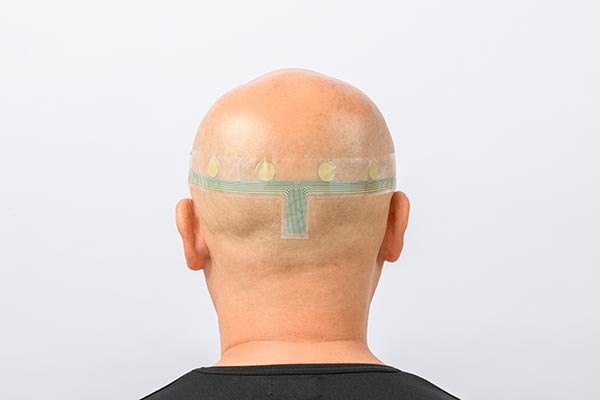
EEGs are weak electrical signals constantly emitted from the cerebral cortex. The frequency of these electrical signals changes depending on the mental state and the activity of the cerebrum. It is possible to grasp the state of the brain by measuring the frequency. EEGs are measured by applying 10 to 20 electrodes to the scalp (Fig. 4).
When monitoring EEGs, it is necessary to attach the electrodes at precise positions. Attaching these electrodes is complicated. This made it difficult for non-specialists to handle such devices.
However, band- and cap-type EEG electrode array devices using stretchable printed circuits have been developed in recent years. It is possible to adapt these devices to the shape and size of the patient's head by using a stretchable printed circuit. It is also possible to embed the stretchable printed circuits themselves into the caps. The cables connecting the electrodes can be hidden inside these devices. This can also reduce risks such as the wiring coming loose when the devices are attached or when the patient moves.
In addition, by embedding amplifiers, filters, or other components near the EEG electrodes, it is possible to obtain highly accurate data with noise removed (Fig. 5).

In artificial joint replacement surgery, a joint deformed due to osteoarthritis, rheumatoid arthritis, or trauma is replaced with an artificial joint. This treatment is performed on each joint, such as the shoulder, hip, and knee, to restore the functions that are important to them: not causing pain, allowing movement, and providing support. Rehabilitation is necessary to restore the functions of joints after artificial joint replacement surgery. Moreover, in addition to rehabilitation, pain care and examinations for complications such as fractures, dislocations, and infectious diseases are also medical procedures required after surgery.
Currently, various forms of care are provided by medical professionals accompanying patients during rehabilitation and observing and examining the affected areas. Furthermore, wearable devices for joints under development in recent years enable movements during daily life and rehabilitation to be monitored and recorded, with those results then shared with medical professionals and patients. It is expected that this will allow those wearable devices to be utilized in determining postoperative rehabilitation plans and in maintaining and improving patients' motivation to continue rehabilitation. In addition, it is also expected that these wearable devices will enable early detection of the onset of complications such as infectious diseases and dislocations.
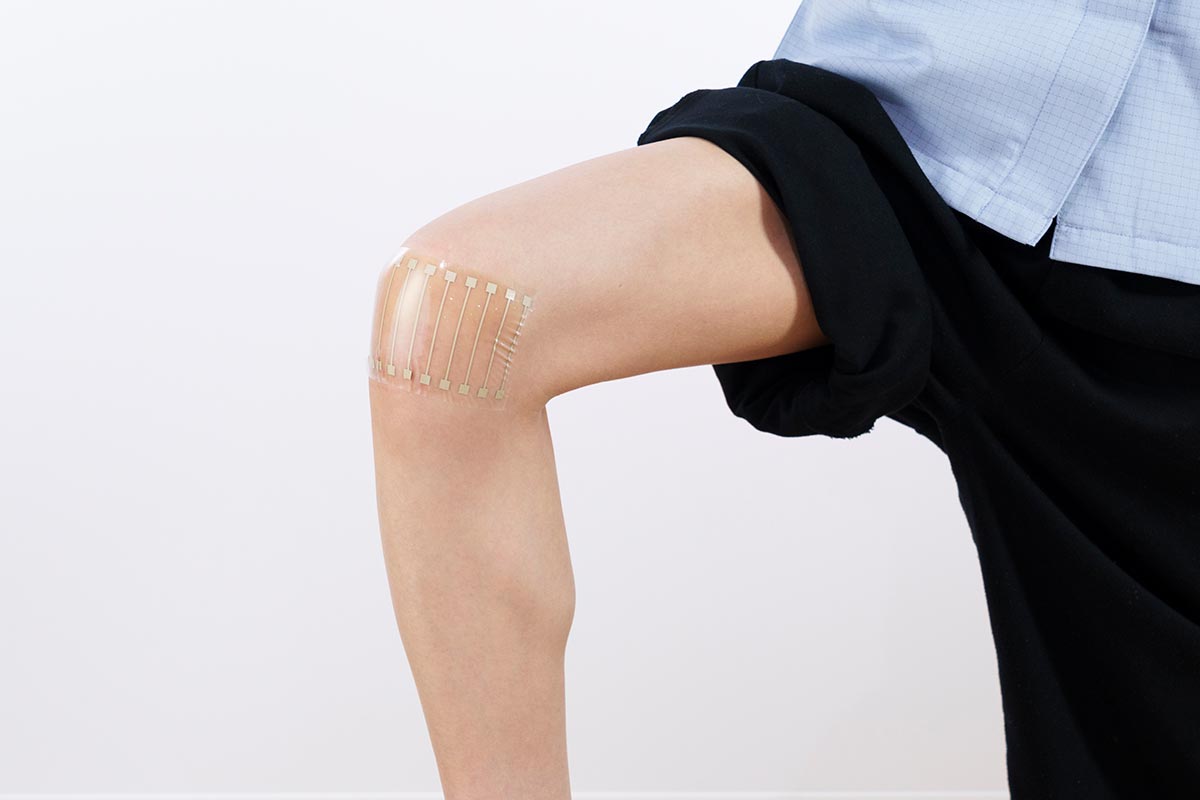
Joints have the greatest range of movement in the body. That means they are parts that require mechanical durability. It is believed that it will be possible to contribute to improving patients' quality of life by grasping at an early stage their condition after artificial joint replacement surgery and changes in that condition. This can be achieved by mounting various sensors on stretchable printed circuits to give them the functions to perform mechanical monitoring such as on the range of motion and the movements of joints and physiological monitoring such as on the condition of the site where the surgery was performed (temperature, swelling, etc.) (Fig. 6).
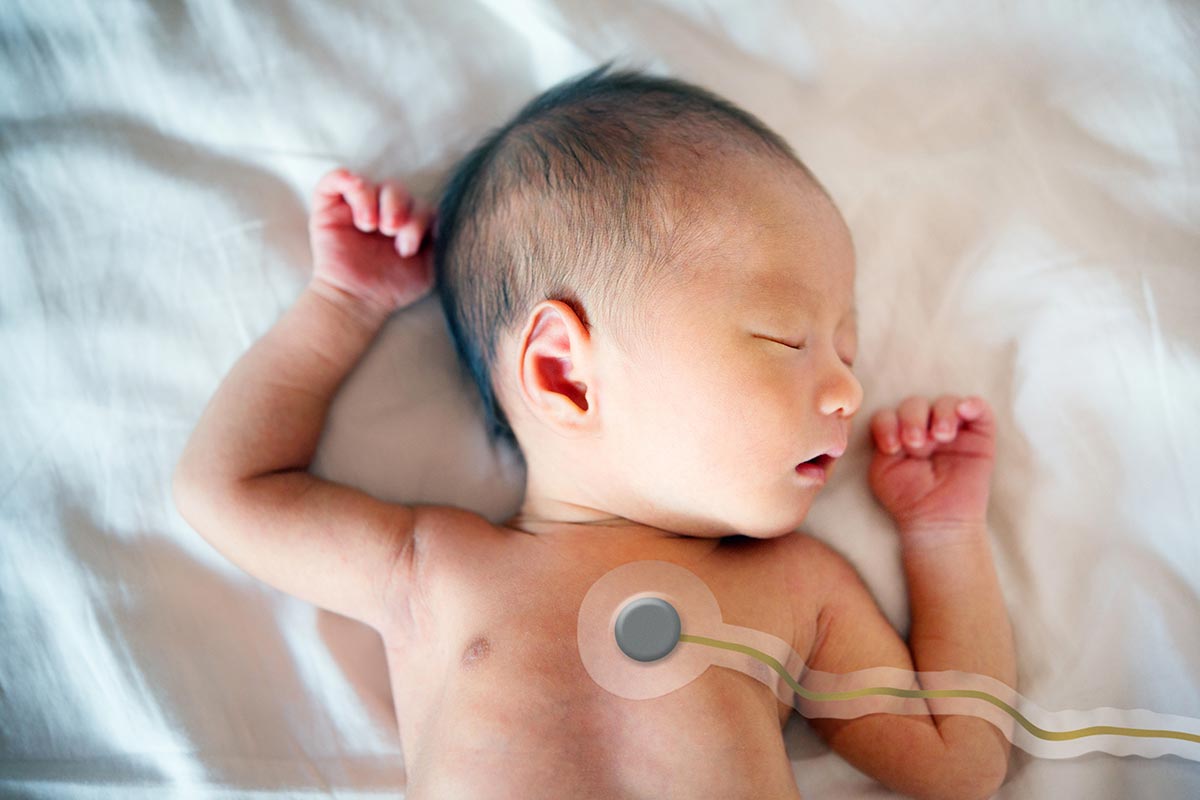
Newborn babies born prematurely or with a low body weight are physically fragile. Therefore, their vital data must be constantly monitored and it must be possible to take action in a timely manner. However, current devices are not optimal for newborn babies because of the hardness of the sensors themselves, the leads connecting the sensors, and the adhesives used to attach the sensors. For instance, leads may interfere with kangaroo care (nursing care in which babies come directly into contact with their parents) and the movements of newborn babies. Additionally, the hardness of the sensors and the adhesives risk causing skin damage.
It is possible to realize a wireless device that does not interfere with kangaroo care or the movements of newborn babies by mounting sensors, batteries, microcomputers, and Bluetooth Low Energy (BLE) on stretchable printed circuits. Moreover, it is possible to attach devices with good conformability to delicate skin by taking advantage of the softness of the board itself. This also enables the realization of monitoring devices that can suppress the risks mentioned above (Fig. 7).
Printed electronics is a technology that has been utilized in Murata Manufacturing's products including multilayer ceramic capacitors (MLCCs). Combining this technology with stretchable boards and conductive materials has realized stretchable printed circuits.
Stretchable printed circuits are a soft technology that combines the existing technology of electronic component manufacturing technology with the technology of stretchable material development. At present, it is expected that these circuits will prove effective in the medical field such as with better conformability to the body, more comfort when worn, improved sensor accuracy, and the ability to be attached for long periods of time. Furthermore, it is predicted these circuits will be utilized in many fields in addition to the medical field in the future such as industrial robots and smart textiles.