
Future Society Supported by Generative AI
Automatic Development of Advanced Devices and Systems with Generative AI That Manipulates Development Languages
Chatbots and other programs that utilize generative AI to freely manipulate natural languages have come to be used in daily life and business. Chatbots themselves have been provided as cloud services for a relatively long time. However, the accuracy of the language and content they manipulate has improved dramatically since the arrival of services based on generative AI. Despite some areas where responses may still feel unnatural due to limited learning, the fluency of dialogue has improved significantly, making it nearly indistinguishable from previous automated document generation. This advancement has undoubtedly surprised many. Generative AI can now seamlessly manipulate languages such as Japanese, German, and Chinese, in addition to English. We have entered an era where people from around the world can interact with computers in diverse languages, and further evolution in this technology is anticipated in the future.
Moreover, generative AI is not just skilled at using human communication. Manipulating development languages used for other purposes than human communication is also largely contributing to the development of robots and advanced devices and systems.
Modern devices and systems are developed with development languages
Nowadays, many industrial products are designed using some kind of development language. These products include electronic devices, home appliances, IT systems, industrial robots, and even automobiles. This is because using development languages makes it easier for developers to grasp the structure, mechanism, and behavior of the development target.
Languages called Verilog HDL and VHDL are used to describe the functions and behavior of hardware when designing the electronic circuits built into devices and systems and the operation models of the semiconductors installed in those devices and systems. C/C++ and other languages are widely used in the development of programs that run on them. Python and other languages are used when developing systems utilizing AI. C/C++, Python, Java, and other languages are also used for the procedures to control robots and other devices.
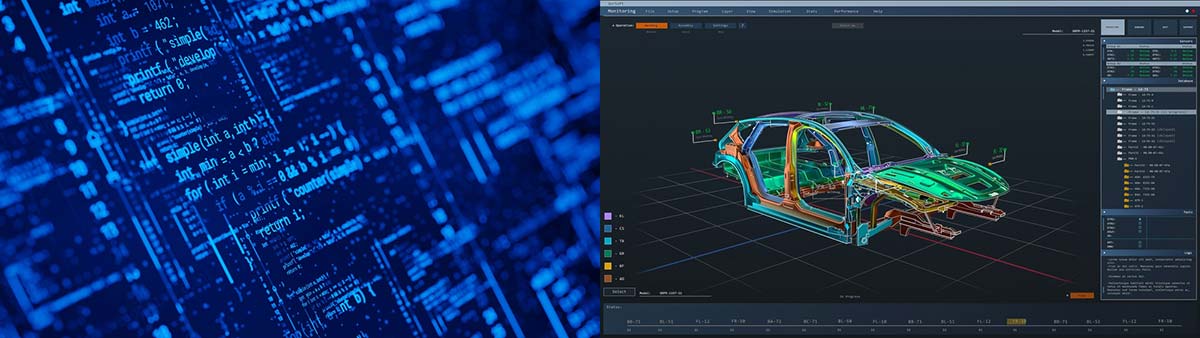
Device and system developers make full use of these development languages to realize their ideas every day. However, generative AI has now also become able to fully use these languages and is playing a role in the development process. Generative AI has become able to interpret and materialize abstract instructions and to then describe and output devices and systems with development languages even if the developer's development image remains abstract. Nevertheless, since materialization is based on abstract instructions, it is not possible to reliably realize the functions and performance according to the requirements in one go. It becomes possible to get closer to realizing devices and systems suited to the purpose of development based on the development target materialized by AI through repeatedly verifying and correcting output while interacting with the AI.
Generative AI can generate more than just development languages. It can also automatically generate 3D models, illustrations, and more of various concepts. This is because generative AI has the ability to convert information in different formats and to perform optimal processing. Examples of this include the automatic generation of illustrations according to the instructions and development targets input in language. It is expected that generative AI will be applied to the development of many devices and systems that handle digital data by taking advantage of this characteristic.
Use of generative AI in the development of devices and systems
The utilization of generative AI has the potential to expand the technological capabilities of companies that develop devices and systems. In general, manufacturers in the manufacturing industry possess vast development assets such as development and design data accumulated over a long period of time. However, it was necessary to prepare data put into the same expression format for learning to train conventional AI, including deep learning, on this data. However, data accumulated in the past was not generally suited to training AI. That is because it was mostly still raw data in diverse formats that had yet to be verbalized or, even if had been verbalized, it had not been put into a form that can be compared and referenced. For example, when expressing data on motor vibrations, some data is given in the form of technical reports that quantitatively indicate operating conditions, vibration measurement conditions, results, and more, while there is also raw data on vibrations collected by sensors. Moreover, even data compiled in technical reports may have different measurement conditions. These differences in data quality are called "modes" in the world of AI. In general, humans have the ability to fill in the gaps based on their knowledge and experience and to then make a comprehensive judgment even with data in these different modes. However, it was difficult with conventional computers to compare data in different modes side by side or to gain insights into the correlation between the data.
In contrast to this, generative AI can also utilize data that has not been verbalized or organized like this. This is because multi-mode learning that transcends or transforms these mode differences has become possible in the foundational model that serves as the base technology of generative AI. This is expected to enable even more advanced utilization of generative AI by training it on the data of partner companies at the same time as training it on the data of one's own company.
Generative AI is being utilized for two main purposes in the development of devices and systems. The first purpose is the use of generative AI with the aim of improving the efficiency of the research, development, and design of devices and systems, and raising the performance and quality of the end product. The other purpose is to incorporate the functions of generative AI in the devices and systems being developed themselves to enable an advanced and flexible response to changes in the environment and circumstances in which they are used. We introduce here usage examples of each of these.
Utilizing generative AI in the development of devices and systems
Attempts to apply generative AI to the development of devices and systems have already begun in various fields (Fig. 1).

For instance, it has become possible to automatically generate operation control programs for robots using generative AI in the field of robot control system development. Learning data on the operating environment and content of tasks and automatically generating optimal operating patterns has enabled the efficient development of robots that perform complex tasks.
Attempts are underway to utilize generative AI in ways such as to propose new functions and user interfaces when developing home appliance functions. Proposals for new functions suited to needs are being made and even more intuitive operation methods are being generated by utilizing AI to analyze data on the usage situation. These efforts are being used to shorten the product development period and to improve quality.
In addition, the use of generative AI to improve the efficiency of semiconductor chip design is also being considered. Specifically, it is expected that generative AI will be applied to areas such as the optimization of layouts and circuit patterns on chips and the automation of circuit design. Learning past design data and proposing new circuit configurations that meet performance, power consumption, and other requirements is shortening the design period and improving chip performance.
Furthermore, attempts to utilize generative AI to propose and optimize vehicle designs are also emerging among automobile manufacturers. Learning a large amount of existing design data enables the generation of new vehicle shape ideas and the presentation of design proposals that improve aerodynamic performance. The technique of using such generative AI and other computer programs to support regular design and conception design is called "generative design." It has come to be especially widely used in the field of architecture, the structural design of industrial products, and other areas in recent years.
Generative AI proposes new perspectives that it is difficult for developers to conceive
It is becoming clear that generative AI is extremely useful as a development support tool. There appear to be many people who think that "development is a world of experiences and senses." However, more and more developers are setting aside their preconceptions and considering the use of generative AI these days.
Generative AI does not completely take the place of the experiences and senses of developers; rather, it plays a role in providing diverse options to support creative activities.
When someone, not just limited to engineers and researchers, is coming up with new things, their ideas inevitably tend to be restricted by their past experiences and knowledge. This personal experience and knowledge is a great help when accurately repeating routine tasks. However, there is a high tendency for such experience and knowledge to prevent great leaps forward in ideas when engaging in creative activities. It is expected that utilizing generative AI will produce new ideas not bound by past knowledge to bring about innovation.
Actual examples of applying generative AI to robots, home appliances, and other devices
Many companies and research institutes are working to enable advanced movement by incorporating operation control using generative AI as one function of robots, drones, home appliances, and other devices.

It is possible to automatically generate control codes based on instructions from natural language by utilizing generative AI. If incorporated into robots, they will become able to take unexpected actions requested in conversations with customers and flexible actions according to the situation. Technology that optimizes home appliances according to the actions and conversations of residents such as in smart homes is becoming a reality as well.
Moreover, if generative AI is incorporated into devices, they will be able to understand the complex differences and changes in instructions and operating environments and to then autonomously execute multi-stage tasks that combine a variety of tasks. For example, robots will become able to accomplish agricultural work optimized individually in multiple steps without human assistance targeting individual crops with different growth conditions in plant factories and other facilities.
Summary
The utilization of generative AI is spreading to the development of devices and systems. We may also see the realization of robots and other devices capable of making advanced judgments to act optimally while considering both the surrounding environment and the user's instructions in customer service, nursing care, and other settings in the future. It may even be possible to gain insights into emotions, preferences, and desires and to then take appropriate actions without being instructed by collecting and analyzing user behavior, voice, facial expression, and other data using cameras and sensors.
The utilization of generative AI will likely become commonplace when developing and designing devices and systems in the future. At present, the functions of devices being developed are expressed in development languages and similar ways. However, it is expected that it will become possible to develop more efficient and effective devices and systems than ever before by also advancing the expression format into one suitable for AI in the future.